
托珠单抗联合标准治疗与标准治疗用于印度中重度 COVID-19 相关细胞因子释放综合征(COVINTOC)患者:一项开放标签、多中心、随机、对照、3 期临床试验。
Tocilizumab plus standard care versus standard care in patients in India with moderate to severe COVID-19-associated cytokine release syndrome (COVINTOC): an open-label, multicentre, randomised, controlled, phase 3 trial.
机构信息
Medanta Institute of Education and Research, Medanta-The Medicity Hospital, Gurugram, Haryana, India.
Medanta Institute of Education and Research, Medanta-The Medicity Hospital, Gurugram, Haryana, India.
出版信息
Lancet Respir Med. 2021 May;9(5):511-521. doi: 10.1016/S2213-2600(21)00081-3. Epub 2021 Mar 4.
BACKGROUND
Global randomised controlled trials of the anti-IL-6 receptor antibody tocilizumab in patients admitted to hospital with COVID-19 have shown conflicting results but potential decreases in time to discharge and burden on intensive care. Tocilizumab reduced progression to mechanical ventilation and death in a trial population enriched for racial and ethnic minorities. We aimed to investigate whether tocilizumab treatment could prevent COVID-19 progression in the first multicentre randomised controlled trial of tocilizumab done entirely in a lower-middle-income country.
METHODS
COVINTOC is an open-label, multicentre, randomised, controlled, phase 3 trial done at 12 public and private hospitals across India. Adults (aged ≥18 years) admitted to hospital with moderate to severe COVID-19 (Indian Ministry of Health grading) confirmed by positive SARS-CoV-2 PCR result were randomly assigned (1:1 block randomisation) to receive tocilizumab 6 mg/kg plus standard care (the tocilizumab group) or standard care alone (the standard care group). The primary endpoint was progression of COVID-19 (from moderate to severe or from severe to death) up to day 14 in the modified intention-to-treat population of all participants who had at least one post-baseline assessment for the primary endpoint. Safety was assessed in all randomly assigned patients. The trial is completed and registered with the Clinical Trials Registry India (CTRI/2020/05/025369).
FINDINGS
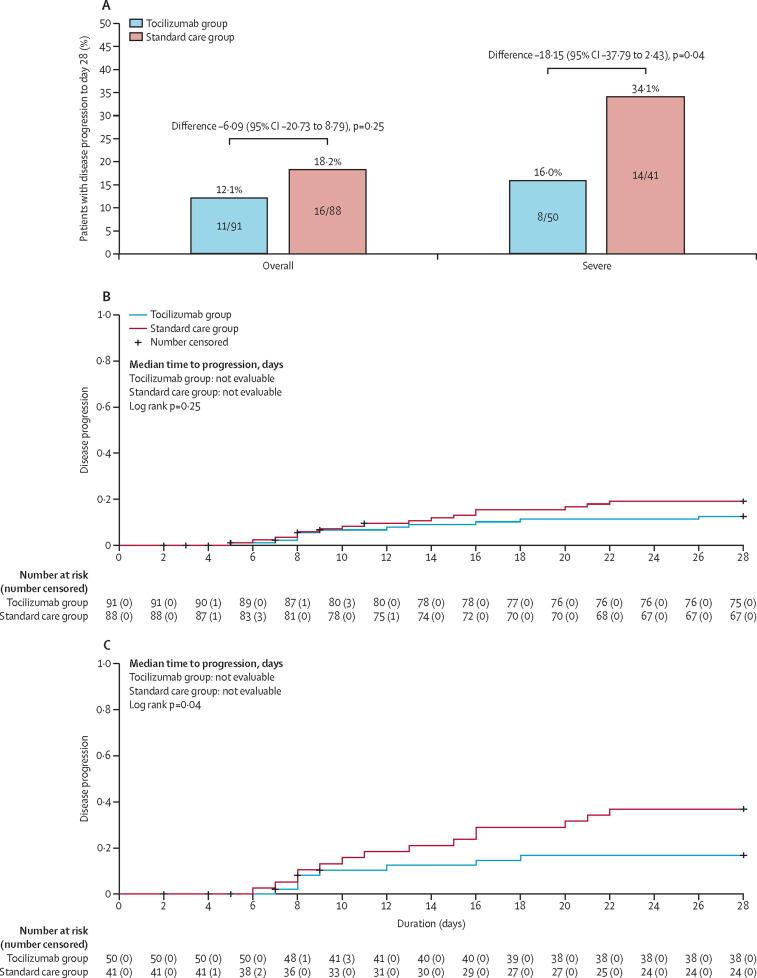
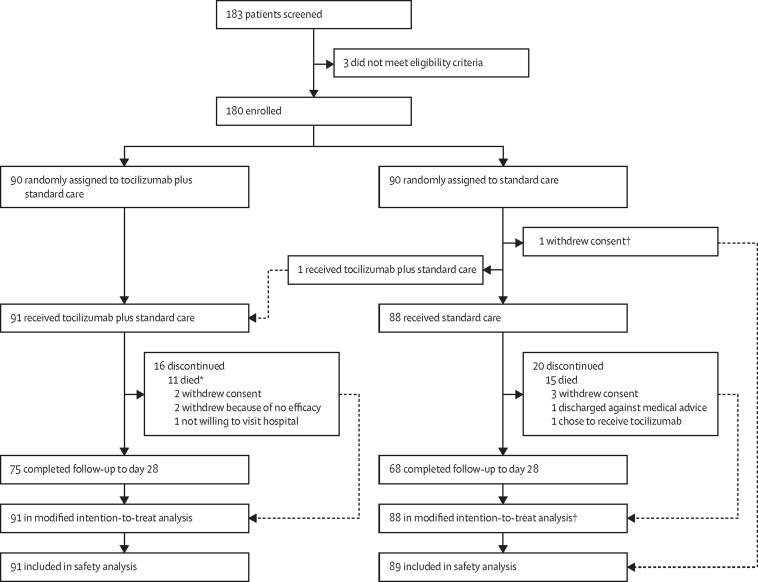
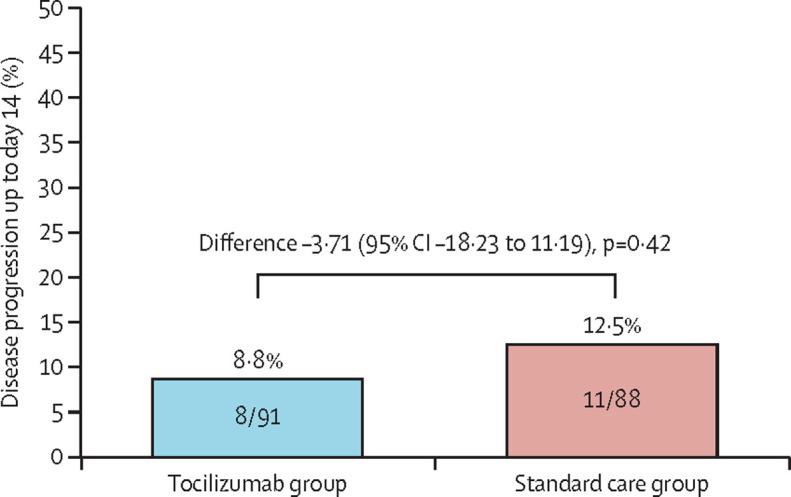
180 patients were recruited between May 30, 2020, and Aug 31, 2020, and randomly assigned to the tocilizumab group (n=90) or the standard care group (n=90). One patient randomly assigned to the standard care group inadvertently received tocilizumab at baseline and was included in the tocilizumab group for all analyses. One patient randomly assigned to the standard care group withdrew consent after the baseline visit and did not receive any study medication and was not included in the modified intention-to-treat population but was still included in safety analyses. 75 (82%) of 91 in the tocilizumab group and 68 (76%) of 89 in the standard care group completed 28 days of follow-up. Progression of COVID-19 up to day 14 occurred in eight (9%) of 91 patients in the tocilizumab group and 11 (13%) of 88 in the standard care group (difference -3·71 [95% CI -18·23 to 11·19]; p=0·42). 33 (36%) of 91 patients in the tocilizumab group and 22 (25%) of 89 patients in the standard care group had adverse events; 18 (20%) and 15 (17%) had serious adverse events. The most common adverse event was acute respiratory distress syndrome, reported in seven (8%) patients in each group. Grade 3 adverse events were reported in two (2%) patients in the tocilizumab group and five (6%) patients in the standard care group. There were no grade 4 adverse events. Serious adverse events were reported in 18 (20%) patients in the tocilizumab group and 15 (17%) in the standard care group; 13 (14%) and 15 (17%) patients died during the study.
INTERPRETATION
Routine use of tocilizumab in patients admitted to hospital with moderate to severe COVID-19 is not supported. However, post-hoc evidence from this study suggests tocilizumab might still be effective in patients with severe COVID-19 and so should be investigated further in future studies.
FUNDING
Medanta Institute of Education and Research, Roche India, Cipla India, and Action COVID-19 India.
背景
在因 COVID-19 住院的患者中,使用抗 IL-6 受体抗体托珠单抗的全球随机对照试验结果相互矛盾,但有可能缩短出院时间和减轻重症监护负担。在一个以少数族裔为主的试验人群中,托珠单抗可减少进展为机械通气和死亡。我们旨在研究在完全在中低收入国家进行的首个托珠单抗多中心随机对照试验中,托珠单抗治疗是否可以预防 COVID-19 的进展。
方法
COVINTOC 是一项在印度 12 家公立和私立医院进行的开放标签、多中心、随机、对照、3 期试验。因中度至重度 COVID-19(印度卫生部分级)且通过 SARS-CoV-2 PCR 结果阳性确诊而入院的成年人(年龄≥18 岁)被随机分配(1:1 块随机分组)接受托珠单抗 6mg/kg 加标准治疗(托珠单抗组)或单独标准治疗(标准治疗组)。主要终点是在至少有一次主要终点的基线后评估的所有参与者的改良意向治疗人群中,COVID-19 从中度进展到重度或从重度进展到死亡的情况,直到第 14 天。所有随机分配的患者均进行安全性评估。该试验已在印度临床试验注册中心(CTRI/2020/05/025369)完成并注册。
结果
2020 年 5 月 30 日至 8 月 31 日期间,共招募了 180 名患者,并随机分配至托珠单抗组(n=90)或标准治疗组(n=90)。1 名随机分配至标准治疗组的患者在基线时无意中接受了托珠单抗,在所有分析中均被纳入托珠单抗组。1 名随机分配至标准治疗组的患者在基线就诊后撤回了同意书,未接受任何研究药物治疗,未纳入改良意向治疗人群,但仍纳入安全性分析。托珠单抗组 91 名患者中有 75 名(82%),标准治疗组 89 名患者中有 68 名(76%)完成了 28 天随访。托珠单抗组有 8 名(9%)患者在第 14 天前进展为 COVID-19,标准治疗组有 11 名(13%)患者(差异-3.71[95%CI-18.23 至 11.19];p=0.42)。托珠单抗组 91 名患者中有 33 名(36%)和标准治疗组 89 名患者中有 22 名(25%)发生不良事件;18 名(20%)和 15 名(17%)发生严重不良事件。最常见的不良事件是急性呼吸窘迫综合征,两组各有 7 名(8%)患者报告。托珠单抗组有 2 名(2%)患者和标准治疗组有 5 名(6%)患者报告了 3 级不良事件。没有 4 级不良事件。托珠单抗组有 18 名(20%)患者和标准治疗组有 15 名(17%)患者发生严重不良事件;13 名(14%)和 15 名(17%)患者在研究期间死亡。
解释
不支持在因 COVID-19 住院的中度至重度患者中常规使用托珠单抗。然而,这项研究的事后证据表明,托珠单抗在重度 COVID-19 患者中仍可能有效,因此应在未来的研究中进一步探讨。
资金
Medanta 教育与研究学会、罗氏印度、西普拉印度和行动 COVID-19 印度。
 Zotero 插件