
抗白细胞介素药物治疗 COVID-19 患者伴细胞因子释放综合征(COV-AID)的效果:一项析因、随机、对照试验。
Effect of anti-interleukin drugs in patients with COVID-19 and signs of cytokine release syndrome (COV-AID): a factorial, randomised, controlled trial.
机构信息
Laboratory of Mucosal Immunology, VIB-UGhent Center for Inflammation Research, Ghent University, Ghent, Belgium; Department of Internal Medicine and Pediatrics, Faculty of Medicine and Health Sciences, Ghent University, Ghent, Belgium; Department of Pulmonary Medicine, University Hospital Ghent, Ghent, Belgium.
Laboratory of Mucosal Immunology, VIB-UGhent Center for Inflammation Research, Ghent University, Ghent, Belgium; Department of Internal Medicine and Pediatrics, Faculty of Medicine and Health Sciences, Ghent University, Ghent, Belgium; Primary Immunodeficiency Research Laboratory, Faculty of Medicine and Health Sciences, Ghent University, Ghent, Belgium.
出版信息
Lancet Respir Med. 2021 Dec;9(12):1427-1438. doi: 10.1016/S2213-2600(21)00377-5. Epub 2021 Oct 29.
BACKGROUND
Infections with SARS-CoV-2 continue to cause significant morbidity and mortality. Interleukin (IL)-1 and IL-6 blockade have been proposed as therapeutic strategies in COVID-19, but study outcomes have been conflicting. We sought to study whether blockade of the IL-6 or IL-1 pathway shortened the time to clinical improvement in patients with COVID-19, hypoxic respiratory failure, and signs of systemic cytokine release syndrome.
METHODS
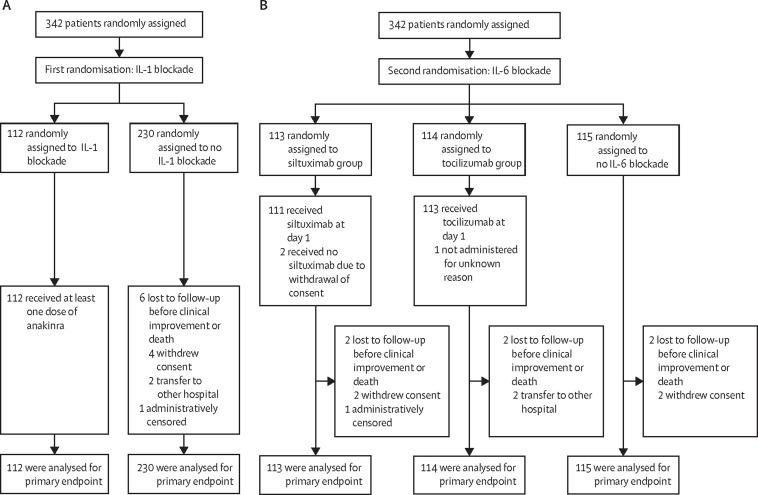
We did a prospective, multicentre, open-label, randomised, controlled trial, in hospitalised patients with COVID-19, hypoxia, and signs of a cytokine release syndrome across 16 hospitals in Belgium. Eligible patients had a proven diagnosis of COVID-19 with symptoms between 6 and 16 days, a ratio of the partial pressure of oxygen to the fraction of inspired oxygen (PaO:FiO) of less than 350 mm Hg on room air or less than 280 mm Hg on supplemental oxygen, and signs of a cytokine release syndrome in their serum (either a single ferritin measurement of more than 2000 μg/L and immediately requiring high flow oxygen or mechanical ventilation, or a ferritin concentration of more than 1000 μg/L, which had been increasing over the previous 24 h, or lymphopenia below 800/mL with two of the following criteria: an increasing ferritin concentration of more than 700 μg/L, an increasing lactate dehydrogenase concentration of more than 300 international units per L, an increasing C-reactive protein concentration of more than 70 mg/L, or an increasing D-dimers concentration of more than 1000 ng/mL). The COV-AID trial has a 2 × 2 factorial design to evaluate IL-1 blockade versus no IL-1 blockade and IL-6 blockade versus no IL-6 blockade. Patients were randomly assigned by means of permuted block randomisation with varying block size and stratification by centre. In a first randomisation, patients were assigned to receive subcutaneous anakinra once daily (100 mg) for 28 days or until discharge, or to receive no IL-1 blockade (1:2). In a second randomisation step, patients were allocated to receive a single dose of siltuximab (11 mg/kg) intravenously, or a single dose of tocilizumab (8 mg/kg) intravenously, or to receive no IL-6 blockade (1:1:1). The primary outcome was the time to clinical improvement, defined as time from randomisation to an increase of at least two points on a 6-category ordinal scale or to discharge from hospital alive. The primary and supportive efficacy endpoints were assessed in the intention-to-treat population. Safety was assessed in the safety population. This study is registered online with ClinicalTrials.gov (NCT04330638) and EudraCT (2020-001500-41) and is complete.
FINDINGS
Between April 4, and Dec 6, 2020, 342 patients were randomly assigned to IL-1 blockade (n=112) or no IL-1 blockade (n=230) and simultaneously randomly assigned to IL-6 blockade (n=227; 114 for tocilizumab and 113 for siltuximab) or no IL-6 blockade (n=115). Most patients were male (265 [77%] of 342), median age was 65 years (IQR 54-73), and median Systematic Organ Failure Assessment (SOFA) score at randomisation was 3 (2-4). All 342 patients were included in the primary intention-to-treat analysis. The estimated median time to clinical improvement was 12 days (95% CI 10-16) in the IL-1 blockade group versus 12 days (10-15) in the no IL-1 blockade group (hazard ratio [HR] 0·94 [95% CI 0·73-1·21]). For the IL-6 blockade group, the estimated median time to clinical improvement was 11 days (95% CI 10-16) versus 12 days (11-16) in the no IL-6 blockade group (HR 1·00 [0·78-1·29]). 55 patients died during the study, but no evidence for differences in mortality between treatment groups was found. The incidence of serious adverse events and serious infections was similar across study groups.
INTERPRETATION
Drugs targeting IL-1 or IL-6 did not shorten the time to clinical improvement in this sample of patients with COVID-19, hypoxic respiratory failure, low SOFA score, and low baseline mortality risk.
FUNDING
Belgian Health Care Knowledge Center and VIB Grand Challenges program.
背景
SARS-CoV-2 感染仍导致严重的发病率和死亡率。白细胞介素(IL)-1 和 IL-6 阻断已被提议作为 COVID-19 的治疗策略,但研究结果存在冲突。我们旨在研究 IL-6 或 IL-1 通路的阻断是否缩短了 COVID-19、低氧性呼吸衰竭和全身细胞因子释放综合征体征患者的临床改善时间。
方法
我们在比利时 16 家医院进行了一项前瞻性、多中心、开放标签、随机、对照试验,纳入了 COVID-19 、低氧血症和细胞因子释放综合征体征的住院患者。符合条件的患者有明确的 COVID-19 诊断,症状在 6 至 16 天之间,在空气或补充氧气下,氧分压与吸入氧分数(PaO:FiO)之比小于 350mmHg,或血清中出现细胞因子释放综合征(铁蛋白单测量值大于 2000μg/L 并立即需要高流量氧气或机械通气,或铁蛋白浓度大于 1000μg/L,在过去 24 小时内持续升高,或淋巴细胞计数低于 800/mL,伴有以下两个标准:铁蛋白浓度持续升高超过 700μg/L,乳酸脱氢酶浓度持续升高超过 300 国际单位/升,C 反应蛋白浓度持续升高超过 70mg/L,或 D-二聚体浓度持续升高超过 1000ng/mL)。COV-AID 试验采用 2×2 析因设计,评估 IL-1 阻断与无 IL-1 阻断和 IL-6 阻断与无 IL-6 阻断的效果。通过具有不同大小和分层的排列块随机分配患者。在第一次随机分组中,患者接受皮下给予 anakinra(每天 100mg)治疗 28 天或直至出院,或不接受 IL-1 阻断(1:2)。在第二步随机分组中,患者接受单次静脉注射 siltuximab(11mg/kg)或单次静脉注射 tocilizumab(8mg/kg),或不接受 IL-6 阻断(1:1:1)。主要结局是临床改善时间,定义为从随机分组到 6 级分类量表增加至少 2 点或从医院出院的时间。主要和支持性疗效终点在意向治疗人群中进行评估。安全性在安全性人群中进行评估。该研究在 ClinicalTrials.gov(NCT04330638)和 EudraCT(2020-001500-41)上进行注册,现已完成。
结果
2020 年 4 月 4 日至 12 月 6 日,342 例患者被随机分配至 IL-1 阻断组(n=112)或无 IL-1 阻断组(n=230),同时随机分配至 IL-6 阻断组(n=227;114 例接受 tocilizumab,113 例接受 siltuximab)或无 IL-6 阻断组(n=115)。大多数患者为男性(342 例中的 265 例[77%]),中位年龄为 65 岁(IQR 54-73),随机分组时的系统性器官衰竭评估(SOFA)评分中位数为 3 分(2-4)。所有 342 例患者均纳入主要意向治疗分析。IL-1 阻断组的估计中位临床改善时间为 12 天(95%CI 10-16),无 IL-1 阻断组为 12 天(10-15)(HR 0.94 [95%CI 0.73-1.21])。IL-6 阻断组的估计中位临床改善时间为 11 天(95%CI 10-16),无 IL-6 阻断组为 12 天(11-16)(HR 1.00 [0.78-1.29])。研究期间有 55 例患者死亡,但未发现治疗组之间死亡率存在差异的证据。严重不良事件和严重感染的发生率在各研究组之间相似。
结论
在 COVID-19、低氧性呼吸衰竭、低 SOFA 评分和低基线死亡风险的患者样本中,靶向 IL-1 或 IL-6 的药物并未缩短临床改善时间。
资助
比利时卫生保健知识中心和 VIB 大挑战计划。

 Zotero 插件