
沙特阿拉伯巴哈地区一家三级医院引起尿路感染的细菌及其抗生素敏感性模式:一项回顾性研究
Bacteria Causing Urinary Tract Infections and Its Antibiotic Susceptibility Pattern at Tertiary Hospital in Al-Baha Region, Saudi Arabia: A Retrospective Study.
作者信息
Alzahrani Mohammed Abdullah, Ali Mohamed Salah, Anwar Sirajudheen
机构信息
Pharmaceutical Care Department, King Fahad Hospital, Albaha, Saudi Arabia.
Clinical Pharmacy Department, College of Pharmacy, Riyadh Elm University, Riyadh, Saudi Arabia.
出版信息
J Pharm Bioallied Sci. 2020 Oct-Dec;12(4):449-456. doi: 10.4103/jpbs.JPBS_294_19. Epub 2020 Oct 8.
CONTEXT
Clinicians face one of the most common bacterial infections in developing countries that is urinary tract infection (UTI). Current knowledge on antimicrobial susceptibility pattern is essential for selecting appropriate therapy.
AIMS
In this study, we investigated the various bacteria causing UTI and determined the sensitivity and resistance of antibiotics pattern against most prevalent uropathogens isolated from patients at tertiary hospital, Al-Baha, Saudi Arabia.
SETTINGS AND DESIGN
This was a retrospective study of urine culture conducted in King Fahad Hospital at Al-Baha in Saudi Arabia.
MATERIALS AND METHODS
Laboratory reports and patient medical files of both inpatient and outpatient were collected between June 2017 and May 2018, targeting both male and female of age above 18 years of age, who had been treated for UTI.
RESULTS
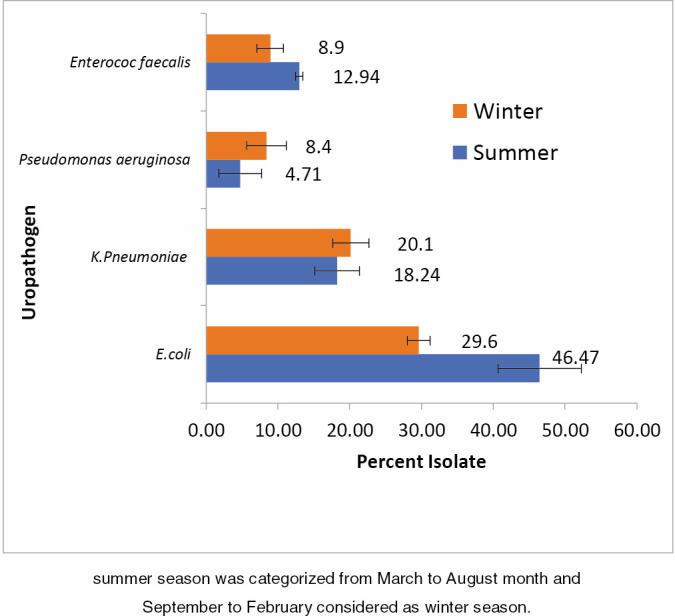
A total of 349 patients' urine report was studied to identify the uropathogens. was the main etiologic agent in community and hospital-acquired infections. The majority of the bacteria was isolated from female (60%), whereas the remaining (40%) was from male. The most common isolates were Extended spectrum beta-lactamases, and ESBL (these represented 37.82%, 19.20%, 10.89%, 10.32%, 6.59%, and 3.72%, of isolate, respectively). UTI due to was at a higher rate during summer than during winter. This study showed that ciprofloxacin (20.29%) and cefuroxime (16.14%) are most prescribed medications, followed by ceftriaxone (12.96%) and then tazocin (8.80%). Imipenem, meropenem, amikacin, vancomycin, tigecycline, linezolid, and colistin were highly sensitive for most types of bacteria, but gram-negative bacteria were highly resistant to ampicillin. Gram-positive bacteria showed highly resistance to cefoxitin.
CONCLUSION
The microbial culture and sensitivity of the isolates from urine samples should be carried out as a routine before starting the antimicrobial therapy. Current knowledge of the antibiotic sensitivity/resistance patterns of uropathogens at a particular geographical region is a guiding factor for choosing an appropriate empirical antimicrobial treatment rather than following universal guidelines.
背景
在发展中国家,临床医生面临着最常见的细菌感染之一,即尿路感染(UTI)。目前关于抗菌药物敏感性模式的知识对于选择合适的治疗方法至关重要。
目的
在本研究中,我们调查了导致尿路感染的各种细菌,并确定了从沙特阿拉伯巴哈三级医院患者中分离出的最常见尿路病原体对抗生素的敏感性和耐药性模式。
设置与设计
这是一项在沙特阿拉伯巴哈法赫德国王医院进行的尿液培养回顾性研究。
材料与方法
收集了2017年6月至2018年5月期间住院患者和门诊患者的实验室报告及病历,目标人群为年龄在18岁以上接受过尿路感染治疗的男性和女性。
结果
共研究了349例患者的尿液报告以鉴定尿路病原体。 是社区获得性感染和医院获得性感染的主要病原体。大多数细菌分离自女性(60%),其余(40%)来自男性。最常见的分离株是超广谱β-内酰胺酶和ESBL(这些分别占分离株的37.82%、19.20%、10.89%、10.32%、6.59%和3.72%)。由 引起的尿路感染在夏季的发生率高于冬季。本研究表明,环丙沙星(20.29%)和头孢呋辛(16.14%)是最常开具的药物,其次是头孢曲松(12.96%),然后是他唑仙(8.80%)。亚胺培南、美罗培南、阿米卡星、万古霉素、替加环素、利奈唑胺和黏菌素对大多数类型的细菌高度敏感,但革兰氏阴性菌对氨苄西林高度耐药。革兰氏阳性菌对头孢西丁高度耐药。
结论
在开始抗菌治疗前,应常规进行尿液样本分离株的微生物培养和药敏试验。了解特定地理区域尿路病原体的抗生素敏感性/耐药性模式是选择合适的经验性抗菌治疗的指导因素,而不是遵循通用指南。

 Zotero 插件