
中国 2008-2019 年李斯特菌病病例及其分离株的遗传多样性。
Listeriosis Cases and Genetic Diversity of Their Isolates in China, 2008-2019.
机构信息
Laboratory of Clinical Microbiology and Infectious Diseases, Department of Pulmonary and Critical Care Medicine, China-Japan Friendship Hospital, Beijing, China.
Center for Respiratory Diseases, China-Japan Friendship Hospital, Beijing, China.
出版信息
Front Cell Infect Microbiol. 2021 Feb 19;11:608352. doi: 10.3389/fcimb.2021.608352. eCollection 2021.
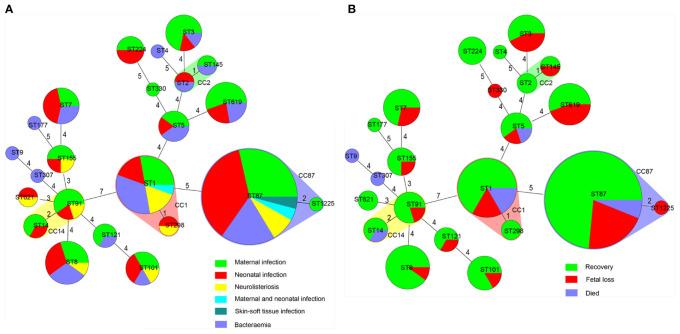
Listeriosis, caused by , is a severe food-borne infection. The nationwide surveillance in China concerning listeriosis is urgently needed. In the present study, 144 isolates were collected from the samples of blood, cerebrospinal fluid (CSF), and fetal membrane/placenta in China for 12 years from 2008 to 2019. We summarized these listeriosis patients' demographical and clinical features and outcomes. The susceptibility profile for 12 antibiotics was also determined by the broth microdilution method. Multilocus sequence typing (MLST) and serogroups of these listeria isolates were analyzed to designate epidemiological types. We enrolled 144 cases from 29 healthcare centers, including 96 maternal-neonatal infections, 33 cases of bacteremia, 13 cases of neurolisteriosis, and two cutaneous listeriosis. There were 31 (59.6%) fetal loss in 52 pregnant women and four (9.8%) neonatal death in 41 newborns. Among the 48 nonmaternal-neonatal cases, 12.5% (6/48) died, 41.7% (20/48) were female, and 64.6% (31/48) occurred in those with significant comorbidities. By MLST, the strains were distinguished into 23 individual sequence types (STs). The most prevalent ST was ST87 (49 isolates, 34.0%), followed by ST1 (18, 12.5%), ST8 (10, 6.9%), ST619 (9, 6.3%), ST7 (7, 4.9%) and ST3 (7, 4.9%). Furthermore, all isolates were uniformly susceptible to penicillin, ampicillin, and meropenem. In summary, our study highlights a high genotypic diversity of strains causing clinical listeriosis in China. Furthermore, a high prevalence of ST87 and ST1 in the listeriosis should be noted.
李斯特菌病是一种由李斯特菌引起的严重食源性感染。中国急需开展全国性的李斯特菌病监测。本研究收集了 2008 年至 2019 年 12 年间中国血液、脑脊液(CSF)和胎膜/胎盘样本中的 144 株李斯特菌分离株。我们总结了这些李斯特菌病患者的人口统计学和临床特征及结局。采用肉汤微量稀释法测定了 12 种抗生素的药敏谱。对这些李斯特菌分离株进行多位点序列分型(MLST)和血清型分析,以确定流行型别。我们从 29 家医疗机构共纳入 144 例病例,包括 96 例母婴感染、33 例菌血症、13 例神经李斯特菌病和 2 例皮肤李斯特菌病。52 例孕妇中有 31 例(59.6%)发生胎儿丢失,41 例新生儿中有 4 例(9.8%)死亡。在 48 例非母婴感染病例中,12.5%(6/48)死亡,41.7%(20/48)为女性,64.6%(31/48)有严重合并症。通过 MLST,菌株被分为 23 个单核苷酸多态性(ST)。最常见的 ST 是 ST87(49 株,34.0%),其次是 ST1(18 株,12.5%)、ST8(10 株,6.9%)、ST619(9 株,6.3%)、ST7(7 株,4.9%)和 ST3(7 株,4.9%)。此外,所有分离株对青霉素、氨苄西林和美罗培南均敏感。总之,本研究强调了中国引起临床李斯特菌病的菌株具有很高的基因多样性。此外,ST87 和 ST1 在李斯特菌病中的高流行率值得关注。


 Zotero 插件