
1990年至2017年全球、区域和国家登革热负担:基于2017年全球疾病负担研究的系统分析。
Global, regional, and national dengue burden from 1990 to 2017: A systematic analysis based on the global burden of disease study 2017.
作者信息
Zeng Zhilin, Zhan Juan, Chen Liyuan, Chen Huilong, Cheng Sheng
机构信息
Department and Institute of Infectious Diseases, Tongji Hospital, Tongji Medical College, Huazhong University of Science and Technology, Wuhan, China.
Department of Dermatology, Tongji Hospital, Tongji Medical College, Huazhong University of Science and Technology, Wuhan, China.
出版信息
EClinicalMedicine. 2021 Jan 6;32:100712. doi: 10.1016/j.eclinm.2020.100712. eCollection 2021 Feb.
BACKGROUND
Dengue is one of the most common vector-borne diseases globally, however, its burden is poorly quantified. Hence, we aimed to report the dengue burden in 195 countries and territories between 1990 and 2017, using data from the Global Burden of Diseases, Injuries, and Risk Factors Study 2017.
METHODS
Following the methodology framework and analytical strategies used in the Global Burden of Disease Study 2017, we analysed the incidence, mortality, and disability-adjusted life years (DALYs) of dengue in geographically defined populations worldwide between 1990 and 2017. We also determined the association between development levels and dengue burden. All estimates were reported as numbers and rates per 100 000 population, with 95% uncertainty intervals.
FINDINGS
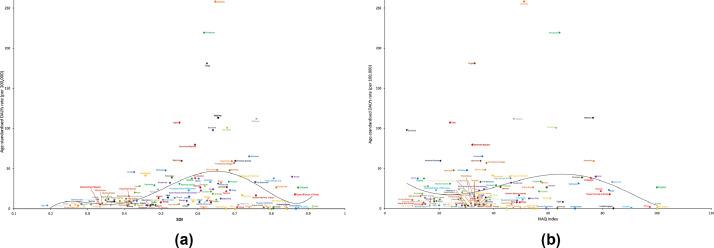
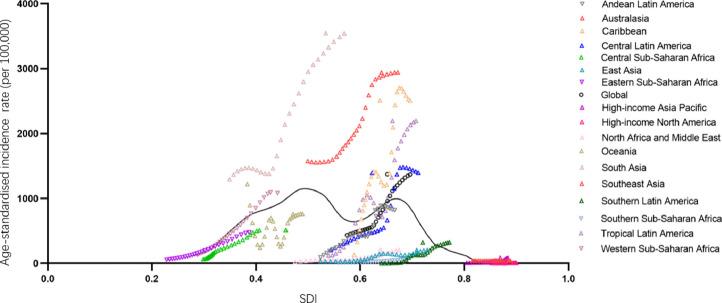
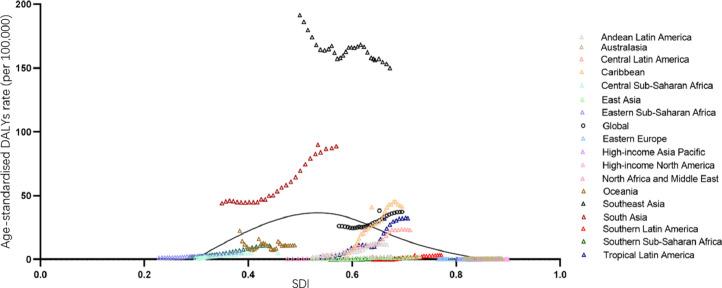
Globally, the total number of dengue cases increased from 23 283 274 (95% UI 453 180.7-51 840 670) in 1990 to 104 771 911 (95% UI 63 759 019-158 870 031) in 2017. The age-standardised incidence rate increased from 431.6 (8.4-961.0) per 100 000 population in 1990 to 1371.3 (834.5-2079.3) per 100 000 population in 2017. In addition, the number of deaths due to dengue increased from approximately16 957 (7 613-30 091) in 1990 to 40 467 (17 620-49 778) in 2017. Meanwhile, the global age-standardised death rate increased from 0.31 (0.14-0•56) per 100 000 population in 1990 to 0.53 (0.23-0•65) per 100 000 population in 2017. Overall, there were 2 922 630 DALYs (1 629 424-3 967 492) attributed to dengue in 2017 globally, an increase of 107.6% since 1990 (1 407 571 DALYs [624 016.4-2 510 025]), and the age-standardised DALY rate increased from 26.10 (11.57-46.53) per 100 000 population to 38.25 (21.33-51.93) per 100 000 population between 1990 and 2017. The association between socio-demographic index (SDI) and dengue-related DALYs suggested that the lowest age-standardised DALY rates were found in countries in the low and high-SDI quintile in 2017, and from 1990 to 2017, the age-standardized DALY rate tended to increase in regions with the lowest SDI but declined in regions with the highest SDI. There was a nonlinear association between the socio-demographic index and the healthcare access and quality index and age-standardised DALY rates.
INTERPRETATION
Dengue is a major public health challenge worldwide. While there is remarkable international variation in its incidence, the dengue burden is increasing globally. The results of this study could be useful for policy makers to implement cost-effective interventions and reduce the dengue burden, particularly in countries with high incidence or increasing burden.
FUNDING
This work was supported by a grant from the National Natural Science Foundation of China (NSFC) (grant numbers 81,800,041 and 82,000,078).
背景
登革热是全球最常见的媒介传播疾病之一,然而其负担情况却鲜有量化。因此,我们旨在利用《2017年全球疾病、伤害及风险因素负担研究》的数据,报告1990年至2017年期间195个国家和地区的登革热负担情况。
方法
按照《2017年全球疾病负担研究》中使用的方法框架和分析策略,我们分析了1990年至2017年全球按地理区域划分人群中登革热的发病率、死亡率和伤残调整生命年(DALYs)。我们还确定了发展水平与登革热负担之间的关联。所有估计值均以每10万人的数量和比率形式报告,并带有95%的不确定性区间。
研究结果
全球范围内,登革热病例总数从1990年的23283274例(95%不确定区间453180.7 - 51840670例)增至2017年的104771911例(95%不确定区间63759019 - 158870031例)。年龄标准化发病率从1990年每10万人431.6例(8.4 - 961.0例)增至2017年每10万人1371.3例(834.5 - 2079.3例)。此外,登革热死亡人数从1990年的约16957例(7613 - 30091例)增至2017年的40467例(17620 - 49778例)。同时,全球年龄标准化死亡率从1990年每10万人0.31例(0.14 - 0.56例)增至2017年每10万人0.53例(0.23 - 0.65例)。总体而言,2017年全球归因于登革热的伤残调整生命年为2922630例(1629424 - 3967492例),自1990年以来增加了107.6%(1990年为1407571例伤残调整生命年[624016.4 - 2510025例]),年龄标准化伤残调整生命年率在1990年至2017年间从每10万人26.10例(11.57 - 46.53例)增至每10万人38.25例(21.33 - 51.93例)。社会人口指数(SDI)与登革热相关伤残调整生命年之间的关联表明,2017年社会人口指数处于低五分位数和高五分位数的国家年龄标准化伤残调整生命年率最低,并且从1990年至2017年,社会人口指数最低的地区年龄标准化伤残调整生命年率趋于上升,而社会人口指数最高的地区则下降。社会人口指数与医疗保健可及性和质量指数以及年龄标准化伤残调整生命年率之间存在非线性关联。
解读
登革热是全球一项重大的公共卫生挑战。虽然其发病率在国际上存在显著差异,但全球登革热负担正在增加。本研究结果有助于政策制定者实施具有成本效益的干预措施并减轻登革热负担,特别是在发病率高或负担加重的国家。
资金资助
本研究得到了中国国家自然科学基金(NSFC)的资助(项目编号81800041和82000078)。




 Zotero 插件