
1950-2017 年 195 个国家和地区按年龄和性别划分的人口和生育率:2017 年全球疾病负担研究的系统分析。
Population and fertility by age and sex for 195 countries and territories, 1950-2017: a systematic analysis for the Global Burden of Disease Study 2017.
出版信息
Lancet. 2018 Nov 10;392(10159):1995-2051. doi: 10.1016/S0140-6736(18)32278-5. Epub 2018 Nov 8.
BACKGROUND
Population estimates underpin demographic and epidemiological research and are used to track progress on numerous international indicators of health and development. To date, internationally available estimates of population and fertility, although useful, have not been produced with transparent and replicable methods and do not use standardised estimates of mortality. We present single-calendar year and single-year of age estimates of fertility and population by sex with standardised and replicable methods.
METHODS
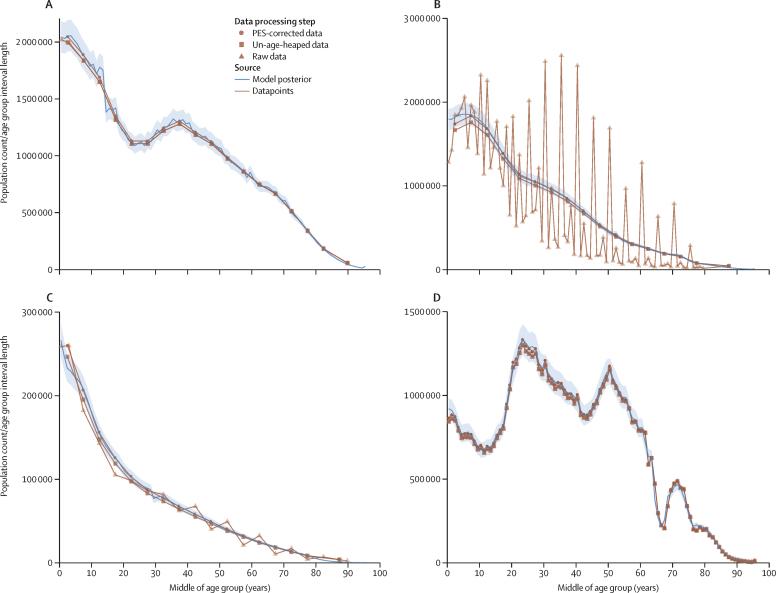
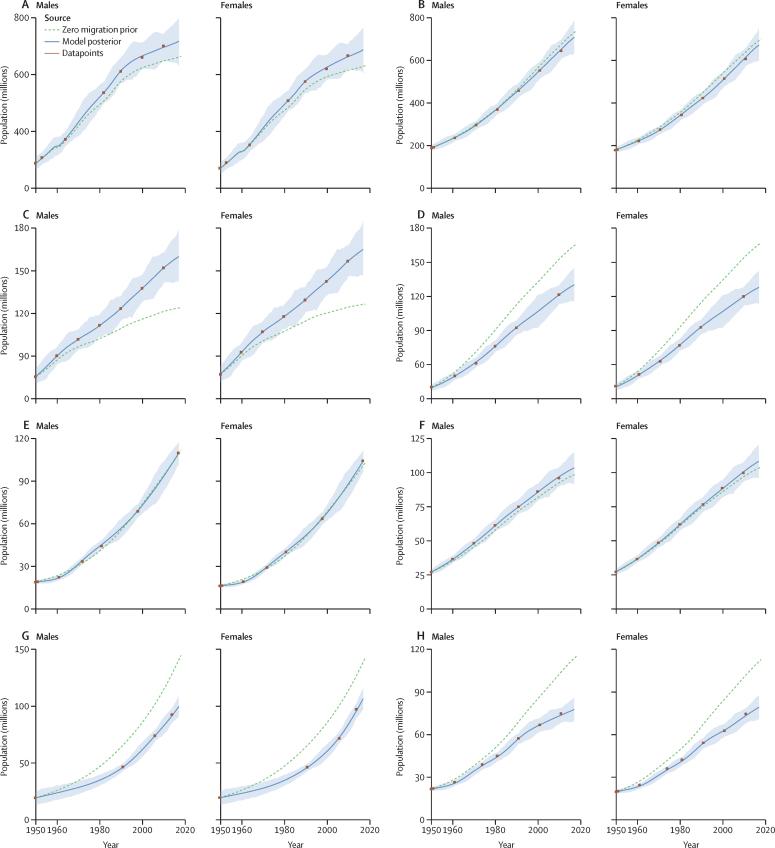
We estimated population in 195 locations by single year of age and single calendar year from 1950 to 2017 with standardised and replicable methods. We based the estimates on the demographic balancing equation, with inputs of fertility, mortality, population, and migration data. Fertility data came from 7817 location-years of vital registration data, 429 surveys reporting complete birth histories, and 977 surveys and censuses reporting summary birth histories. We estimated age-specific fertility rates (ASFRs; the annual number of livebirths to women of a specified age group per 1000 women in that age group) by use of spatiotemporal Gaussian process regression and used the ASFRs to estimate total fertility rates (TFRs; the average number of children a woman would bear if she survived through the end of the reproductive age span [age 10-54 years] and experienced at each age a particular set of ASFRs observed in the year of interest). Because of sparse data, fertility at ages 10-14 years and 50-54 years was estimated from data on fertility in women aged 15-19 years and 45-49 years, through use of linear regression. Age-specific mortality data came from the Global Burden of Diseases, Injuries, and Risk Factors Study (GBD) 2017 estimates. Data on population came from 1257 censuses and 761 population registry location-years and were adjusted for underenumeration and age misreporting with standard demographic methods. Migration was estimated with the GBD Bayesian demographic balancing model, after incorporating information about refugee migration into the model prior. Final population estimates used the cohort-component method of population projection, with inputs of fertility, mortality, and migration data. Population uncertainty was estimated by use of out-of-sample predictive validity testing. With these data, we estimated the trends in population by age and sex and in fertility by age between 1950 and 2017 in 195 countries and territories.
FINDINGS
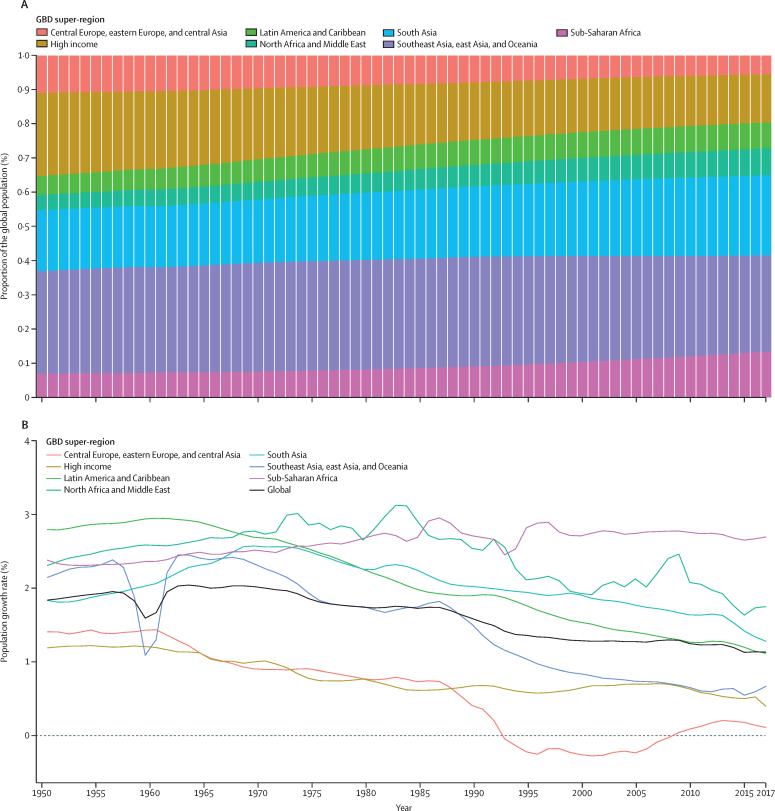
From 1950 to 2017, TFRs decreased by 49·4% (95% uncertainty interval [UI] 46·4-52·0). The TFR decreased from 4·7 livebirths (4·5-4·9) to 2·4 livebirths (2·2-2·5), and the ASFR of mothers aged 10-19 years decreased from 37 livebirths (34-40) to 22 livebirths (19-24) per 1000 women. Despite reductions in the TFR, the global population has been increasing by an average of 83·8 million people per year since 1985. The global population increased by 197·2% (193·3-200·8) since 1950, from 2·6 billion (2·5-2·6) to 7·6 billion (7·4-7·9) people in 2017; much of this increase was in the proportion of the global population in south Asia and sub-Saharan Africa. The global annual rate of population growth increased between 1950 and 1964, when it peaked at 2·0%; this rate then remained nearly constant until 1970 and then decreased to 1·1% in 2017. Population growth rates in the southeast Asia, east Asia, and Oceania GBD super-region decreased from 2·5% in 1963 to 0·7% in 2017, whereas in sub-Saharan Africa, population growth rates were almost at the highest reported levels ever in 2017, when they were at 2·7%. The global average age increased from 26·6 years in 1950 to 32·1 years in 2017, and the proportion of the population that is of working age (age 15-64 years) increased from 59·9% to 65·3%. At the national level, the TFR decreased in all countries and territories between 1950 and 2017; in 2017, TFRs ranged from a low of 1·0 livebirths (95% UI 0·9-1·2) in Cyprus to a high of 7·1 livebirths (6·8-7·4) in Niger. The TFR under age 25 years (TFU25; number of livebirths expected by age 25 years for a hypothetical woman who survived the age group and was exposed to current ASFRs) in 2017 ranged from 0·08 livebirths (0·07-0·09) in South Korea to 2·4 livebirths (2·2-2·6) in Niger, and the TFR over age 30 years (TFO30; number of livebirths expected for a hypothetical woman ageing from 30 to 54 years who survived the age group and was exposed to current ASFRs) ranged from a low of 0·3 livebirths (0·3-0·4) in Puerto Rico to a high of 3·1 livebirths (3·0-3·2) in Niger. TFO30 was higher than TFU25 in 145 countries and territories in 2017. 33 countries had a negative population growth rate from 2010 to 2017, most of which were located in central, eastern, and western Europe, whereas population growth rates of more than 2·0% were seen in 33 of 46 countries in sub-Saharan Africa. In 2017, less than 65% of the national population was of working age in 12 of 34 high-income countries, and less than 50% of the national population was of working age in Mali, Chad, and Niger.
INTERPRETATION
Population trends create demographic dividends and headwinds (ie, economic benefits and detriments) that affect national economies and determine national planning needs. Although TFRs are decreasing, the global population continues to grow as mortality declines, with diverse patterns at the national level and across age groups. To our knowledge, this is the first study to provide transparent and replicable estimates of population and fertility, which can be used to inform decision making and to monitor progress.
FUNDING
Bill & Melinda Gates Foundation.
背景
人口估计数是人口学和流行病学研究的基础,用于跟踪众多国际健康和发展指标的进展情况。迄今为止,虽然国际上提供的人口和生育率估计数虽然有用,但它们不是用透明和可复制的方法产生的,也没有使用标准化的死亡率估计数。我们提出了使用标准化和可复制的方法对 195 个地点按单一历年和单一年龄组的生育率和人口进行的估计数。
方法
我们根据人口平衡方程,利用生育率、死亡率、人口和移民数据,对 1950 年至 2017 年期间 195 个地点的人口进行了单一年龄组和单一历年的估计。生育率数据来自 7817 个地点年的生命登记数据、429 个完整生育史报告调查以及 977 个汇总生育史报告调查和普查。我们使用时空高斯过程回归来估计特定年龄生育率(ASFR;特定年龄组的每 1000 名女性中活产数),并使用 ASFR 来估计总生育率(TFR;如果一名女性在生育年龄(10-54 岁)结束前幸存下来并经历了她在感兴趣的年份所观察到的特定 ASFR 集,则她将生育的平均孩子数)。由于数据稀疏,我们通过使用线性回归从 15-19 岁和 45-49 岁的女性的生育数据来估计 10-14 岁和 50-54 岁的生育数据。特定年龄组的死亡率数据来自全球疾病、伤害和危险因素研究(GBD)2017 年的估计数。人口数据来自 1257 次普查和 761 个人口登记地点年,并使用标准人口方法对漏报和年龄错报进行了调整。通过使用生育率、死亡率和移民数据的人口预测的队列成分方法,对最终人口估计数进行了调整。通过使用样本外预测有效性测试来估计人口不确定性。有了这些数据,我们估计了 1950 年至 2017 年期间 195 个国家和地区的人口按年龄和性别以及生育率按年龄的趋势。
结果
从 1950 年至 2017 年,总生育率(TFR)下降了 49.4%(95%置信区间[UI]46.4-52.0)。TFR 从 4.7 个活产数(4.5-4.9)降至 2.4 个活产数(2.2-2.5),10-19 岁母亲的 ASFR 从 37 个活产数(34-40)降至 22 个活产数(19-24)每 1000 名妇女。尽管 TFR 有所下降,但自 1985 年以来,全球人口每年平均增长 8380 万人。自 1950 年以来,全球人口增长了 197.2%(193.3-200.8),从 26 亿(25-26)增至 2017 年的 76 亿(7.4-7.9)人;其中大部分增长发生在南亚和撒哈拉以南非洲的全球人口比例中。全球人口增长率在 1950 年至 1964 年之间有所增加,当时达到 2.0%的峰值;此后,这一速度基本保持不变,直到 1970 年,然后在 2017 年降至 1.1%。东南亚、东亚和大洋洲 GBD 超级区域的生育率从 1963 年的 2.5%下降到 2017 年的 0.7%,而撒哈拉以南非洲的人口增长率在 2017 年达到了历史最高水平,当时达到了 2.7%。全球平均年龄从 1950 年的 26.6 岁增加到 2017 年的 32.1 岁,15-64 岁的劳动年龄人口比例从 59.9%增加到 65.3%。在国家一级,1950 年至 2017 年间,所有国家和地区的总生育率都有所下降;2017 年,总生育率范围从塞浦路斯的 1.0 个活产数(95% UI 0.9-1.2)到尼日尔的 7.1 个活产数(6.8-7.4)。2017 年,TFU25(假设一名女性在年龄组中幸存下来并暴露于当前 ASFR 下,她在 25 岁之前预期的活产数)的范围从韩国的 0.08 个活产数(0.07-0.09)到尼日尔的 2.4 个活产数(2.2-2.6),TFO30(假设一名女性从 30 岁到 54 岁年龄组中幸存下来并暴露于当前 ASFR 下,她预期的活产数)的范围从波多黎各的 0.3 个活产数(0.3-0.4)到尼日尔的 3.1 个活产数(3.0-3.2)。在 2017 年,145 个国家和地区的 TFO30 高于 TFU25。2010 年至 2017 年期间,有 33 个国家的人口增长率为负,其中大部分位于中欧、东欧和西欧,而在撒哈拉以南非洲的 46 个国家中,有 33 个国家的人口增长率超过 2.0%。2017 年,在 34 个高收入国家中,有 12 个国家的劳动年龄人口(15-64 岁)不足 65%,在马里、乍得和尼日尔,不到 50%的全国人口处于劳动年龄。
解释
人口趋势创造了人口红利和人口逆差(即经济利益和损害),这些红利和逆差影响着国家经济,并决定着国家的规划需求。尽管 TFR 正在下降,但由于死亡率下降,全球人口仍在继续增长,而且在国家一级和各年龄组之间存在不同的模式。据我们所知,这是第一项提供透明和可复制的人口和生育率估计数的研究,可以用于决策制定和监测进展情况。
资金来源
比尔及梅琳达·盖茨基金会。




 Zotero 插件