
全球、区域和国家 5 岁以下儿童死亡率、成人死亡率、特定年龄死亡率和预期寿命,1970-2016 年:2016 年全球疾病负担研究的系统分析。
Global, regional, and national under-5 mortality, adult mortality, age-specific mortality, and life expectancy, 1970-2016: a systematic analysis for the Global Burden of Disease Study 2016.
出版信息
Lancet. 2017 Sep 16;390(10100):1084-1150. doi: 10.1016/S0140-6736(17)31833-0.
BACKGROUND
Detailed assessments of mortality patterns, particularly age-specific mortality, represent a crucial input that enables health systems to target interventions to specific populations. Understanding how all-cause mortality has changed with respect to development status can identify exemplars for best practice. To accomplish this, the Global Burden of Diseases, Injuries, and Risk Factors Study 2016 (GBD 2016) estimated age-specific and sex-specific all-cause mortality between 1970 and 2016 for 195 countries and territories and at the subnational level for the five countries with a population greater than 200 million in 2016.
METHODS
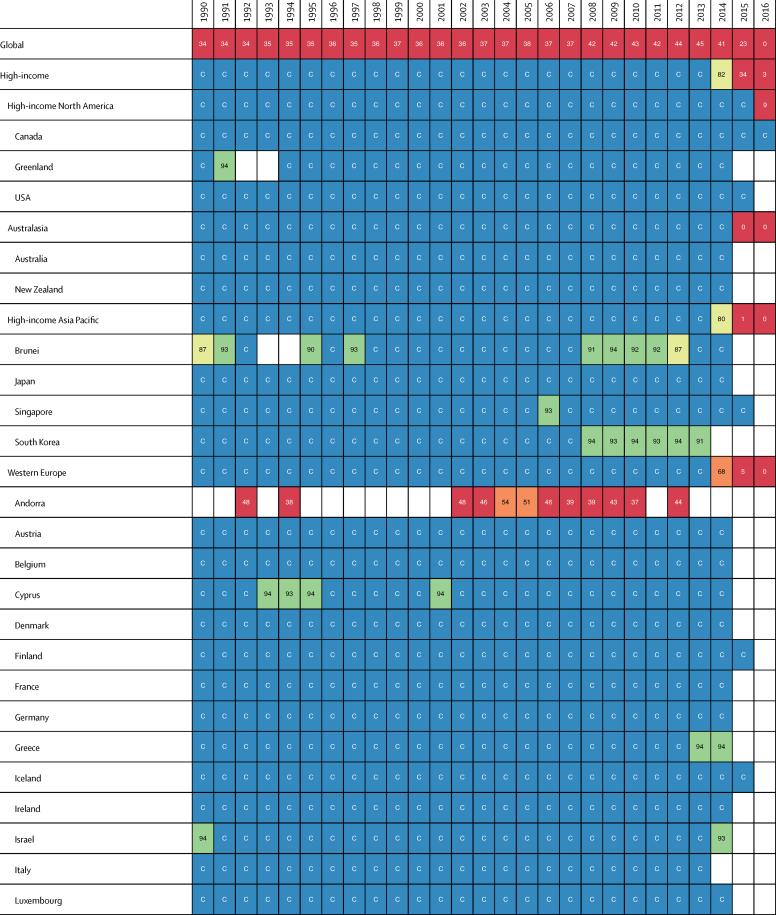
We have evaluated how well civil registration systems captured deaths using a set of demographic methods called death distribution methods for adults and from consideration of survey and census data for children younger than 5 years. We generated an overall assessment of completeness of registration of deaths by dividing registered deaths in each location-year by our estimate of all-age deaths generated from our overall estimation process. For 163 locations, including subnational units in countries with a population greater than 200 million with complete vital registration (VR) systems, our estimates were largely driven by the observed data, with corrections for small fluctuations in numbers and estimation for recent years where there were lags in data reporting (lags were variable by location, generally between 1 year and 6 years). For other locations, we took advantage of different data sources available to measure under-5 mortality rates (U5MR) using complete birth histories, summary birth histories, and incomplete VR with adjustments; we measured adult mortality rate (the probability of death in individuals aged 15-60 years) using adjusted incomplete VR, sibling histories, and household death recall. We used the U5MR and adult mortality rate, together with crude death rate due to HIV in the GBD model life table system, to estimate age-specific and sex-specific death rates for each location-year. Using various international databases, we identified fatal discontinuities, which we defined as increases in the death rate of more than one death per million, resulting from conflict and terrorism, natural disasters, major transport or technological accidents, and a subset of epidemic infectious diseases; these were added to estimates in the relevant years. In 47 countries with an identified peak adult prevalence for HIV/AIDS of more than 0·5% and where VR systems were less than 65% complete, we informed our estimates of age-sex-specific mortality using the Estimation and Projection Package (EPP)-Spectrum model fitted to national HIV/AIDS prevalence surveys and antenatal clinic serosurveillance systems. We estimated stillbirths, early neonatal, late neonatal, and childhood mortality using both survey and VR data in spatiotemporal Gaussian process regression models. We estimated abridged life tables for all location-years using age-specific death rates. We grouped locations into development quintiles based on the Socio-demographic Index (SDI) and analysed mortality trends by quintile. Using spline regression, we estimated the expected mortality rate for each age-sex group as a function of SDI. We identified countries with higher life expectancy than expected by comparing observed life expectancy to anticipated life expectancy on the basis of development status alone.
FINDINGS
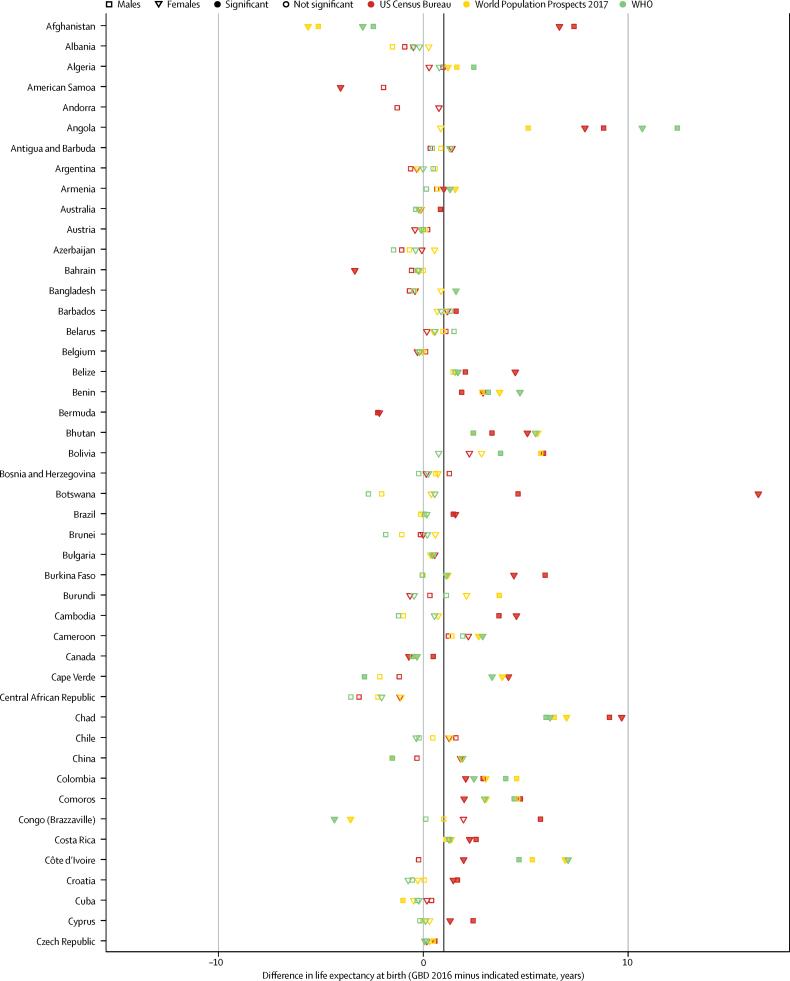
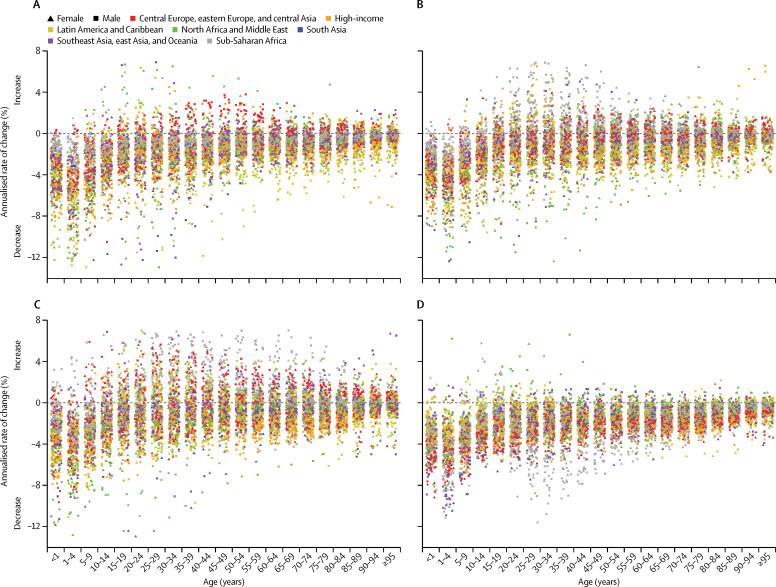
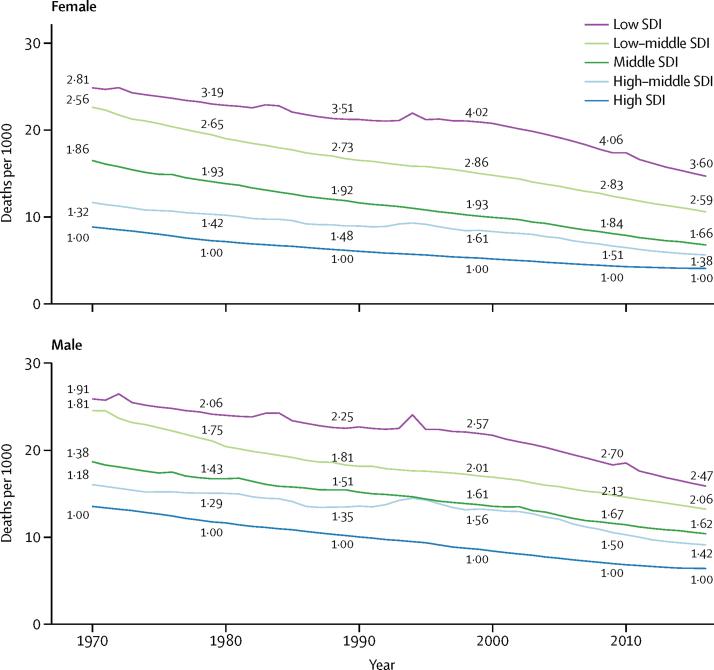
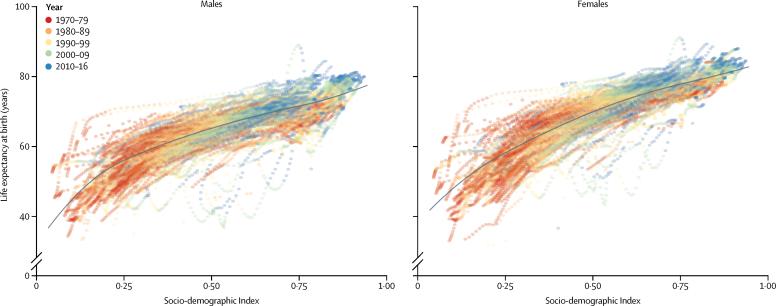
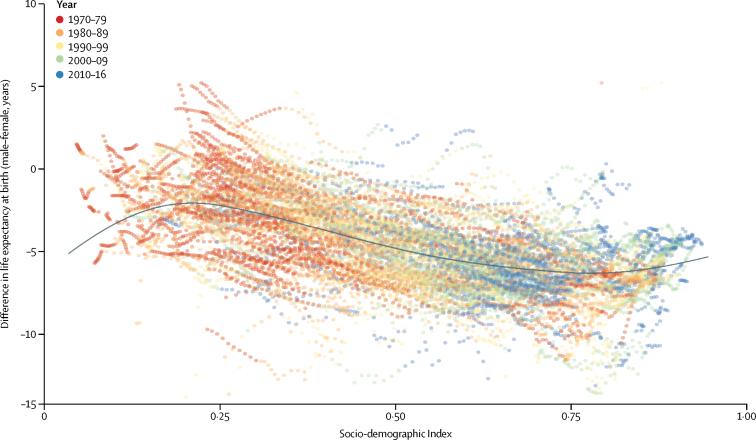
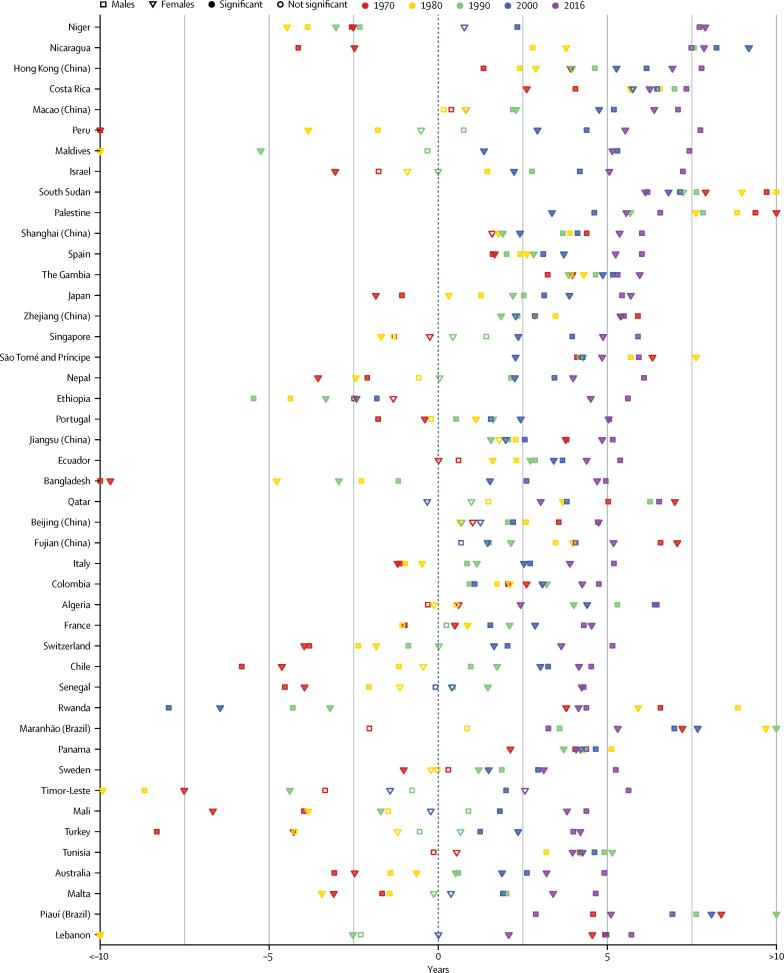
Completeness in the registration of deaths increased from 28% in 1970 to a peak of 45% in 2013; completeness was lower after 2013 because of lags in reporting. Total deaths in children younger than 5 years decreased from 1970 to 2016, and slower decreases occurred at ages 5-24 years. By contrast, numbers of adult deaths increased in each 5-year age bracket above the age of 25 years. The distribution of annualised rates of change in age-specific mortality rate differed over the period 2000 to 2016 compared with earlier decades: increasing annualised rates of change were less frequent, although rising annualised rates of change still occurred in some locations, particularly for adolescent and younger adult age groups. Rates of stillbirths and under-5 mortality both decreased globally from 1970. Evidence for global convergence of death rates was mixed; although the absolute difference between age-standardised death rates narrowed between countries at the lowest and highest levels of SDI, the ratio of these death rates-a measure of relative inequality-increased slightly. There was a strong shift between 1970 and 2016 toward higher life expectancy, most noticeably at higher levels of SDI. Among countries with populations greater than 1 million in 2016, life expectancy at birth was highest for women in Japan, at 86·9 years (95% UI 86·7-87·2), and for men in Singapore, at 81·3 years (78·8-83·7) in 2016. Male life expectancy was generally lower than female life expectancy between 1970 and 2016, and the gap between male and female life expectancy increased with progression to higher levels of SDI. Some countries with exceptional health performance in 1990 in terms of the difference in observed to expected life expectancy at birth had slower progress on the same measure in 2016.
INTERPRETATION
Globally, mortality rates have decreased across all age groups over the past five decades, with the largest improvements occurring among children younger than 5 years. However, at the national level, considerable heterogeneity remains in terms of both level and rate of changes in age-specific mortality; increases in mortality for certain age groups occurred in some locations. We found evidence that the absolute gap between countries in age-specific death rates has declined, although the relative gap for some age-sex groups increased. Countries that now lead in terms of having higher observed life expectancy than that expected on the basis of development alone, or locations that have either increased this advantage or rapidly decreased the deficit from expected levels, could provide insight into the means to accelerate progress in nations where progress has stalled.
FUNDING
Bill & Melinda Gates Foundation, and the National Institute on Aging and the National Institute of Mental Health of the National Institutes of Health.
背景
详细评估死亡率模式,特别是特定年龄的死亡率,是卫生系统针对特定人群进行干预的关键投入。了解发展状况下的全因死亡率如何变化,可以确定最佳实践的典范。为了实现这一目标,全球疾病、伤害和风险因素研究 2016 年(GBD 2016)估计了 1970 年至 2016 年期间 195 个国家和地区以及五个 2016 年人口超过 2 亿的国家的特定年龄和性别全因死亡率,以及在国家以下各级别的死亡率。
方法
我们使用了一系列称为成人死亡分布方法的人口学方法来评估民事登记系统对死亡的记录情况,同时还考虑了对 5 岁以下儿童的调查和人口普查数据。我们通过将每个地点-年份的登记死亡人数除以我们从整体估计过程中生成的所有年龄死亡人数来评估登记死亡人数的完整性。对于 163 个地点,包括人口超过 2 亿的国家中具有完整生命登记系统的国家以下各级单位,我们的估计主要受到观察数据的驱动,对于近年来数据报告滞后的情况,我们进行了小波动数量的修正和最近年份的估计(滞后时间因地点而异,一般为 1 年至 6 年)。对于其他地点,我们利用不同的数据来源来衡量使用完整出生记录、汇总出生记录和调整后的不完整生命登记系统的 5 岁以下儿童死亡率(U5MR);我们使用调整后的不完整生命登记系统、兄弟姐妹记录和家庭死亡回忆来衡量成人死亡率(15-60 岁个体死亡的概率)。我们使用 U5MR 和成人死亡率,以及 GBD 生命表系统中的 HIV 导致的粗死亡率,来估计每个地点-年份的特定年龄和性别死亡率。我们使用各种国际数据库,确定了致命的不连续性,我们将其定义为死亡率增加超过每百万 1 人死亡,这是由冲突和恐怖主义、自然灾害、重大运输或技术事故以及一部分传染性疾病流行引起的;这些都被添加到相关年份的估计中。在 47 个国家,艾滋病毒/艾滋病成人流行率超过 0.5%,且生命登记系统的完整性不足 65%,我们利用针对国家艾滋病毒/艾滋病流行情况调查和产前诊所血清学监测系统的拟合国家艾滋病毒/艾滋病流行情况调查和产前诊所血清学监测系统的 Estimation and Projection Package(EPP)-Spectrum 模型,为我们对年龄-性别特定死亡率的估计提供信息。我们使用时空高斯过程回归模型中的调查和生命登记数据来估计死产、早期新生儿、晚期新生儿和儿童死亡率。我们使用特定年龄死亡率估算所有地点-年份的简化生命表。我们根据社会人口指数(SDI)将地点分为发展五分位数,并按五分位数分析死亡率趋势。我们使用样条回归,根据发展状况本身,将每个年龄-性别组的预期死亡率作为 SDI 的函数进行估计。我们通过将观察到的预期寿命与仅根据发展状况预期的预期寿命进行比较,来确定预期寿命高于预期的国家。
结果
1970 年至 2013 年,死亡登记的完整性从 28%增加到 45%的峰值;由于报告滞后,2013 年后的完整性降低。5 岁以下儿童总死亡人数从 1970 年减少到 2016 年,而 5-24 岁年龄组的死亡率下降速度较慢。相比之下,25 岁以上每个 5 岁年龄组的成年死亡人数都在增加。2000 年至 2016 年期间,特定年龄死亡率的年化变化率分布与前几十年不同:年化变化率的增加频率较低,尽管在一些地点,尤其是青少年和年轻成年人年龄组,仍然发生了上升的年化变化率。全球范围内,1970 年以来,死产率和 5 岁以下儿童死亡率均有所下降。死亡率趋同的证据参差不齐;尽管在最低和最高 SDI 国家之间,年龄标准化死亡率的绝对差异缩小,但这些死亡率的比率(衡量相对不平等的指标)略有增加。1970 年至 2016 年期间,人们的生活期望发生了明显转变,在更高的 SDI 水平下尤为明显。在 2016 年人口超过 100 万的国家中,女性的预期寿命最高的是日本,为 86.9 岁(95%UI 86.7-87.2),男性的预期寿命最高的是新加坡,为 81.3 岁(78.8-83.7)。1970 年至 2016 年期间,男性的预期寿命普遍低于女性,并且男性和女性之间的预期寿命差距随着向更高 SDI 水平的发展而扩大。一些在 1990 年在出生时观察到的预期寿命与预期寿命之差方面表现出色的国家,在 2016 年同样衡量指标的进展上进展缓慢。
解释
在过去的五十年中,全球所有年龄段的死亡率都有所下降,其中 5 岁以下儿童的死亡率降幅最大。然而,在国家一级,特定年龄组死亡率的变化水平和速度仍然存在很大差异;在一些地点,某些年龄组的死亡率有所上升。我们发现,各国特定年龄死亡的绝对差距有所缩小,尽管某些年龄-性别组的相对差距有所增加。现在在观察到的预期寿命高于仅根据发展状况预期的预期寿命方面领先的国家,或者在提高这一优势或迅速减少与预期水平的差距方面取得进展的国家,可以为加速那些停滞不前的国家的进展提供一些启示。
资金
比尔及梅琳达·盖茨基金会,以及美国国立卫生研究院的国家老龄化研究所和国家精神卫生研究所。


 Zotero 插件