
1990年至2021年金砖国家孕产妇败血症及其他孕产妇感染的负担与趋势
Burden and trend of maternal sepsis and other maternal infections in BRICS countries from 1990 to 2021.
作者信息
Long Jiao, Zhang Qi, Ma Chao
机构信息
Department of Anesthesiology, The Seventh Affiliated Hospital of Sun Yat-sen University, Shenzhen, Guangdong, 518107, China.
出版信息
BMC Pregnancy Childbirth. 2025 May 20;25(1):591. doi: 10.1186/s12884-025-07694-x.
BACKGROUND
Maternal septicemia and other maternal infections (MSMIs) continue to pose considerable challenges to public health on a global scale. However, comprehensive data on their impacts and trends are limited, particularly in BRICS countries, which include Brazil, Russian Federation, India, China, and South Africa. This study aims to compare the global epidemiological trends of MSMIs from 1990 to 2021 to MSMIs trends in BRICS countries and examine the relationship of disease burden with age and social development.
METHODS
Using data from the Global Burden of Disease database, this study analyzed the prevalence, incidence, death, and disability-adjusted life years (DALYs) of MSMIs from 1990 to 2021 globally and in BRICS countries. Temporal trends were assessed through estimated annual percentage change (EAPC) and percentage change. Joinpoint regression analysis was employed to rigorously evaluate time trends, allowing for the calculation of annual percentage change (APC) and average annual percentage change (AAPC), with corresponding 95% confidence intervals (CI).
RESULTS
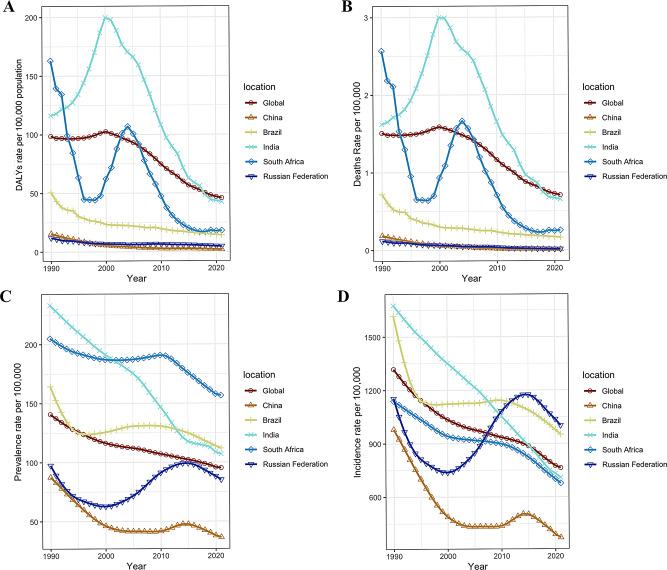
In 2021, South Africa showed the highest prevalence of MSMIs (156.54 per 100,000), while the Russian Federation exhibited the highest incidence (1,001.51 per 100,000). Deaths and DALYs of MSMIs were lowered in BRICS countries compared to global averages. Between 1990 and 2019, India experienced the greatest decline in both incidence (EAPC = -2.68%) and prevalence (EAPC = -2.65%). Despite the global decline, regional variations in incidence were observed. In China, the incidence increased significantly between 2010 and 2014 (APC = 4.15%; 95% CI: 3.59-4.71%; P < 0.001). Similarly, in the Russian Federation, the incidence rose during three distinct periods: 2000-2004 (APC = 2.52%; 95% CI: 2.0-3.05%; P < 0.001), 2004-2010 (APC = 5.2%; 95% CI: 4.95-5.44%; P < 0.001), and 2010-2015 (APC = 1.79%; 95% CI: 1.46-2.12%; P < 0.001).
CONCLUSION
MSMIs remain prevalent globally, imposing a substantial disability burden, particularly in BRICS countries. While China exhibits relatively low disease burdens, South Africa faces high prevalence, and global deaths and DALYs from MSMIs remain elevated.
背景
孕产妇败血症和其他孕产妇感染(MSMI)在全球范围内继续对公共卫生构成重大挑战。然而,关于其影响和趋势的全面数据有限,特别是在包括巴西、俄罗斯联邦、印度、中国和南非的金砖国家。本研究旨在比较1990年至2021年MSMI的全球流行病学趋势与金砖国家的MSMI趋势,并研究疾病负担与年龄和社会发展的关系。
方法
利用全球疾病负担数据库的数据,本研究分析了1990年至2021年全球及金砖国家MSMI的患病率、发病率、死亡率和伤残调整生命年(DALY)。通过估计年百分比变化(EAPC)和百分比变化评估时间趋势。采用Joinpoint回归分析严格评估时间趋势,计算年百分比变化(APC)和平均年百分比变化(AAPC)以及相应的95%置信区间(CI)。
结果
2021年,南非的MSMI患病率最高(每10万人中156.54例),而俄罗斯联邦的发病率最高(每10万人中1001.51例)。与全球平均水平相比,金砖国家MSMI的死亡人数和伤残调整生命年有所降低。1990年至2019年期间,印度的发病率(EAPC = -2.68%)和患病率(EAPC = -2.65%)下降幅度最大。尽管全球发病率呈下降趋势,但仍存在地区差异。在中国,2010年至2014年期间发病率显著上升(APC = 4.15%;95%CI:3.59 - 4.71%;P < 0.001)。同样,在俄罗斯联邦,发病率在三个不同时期上升:2000 - 2004年(APC = 2.52%;95%CI:2.0 - 3.05%;P < 0.001)、2004 - 2010年(APC = 5.2%;95%CI:4.95 - 5.44%;P < 0.001)和2010 - 2015年(APC = 1.79%;95%CI:1.46 - 2.12%;P < 0.001)。
结论
MSMI在全球范围内仍然普遍存在,造成了巨大的残疾负担,特别是在金砖国家。虽然中国的疾病负担相对较低,但南非的患病率很高,全球MSMI的死亡人数和伤残调整生命年仍然居高不下。


 Zotero 插件