
m6A RNA甲基化调节剂在睾丸生殖细胞肿瘤患者的预后中起重要作用。
m6A RNA methylation regulators play an important role in the prognosis of patients with testicular germ cell tumor.
作者信息
Cong Rong, Ji Chengjian, Zhang Jiayi, Zhang Qijie, Zhou Xiang, Yao Liangyu, Luan Jiaochen, Meng Xianghu, Song Ninghong
机构信息
Department of Urology, The First Affiliated Hospital of Nanjing Medical University, Nanjing, China.
Department of Urology, The Affiliated Kizilsu Kirghiz Autonomous Prefecture People's Hospital of Nanjing Medical University, Artux, China.
出版信息
Transl Androl Urol. 2021 Feb;10(2):662-679. doi: 10.21037/tau-20-963.
BACKGROUND
N6-methyladenosine (m6A) is found to be associated with promoting tumorigenesis in different types of cancers, however, the function of m6A-related genes in testicular germ cell tumors (TGCT) development remains to be illuminated. This study aimed to investigated the prognostic value of m6A RNA methylation regulators in TGCT.
METHODS
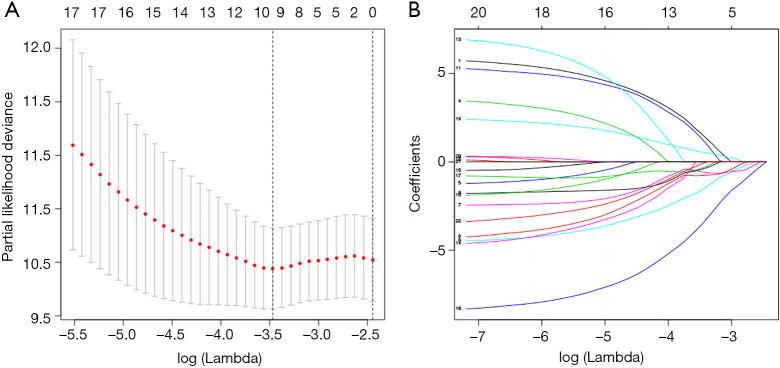
We collected TGCT patients' information about clinicopathologic parameters and twenty-two m6A regulatory genes expression from The Cancer Genome Atlas (TCGA) database and Genotype-Tissue Expression (GTEx). We analyzed the differentially expressed m6A RNA methylation regulators between tumor tissues and normal tissues, as well as the correlation of m6A RNA methylation regulators. By using Cox univariate analysis, last absolute shrinkage and selection operator (LASSO) Cox regression algorithm and Cox multivariate proportional hazards regression analysis, a risk score was constructed based on a TCGA training cohort, and further verified in the TCGA testing cohort. Then, univariate and multivariate Cox regression analyses were used to evaluate the relationship between risk score and progression-free survival (PFS) in TGCT. Finally, the six-gene risk score was further verified by two gene expression profiles (GSE3218 and GSE10783) as an independent external validation cohort.
RESULTS
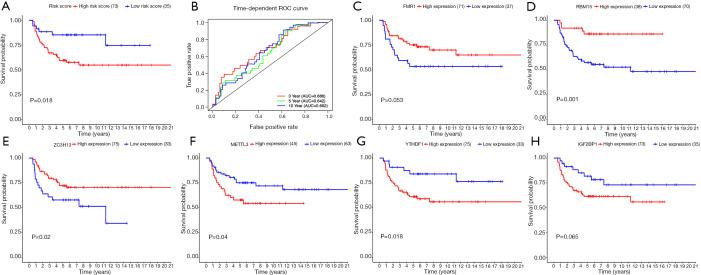
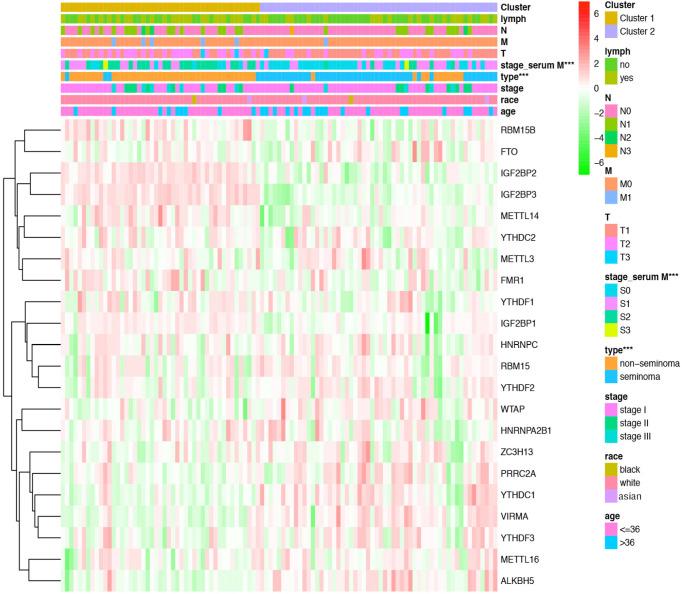
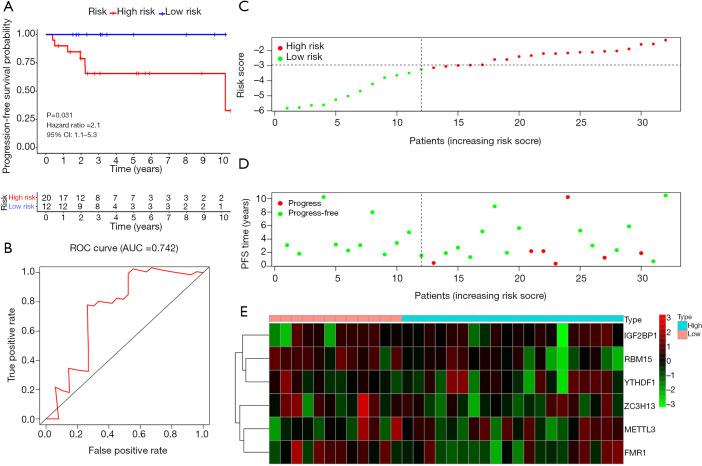
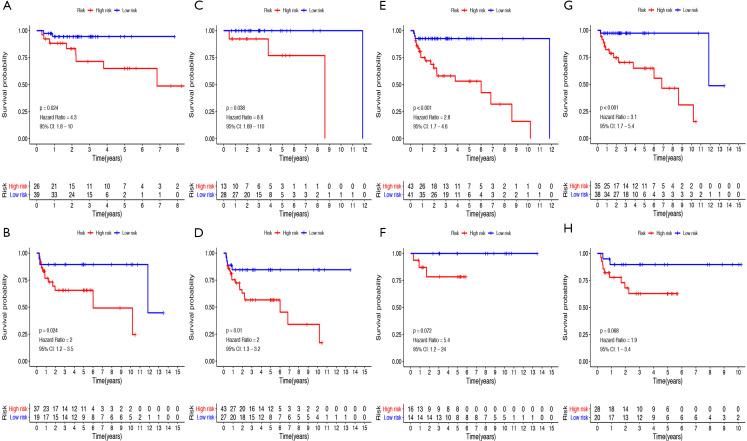
Distinct expression patterns of m6A regulatory genes were identified between TGCT tissues and normal tissues in TCGA and GTEx datasets. To predict prognosis of TGCT patients, a risk score was calculated based on six selected m6A RNA methylation regulators (YTHDF1, RBM15, IGF2BP1, ZC3H13, METTL3, and FMR1). Additionally, we found significant differences between the high-risk and low-risk groups in serum marker study levels and histologic subtype. Univariate and multivariate analysis indicated that high risk score was associated with unfavorable PFS. Ultimately, the risk score was further verified by two gene expression profiles (GSE3218 and GSE10783).
CONCLUSIONS
Based on six selected m6A RNA methylation regulators, we developed a m6A methylation related risk score that can independently predict the prognosis of TGCT patients, and verify the prediction efficiency in TCGA and GEO datasets. Patients in high-risk group were associated with serum tumor marker study levels beyond the normal limits, non-seminoma, and unfavorable survival time. However, further prospective experiments should be carried out to verify our results.
背景
N6-甲基腺苷(m6A)被发现与不同类型癌症的肿瘤发生促进有关,然而,m6A相关基因在睾丸生殖细胞肿瘤(TGCT)发展中的功能仍有待阐明。本研究旨在探讨m6A RNA甲基化调节因子在TGCT中的预后价值。
方法
我们从癌症基因组图谱(TCGA)数据库和基因型-组织表达(GTEx)中收集了TGCT患者的临床病理参数信息和22个m6A调节基因的表达情况。我们分析了肿瘤组织和正常组织之间差异表达的m6A RNA甲基化调节因子,以及m6A RNA甲基化调节因子之间的相关性。通过使用Cox单因素分析、最小绝对收缩和选择算子(LASSO)Cox回归算法以及Cox多因素比例风险回归分析,基于TCGA训练队列构建了一个风险评分,并在TCGA测试队列中进一步验证。然后,使用单因素和多因素Cox回归分析来评估风险评分与TGCT无进展生存期(PFS)之间的关系。最后,通过两个基因表达谱(GSE3218和GSE10783)作为独立的外部验证队列进一步验证了六基因风险评分。
结果
在TCGA和GTEx数据集中,TGCT组织和正常组织之间鉴定出了m6A调节基因的不同表达模式。为了预测TGCT患者的预后,基于六个选定的m6A RNA甲基化调节因子(YTHDF1、RBM15、IGF2BP1、ZC3H13、METTL3和FMR1)计算了一个风险评分。此外,我们发现高危组和低危组在血清标志物研究水平和组织学亚型方面存在显著差异。单因素和多因素分析表明高风险评分与不良的PFS相关。最终,通过两个基因表达谱(GSE3218和GSE10783)进一步验证了风险评分。
结论
基于六个选定的m6A RNA甲基化调节因子,我们开发了一种与m6A甲基化相关的风险评分,该评分可以独立预测TGCT患者的预后,并在TCGA和GEO数据集中验证了预测效率。高危组患者与超出正常范围的血清肿瘤标志物研究水平相关,与非精原细胞瘤相关,且生存时间不佳。然而,应进行进一步的前瞻性实验来验证我们的结果。




 Zotero 插件