
肿瘤微环境分析确定了与膀胱癌预后及肿瘤免疫治疗反应相关的亚型。
Tumor Microenvironment Analysis Identified Subtypes Associated With the Prognosis and the Tumor Response to Immunotherapy in Bladder Cancer.
作者信息
Zhang Hongxian, Song Jiwen, Dong Junqiang, Liu Zhuo, Lin Lixuan, Wang Bing, Ma Qiang, Ma Lulin
机构信息
Department of Urology, Peking University Third Hospital, Beijing, China.
Department of Urology, Shanxi Provincial Cancer Hospital, Taiyuan, China.
出版信息
Front Genet. 2021 Mar 1;12:551605. doi: 10.3389/fgene.2021.551605. eCollection 2021.
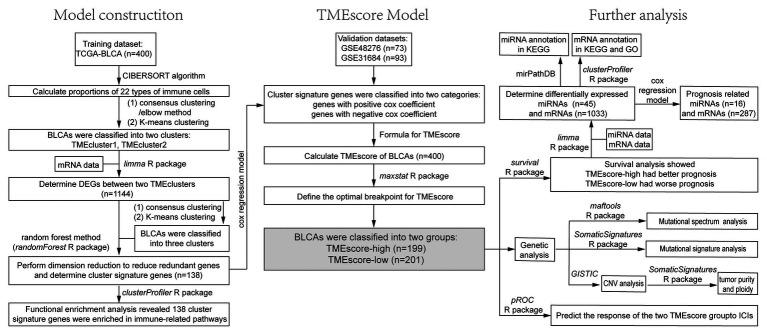
: The efficiency of immune checkpoint inhibitors (ICIs) in bladder cancer (BLCA) treatment has been widely validated; however, the tumor response to ICIs was generally low. It is critical and urgent to find biomarkers that can predict tumor response to ICIs. The tumor microenvironment (TME), which may play important roles to either dampen or enhance immune responses, has been widely concerned. : The cancer genome atlas BLCA (TCGA-BLCA) cohort ( = 400) was used in this study. Based on the proportions of 22 types of immune cells calculated by CIBERSORT, TME was classified by K-means Clustering and differentially expressed genes (DEGs) were determined. Based on DEGs, patients were classified into three groups, and cluster signature genes were identified after reducing redundant genes. Then TMEscore was calculated based on cluster signature genes, and the samples were classified to two subtypes. We performed somatic mutation and copy number variation analysis to identify the genetic characteristics of the two subtypes. Correlation analysis was performed to explore the correlation between TMEscore and the tumor response to ICIs as well as the prognosis of BLCA. : According to the proportions of immune cells, two TME clusters were determined, and 1,144 DEGs and 138 cluster signature genes were identified. Based on cluster signature genes, samples were classified into TMEscore-high ( = 199) and TMEscore-low ( = 201) subtypes. Survival analysis showed patients with TMEscore-high phenotype had better prognosis. Among the 45 differentially expressed micro-RNAs (miRNAs) and 1,033 differentially expressed messenger RNAs (mRNAs) between the two subtypes, 16 miRNAs and 287 mRNAs had statistically significant impact on the prognosis of BLCA. Furthermore, there were 94 genes with significant differences between the two subtypes, and they were enriched in RTK-RAS, NOTCH, WNT, Hippo, and PI3K pathways. The Tumor Immune Dysfunction and Exclusion (TIDE) score of TMEscore-high BLCA was statistically lower than that of TMEscore-low BLCA. Receiver operating characteristic (ROC) curve analysis showed that the area under the curve (AUC) of TMEscore and tumor mutation burden (TMB) is 0.6918 and 0.5374, respectively. : We developed a method to classify BLCA patients to two TME subtypes, TMEscore-high and TMEscore-low, and we found TMEscore-high subtype of BLCA had a good prognosis and a good response to ICIs.
免疫检查点抑制剂(ICIs)在膀胱癌(BLCA)治疗中的疗效已得到广泛验证;然而,肿瘤对ICIs的反应通常较低。寻找能够预测肿瘤对ICIs反应的生物标志物至关重要且迫在眉睫。肿瘤微环境(TME)可能在抑制或增强免疫反应中发挥重要作用,已受到广泛关注。
本研究使用了癌症基因组图谱BLCA(TCGA - BLCA)队列(n = 400)。基于通过CIBERSORT计算的22种免疫细胞的比例,采用K均值聚类对TME进行分类,并确定差异表达基因(DEGs)。基于DEGs,将患者分为三组,在减少冗余基因后鉴定聚类特征基因。然后基于聚类特征基因计算TMEscore,并将样本分为两个亚型。我们进行了体细胞突变和拷贝数变异分析,以鉴定两个亚型的遗传特征。进行相关性分析以探讨TMEscore与肿瘤对ICIs的反应以及BLCA预后之间的相关性。
根据免疫细胞比例,确定了两个TME聚类,鉴定出1144个DEGs和138个聚类特征基因。基于聚类特征基因,样本被分为TMEscore高(n = 199)和TMEscore低(n = 201)亚型。生存分析表明,TMEscore高表型的患者预后较好。在两个亚型之间的45个差异表达的微小RNA(miRNAs)和1033个差异表达的信使RNA(mRNAs)中,16个miRNAs和287个mRNAs对BLCA的预后有统计学显著影响。此外,两个亚型之间有94个基因存在显著差异,它们富集于RTK - RAS、NOTCH、WNT、Hippo和PI3K通路。TMEscore高的BLCA的肿瘤免疫功能障碍和排除(TIDE)评分在统计学上低于TMEscore低的BLCA。受试者工作特征(ROC)曲线分析表明,TMEscore和肿瘤突变负荷(TMB)的曲线下面积(AUC)分别为0.6918和0.5374。
我们开发了一种方法将BLCA患者分为TMEscore高和TMEscore低两个亚型,并且发现BLCA的TMEscore高亚型具有良好的预后和对ICIs的良好反应。



 Zotero 插件