
零剂量儿童与免疫级联:理解中低收入国家的免疫途径。
Zero-dose children and the immunisation cascade: Understanding immunisation pathways in low and middle-income countries.
机构信息
1160 Marechal Deodoro, Pelotas, RS 96020-220, Brazil.
1160 Marechal Deodoro, Pelotas, RS 96020-220, Brazil.
出版信息
Vaccine. 2021 Jul 22;39(32):4564-4570. doi: 10.1016/j.vaccine.2021.02.072. Epub 2021 Mar 18.
INTRODUCTION
Zero-dose prevalence refers to children who failed to receive any routine vaccination. Little is known about the "immunisation cascade" in low- and middle-income countries (LMICs), defined as how children move from zero dose to full immunisation.
METHODS
Using data from national surveys carried out in 92 LMICs since 2010 and focusing on the four basic vaccines delivered in infancy (BCG, polio, DPT and MCV), we describe zero-dose prevalence and the immunisation cascade in children aged 12 to 23 months. We also describe the most frequent combinations of vaccines (or co-coverage) among children who are partially immunized. Analyses are stratified by country income groups, household wealth quintiles derived from asset indices, sex of the child and area of residence. Results were pooled across countries using child populations as weights.
RESULTS
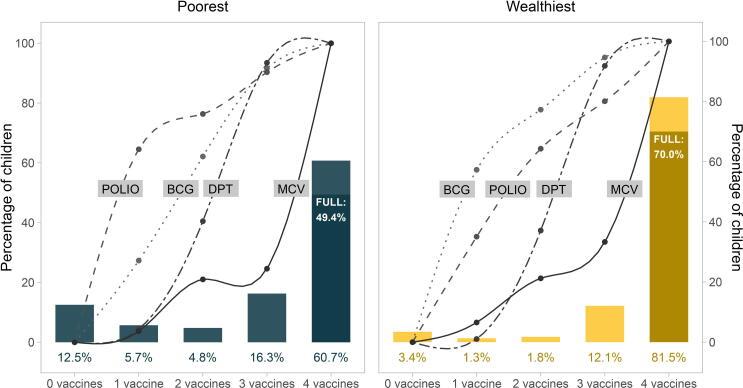
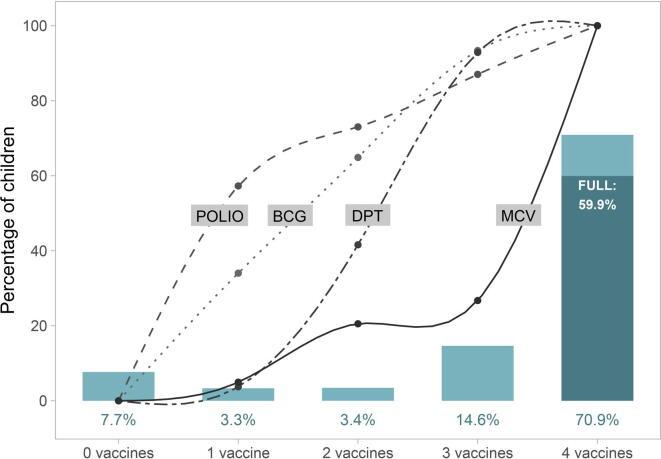
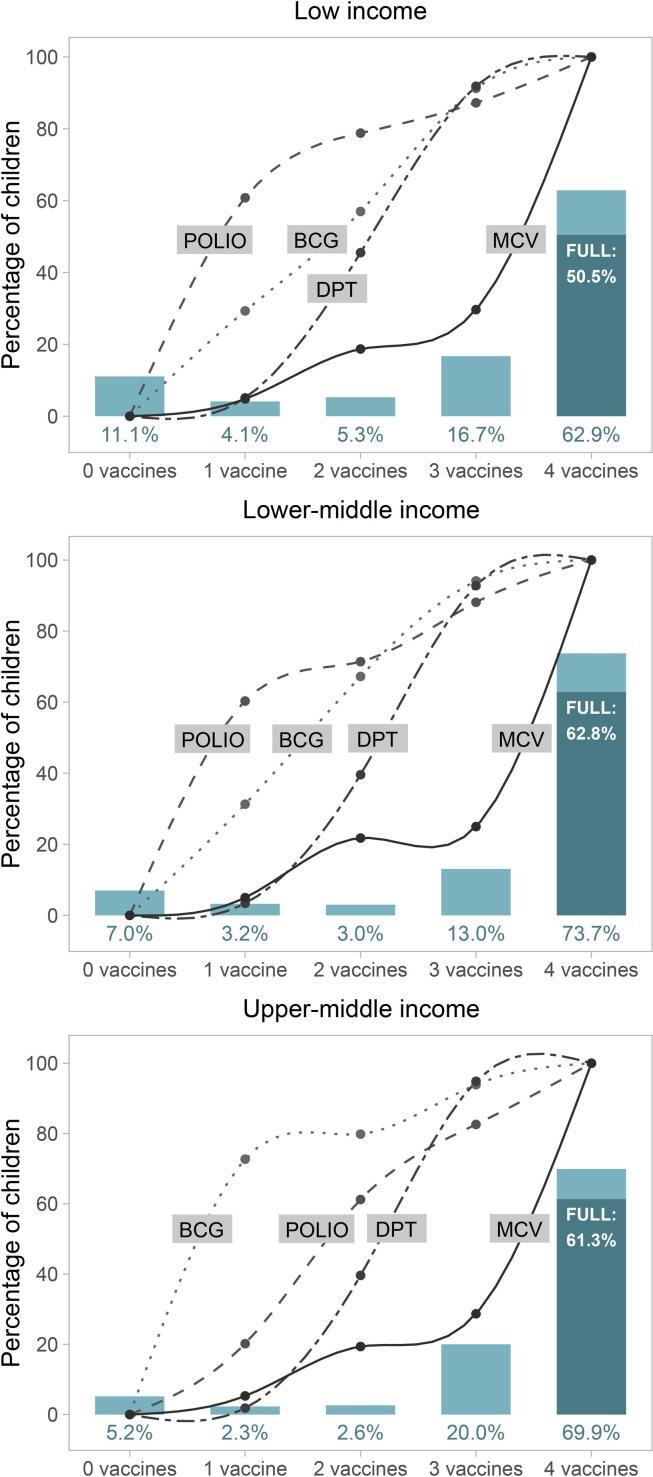
In the 92 countries, 7.7% were in the zero-dose group, and 3.3%, 3.4% and 14.6% received one, two or three vaccines, respectively; 70.9% received the four types and 59.9% of the total were fully immunised with all doses of the four vaccines. Three quarters (76.8%) of children who received the first vaccine received all four types. Among children with a single vaccine, polio was the most common in low- and lower-middle income countries, and BCG in upper-middle income countries. There were sharp inequalities according to household wealth, with zero-dose prevalence ranging from 12.5% in the poorest to 3.4% in the wealthiest quintile across all countries. The cascades were similar for boys and girls. In terms of dropout, 4% of children receiving BCG did not receive DPT1, 14% receiving DPT1 did not receive DPT3, and 9% receiving DPT3 did not progress to receive MCV.
INTERPRETATION
Focusing on zero-dose children is particularly important because those who are reached with the first vaccine are highly likely to also receive remaining vaccines.
简介
零剂量流行率是指未接受任何常规疫苗接种的儿童。在中低收入国家(LMICs),关于“免疫级联”(即儿童从零剂量到完全免疫的过程)的了解甚少。
方法
我们使用了自 2010 年以来在 92 个 LMIC 进行的国家调查的数据,重点关注在婴儿期接种的四种基本疫苗(卡介苗、脊髓灰质炎、DPT 和 MCV),描述了 12 至 23 个月儿童的零剂量流行率和免疫级联。我们还描述了部分免疫儿童中最常见的疫苗组合(或共同覆盖率)。分析按国家收入组、源自资产指数的家庭财富五分位数、儿童性别和居住地区进行分层。使用儿童人口作为权重,对各国的结果进行汇总。
结果
在这 92 个国家中,有 7.7%的儿童处于零剂量组,分别有 3.3%、3.4%和 14.6%的儿童接种了一种、两种或三种疫苗;70.9%的儿童接种了四种疫苗,59.9%的儿童完全接种了四种疫苗的所有剂量。接受第一剂疫苗的儿童中有四分之三(76.8%)接受了所有四种类型的疫苗。在接种了单一疫苗的儿童中,脊髓灰质炎在低收入和中低收入国家最为常见,卡介苗在中高收入国家最为常见。根据家庭财富存在明显的不平等,所有国家最贫穷的 12.5%的儿童和最富裕的五分之一的儿童的零剂量流行率存在差异。男孩和女孩的级联相似。就辍学而言,4%接受卡介苗的儿童没有接种 DPT1,14%接种 DPT1 的儿童没有接种 DPT3,9%接种 DPT3 的儿童没有接种 MCV。
解释
关注零剂量儿童尤为重要,因为那些接种了第一剂疫苗的儿童极有可能也会接种其余疫苗。
 Zotero 插件