
CD39/CD73/腺苷途径失衡促进慢性乙型肝炎患者的B细胞过度活化和疾病进展。
Skewed CD39/CD73/adenosine pathway contributes to B-cell hyperactivation and disease progression in patients with chronic hepatitis B.
作者信息
Zhou Shuang-Nan, Zhang Ning, Liu Hong-Hong, Xia Peng, Zhang Chao, Song Jin-Wen, Fan Xing, Shi Ming, Jin Lei, Zhang Ji-Yuan, Wang Fu-Sheng
机构信息
Medical School of Chinese PLA, Beijing, P. R. China.
Infectious Disease Treatment and Research Center, The Fifth Medical Center of Chinese PLA General Hospital, Beijing, P. R. China.
出版信息
Gastroenterol Rep (Oxf). 2020 Aug 30;9(1):49-58. doi: 10.1093/gastro/goaa048. eCollection 2021 Jan.
BACKGROUND
The mechanisms underlying B-cell hyperactivation in patients with chronic hepatitis B virus (HBV) infection remain largely undefined. The present study assessed the clinical characteristics of the CD39/CD73/adenosine pathway in patients with chronic hepatitis B (CHB).
METHODS
We examined CD39 and CD73 expression and adenosine production by B-cells from 202 HBV-infected patients. B-cell-activation phenotypes were assessed by flow cytometry after CpG+CD40 ligand stimulation with or without blockade and activation of the adenosine pathway.
RESULTS
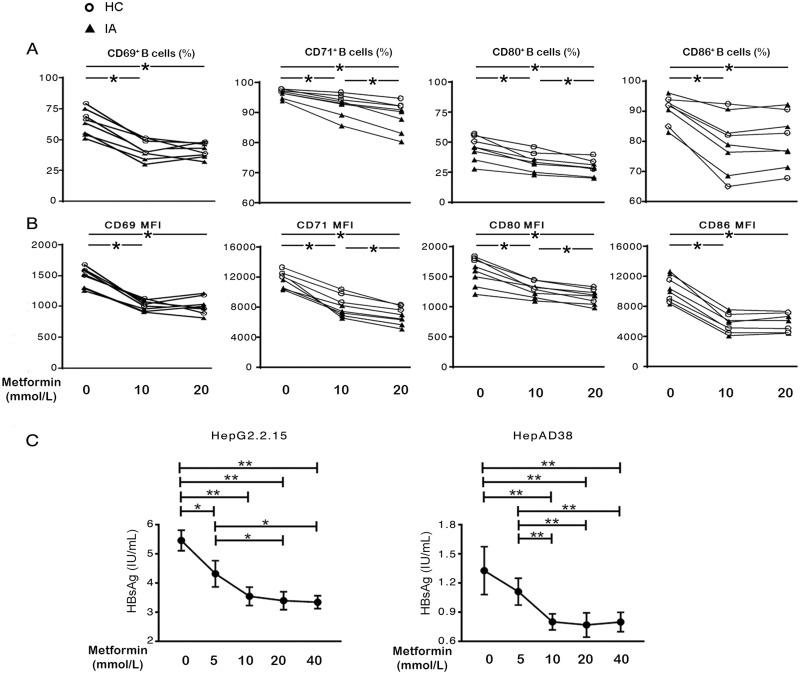
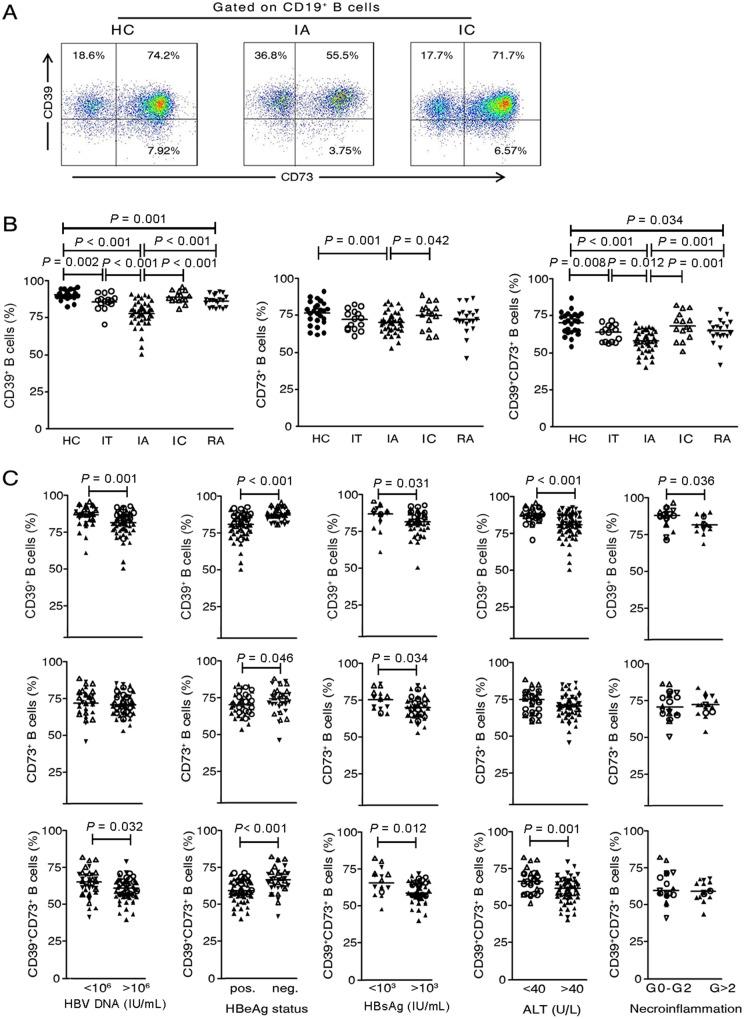
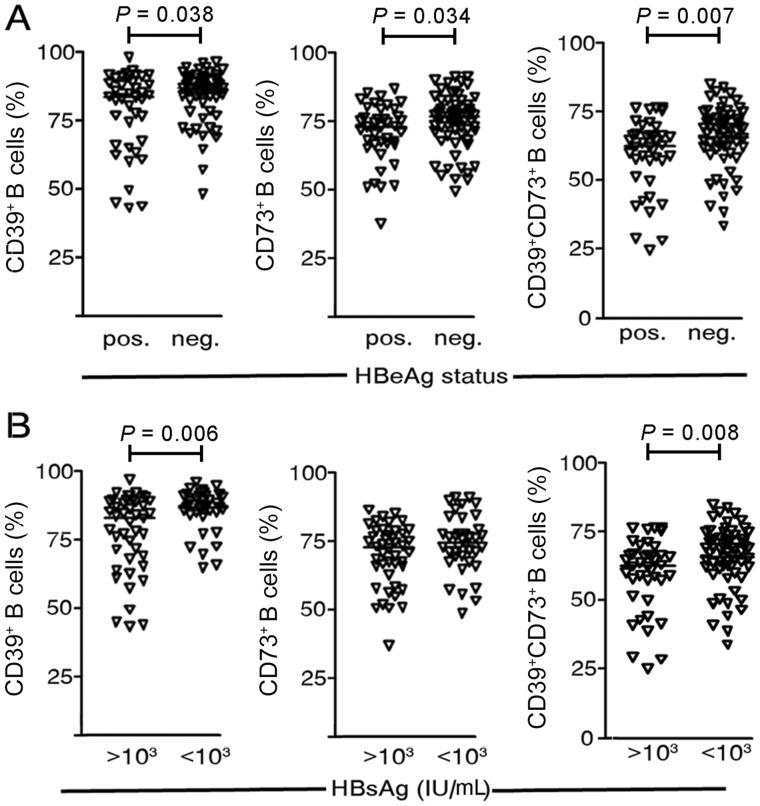
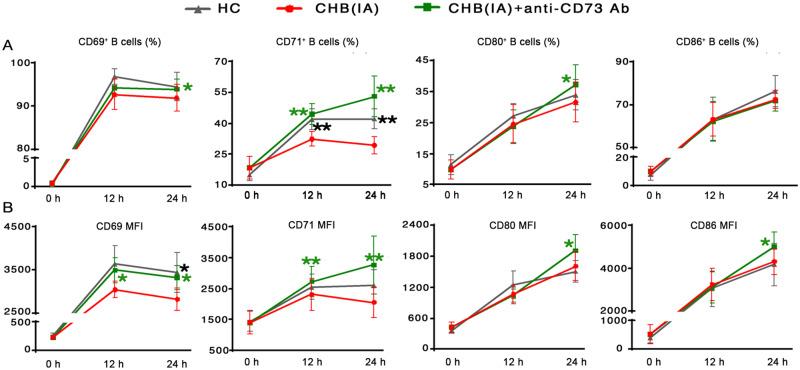
CD39 and CD73 expression on circulating B-cells was decreased in CHB patients with high HBV DNA, HBeAg positivity, high HBsAg levels, and active liver inflammation, and was hierarchically restored in complete responders according to HBeAg seroconversion or HBsAg reduction. However, CD39 and CD73 expression on activated memory and tissue-like memory B-cell subsets in complete responders was not increased despite effective antiviral treatments. Furthermore, CD39 and CD73 expression on intra-hepatic B-cells was decreased in inflammatory livers. , B-cells from CHB patients showed a markedly reduced capacity to generate CD39/CD73-dependent extracellular adenosine and expressed increased levels of activation markers after adenosine-production blockade. Contrastingly, metformin significantly reduced activation-marker expression via regulating AMP-activated protein kinase.
CONCLUSIONS
The skewed CD39 and CD73 expression on B-cells was associated with a high viral burden, liver inflammation, and antiviral efficacy in CHB patients, and the skewed CD39/CD73/adenosine pathway contributed to B-cell hyperactivation. Regulation of the CD39/CD73/adenosine pathway using metformin may represent a therapeutic option to reverse HBV-induced immune pathogenesis.
背景
慢性乙型肝炎病毒(HBV)感染患者B细胞过度活化的潜在机制在很大程度上仍不明确。本研究评估了慢性乙型肝炎(CHB)患者中CD39/CD73/腺苷途径的临床特征。
方法
我们检测了202例HBV感染患者B细胞的CD39和CD73表达以及腺苷生成情况。在用或不用腺苷途径阻断和激活的情况下,通过CpG + CD40配体刺激后,用流式细胞术评估B细胞活化表型。
结果
在HBV DNA水平高、HBeAg阳性、HBsAg水平高和有活动性肝脏炎症的CHB患者中,循环B细胞上的CD39和CD73表达降低,并根据HBeAg血清学转换或HBsAg降低在完全应答者中分层恢复。然而,尽管进行了有效的抗病毒治疗,完全应答者中活化记忆和组织样记忆B细胞亚群上的CD39和CD73表达并未增加。此外,炎症肝脏中肝内B细胞上的CD39和CD73表达降低。CHB患者的B细胞产生CD39/CD73依赖性细胞外腺苷的能力明显降低,并且在腺苷生成阻断后活化标志物水平升高。相反,二甲双胍通过调节AMP活化蛋白激酶显著降低活化标志物表达。
结论
CHB患者B细胞上CD39和CD73表达异常与高病毒载量、肝脏炎症和抗病毒疗效相关,且CD39/CD73/腺苷途径异常导致B细胞过度活化。使用二甲双胍调节CD39/CD73/腺苷途径可能是逆转HBV诱导的免疫发病机制的一种治疗选择。


 Zotero 插件