
ε2基因型对老年乳腺癌幸存者认知功能的保护作用:癌症生存者的思考与生活研究
Protective Effects of ε2 Genotype on Cognition in Older Breast Cancer Survivors: The Thinking and Living With Cancer Study.
作者信息
Van Dyk Kathleen, Zhou Xingtao, Small Brent J, Ahn Jaeil, Zhai Wanting, Ahles Tim, Graham Deena, Jacobsen Paul B, Jim Heather, McDonald Brenna C, Nudelman Holohan Kelly, Patel Sunita K, Rebeck G William, Root James C, Saykin Andrew J, Cohen Harvey Jay, Mandelblatt Jeanne S, Carroll Judith E
机构信息
UCLA Department of Psychiatry and Biobehavioral Sciences, University of California, Los Angeles, David Geffen School of Medicine, Jane and Terry Semel Institute for Neuroscience and Human Behavior, Jonsson Comprehensive Cancer Center, Los Angeles, CA, USA.
Department of Biostatistics, Bioinformatics and Biomathematics, Georgetown-Lombardi Comprehensive Cancer Center, Georgetown University, Washington, DC, USA.
出版信息
JNCI Cancer Spectr. 2021 Jan 27;5(2). doi: 10.1093/jncics/pkab013. eCollection 2021 Apr.
BACKGROUND
Cancer-related cognitive decline (CRCD) has been linked to apolipoprotein E () gene ε4 polymorphisms. ε4 polymorphisms are also the strongest genetic risk for late-onset Alzheimer disease (AD), whereas ε2 polymorphisms protect against AD. However, the effects of ε2 polymorphisms on CRCD have not been evaluated.
METHODS
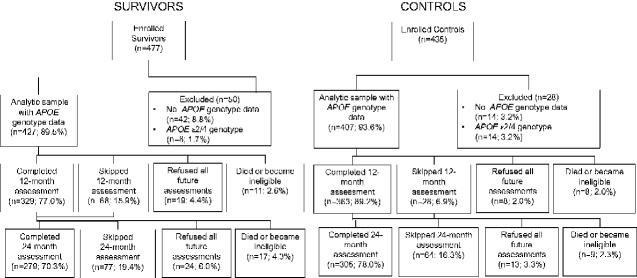
We evaluated nonmetastatic breast cancer survivors (n = 427) and matched noncancer controls (n = 407) ages 60-98 years assessed presystemic therapy from August 2010 to December 2017 with annual follow-up to 24 months. Neuropsychological assessment measured attention, processing speed, executive function, and learning and memory. Linear mixed-effects models tested the effects of having an ε2 allele (vs none) on longitudinal cognitive domain scores by treatment group (chemotherapy with or without hormonal therapy, hormonal therapy, and control) controlling for covariates; participants with ε2/ε4 genotype were excluded. Sensitivity analyses examined effects of other covariates and any ε4 positivity.
RESULTS
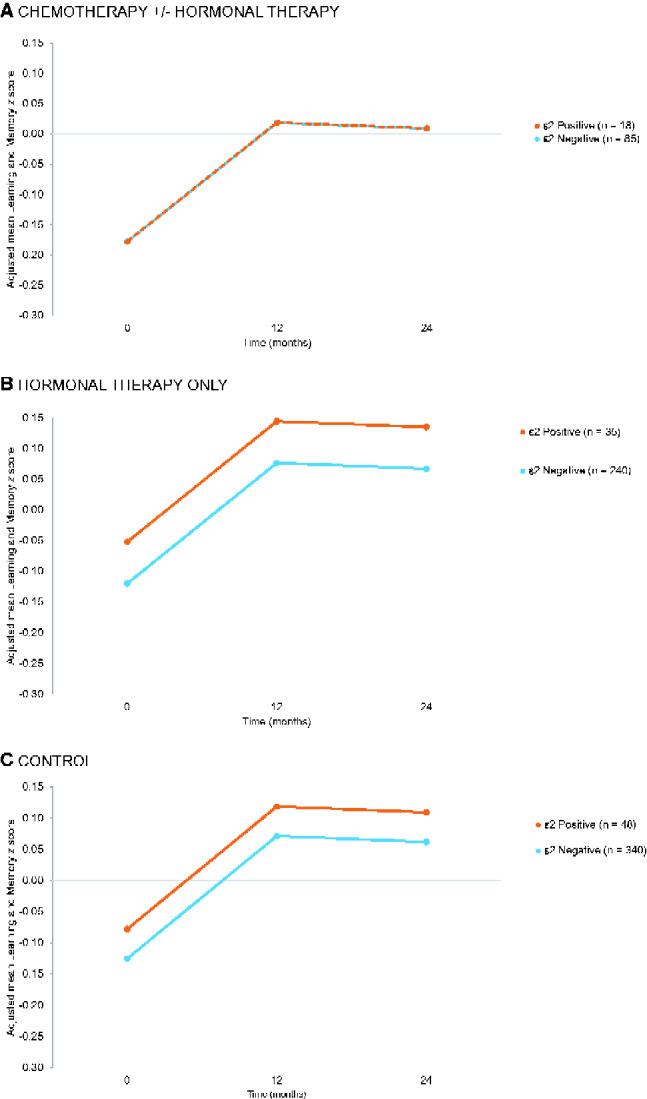
There was an interaction with genotype for attention, processing speed, and executive functioning domain scores (Beta = 0.32, 95% confidence interval = 0.00 to 0.65); the chemotherapy group with an ε2 allele had higher scores at baseline and maintained higher scores over time compared with those without an ε2 allele, and this protective effect was not seen for other groups. There was no effect of ε2 on learning and memory domain scores.
CONCLUSIONS
ε2 polymorphisms may protect against CRCD in older breast cancer survivors receiving chemotherapy. With replication, this information could be useful for survivorship care and informing future studies of possible links to AD and defining mechanisms of protection.
背景
癌症相关认知功能下降(CRCD)与载脂蛋白E(ApoE)基因ε4多态性有关。ε4多态性也是晚发型阿尔茨海默病(AD)最强的遗传风险因素,而ε2多态性可预防AD。然而,ε2多态性对CRCD的影响尚未得到评估。
方法
我们评估了427例非转移性乳腺癌幸存者和407例年龄在60 - 98岁的配对非癌症对照者,这些患者于2010年8月至2017年12月接受全身治疗前进行评估,并进行为期24个月的年度随访。神经心理学评估测量注意力、处理速度、执行功能以及学习和记忆。线性混合效应模型通过治疗组(化疗联合或不联合激素治疗、激素治疗以及对照组),在控制协变量的情况下,测试携带ε2等位基因(与不携带相比)对纵向认知领域得分的影响;排除携带ε2/ε4基因型的参与者。敏感性分析检查了其他协变量和任何ε4阳性的影响。
结果
在注意力、处理速度和执行功能领域得分方面存在基因型交互作用(β = 0.32,95%置信区间 = 0.00至0.65);与没有ε2等位基因的患者相比,携带ε2等位基因的化疗组在基线时得分更高,并且随着时间推移保持更高得分,而其他组未观察到这种保护作用。ε2对学习和记忆领域得分没有影响。
结论
ε2多态性可能对接受化疗的老年乳腺癌幸存者的CRCD具有保护作用。若能重复验证,该信息可能有助于癌症幸存者护理,并为未来关于与AD可能联系的研究以及确定保护机制提供参考。

 Zotero 插件