
认知卸载的后果:提高表现但降低记忆。
Consequences of cognitive offloading: Boosting performance but diminishing memory.
机构信息
Department of Psychology, University of Tübingen, Tübingen, Germany.
Department of Psychology, University of Graz, Graz, Austria.
出版信息
Q J Exp Psychol (Hove). 2021 Sep;74(9):1477-1496. doi: 10.1177/17470218211008060. Epub 2021 Apr 4.
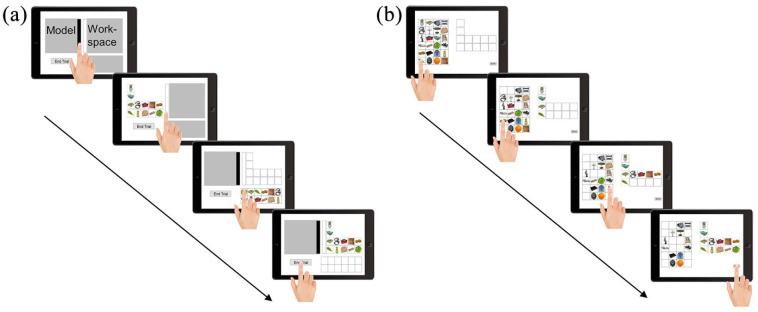
Modern technical tools such as tablets allow for the temporal externalisation of working memory processes (i.e., cognitive offloading). Although such externalisations support immediate performance on different tasks, little is known about potential long-term consequences of offloading behaviour. In the current set of experiments, we studied the relationship between cognitive offloading and subsequent memory for the offloaded information as well as the interplay of this relationship with the goal to acquire new memory representations. Our participants solved the Pattern Copy Task, in which we manipulated the costs of cognitive offloading and the awareness of a subsequent memory test. In Experiment 1 ( = 172), we showed that increasing the costs for offloading induces reduced offloading behaviour. This reduction in offloading came along with lower immediate task performance but more accurate memory in an unexpected test. In Experiment 2 ( = 172), we confirmed these findings and observed that offloading behaviour remained detrimental for subsequent memory performance when participants were aware of the upcoming memory test. Interestingly, Experiment 3 ( = 172) showed that cognitive offloading is not detrimental for long-term memory formation under all circumstances. Those participants who were forced to offload maximally but were aware of the memory test could almost completely counteract the negative impact of offloading on memory. Our experiments highlight the importance of the explicit goal to acquire new memory representations when relying on technical tools as offloading did have detrimental effects on memory without such a goal.
现代技术工具,如平板电脑,可以实现工作记忆过程的临时外化(即认知卸载)。虽然这种外化可以支持在不同任务上的即时表现,但对于卸载行为的潜在长期后果知之甚少。在当前的一系列实验中,我们研究了认知卸载与随后对卸载信息的记忆之间的关系,以及这种关系与获取新记忆表征的目标之间的相互作用。我们的参与者完成了模式复制任务,我们在该任务中操纵了认知卸载的成本和对后续记忆测试的意识。在实验 1(n=172)中,我们表明增加卸载成本会导致卸载行为减少。这种卸载减少伴随着即时任务表现的下降,但在意外测试中记忆更准确。在实验 2(n=172)中,我们证实了这些发现,并观察到当参与者意识到即将进行的记忆测试时,卸载行为仍然会对随后的记忆表现产生不利影响。有趣的是,实验 3(n=172)表明,在所有情况下,认知卸载对长期记忆形成都没有不利影响。那些被迫最大程度地卸载但意识到记忆测试的参与者几乎可以完全抵消卸载对记忆的负面影响。我们的实验强调了在依赖技术工具时明确获取新记忆表征的目标的重要性,因为如果没有这样的目标,卸载确实会对记忆产生不利影响。

 Zotero 插件