
肿瘤免疫与免疫治疗中的组织驻留记忆 T 细胞。
Tissue-resident memory T cells in tumor immunity and immunotherapy.
机构信息
Department of Surgery, University of Michigan Rogel Cancer Center, Ann Arbor, MI.
Center of Excellence for Cancer Immunology and Immunotherapy, University of Michigan Rogel Cancer Center, Ann Arbor, MI.
出版信息
J Exp Med. 2021 Apr 5;218(4). doi: 10.1084/jem.20201605.
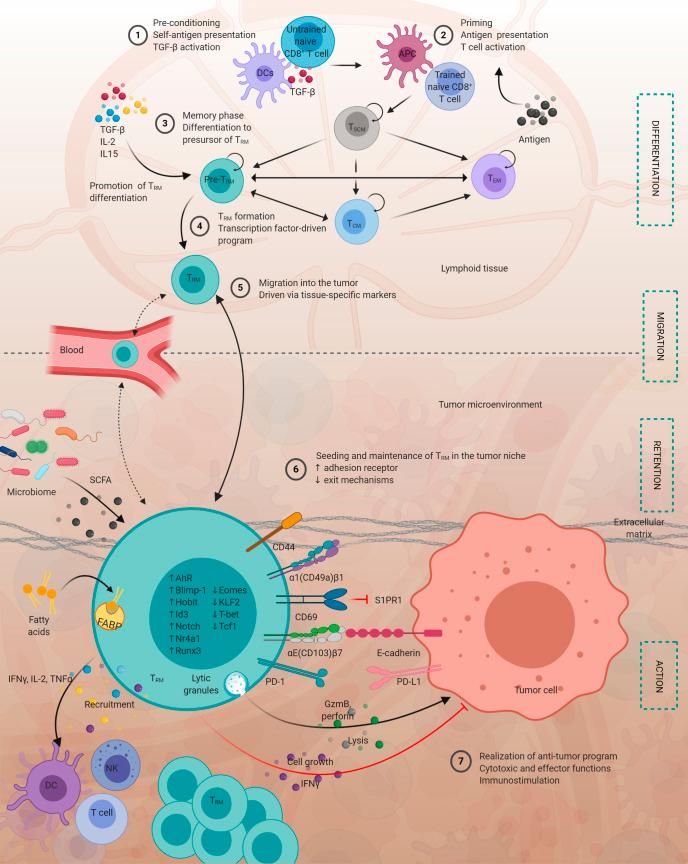
Tissue-resident memory T cells (TRM) represent a heterogeneous T cell population with the functionality of both effector and memory T cells. TRM express residence gene signatures. This feature allows them to traffic to, reside in, and potentially patrol peripheral tissues, thereby enforcing an efficient long-term immune-protective role. Recent studies have revealed TRM involvement in tumor immune responses. TRM tumor infiltration correlates with enhanced response to current immunotherapy and is often associated with favorable clinical outcome in patients with cancer. Thus, targeting TRM may lead to enhanced cancer immunotherapy efficacy. Here, we review and discuss recent advances on the nature of TRM in the context of tumor immunity and immunotherapy.
组织驻留记忆 T 细胞(TRM)代表了一类具有效应细胞和记忆细胞功能的异质性 T 细胞群体。TRM 表达归巢基因特征。这一特性使它们能够迁移到、驻留于并可能巡弋于外周组织,从而发挥有效的长期免疫保护作用。最近的研究揭示了 TRM 参与肿瘤免疫反应。TRM 浸润肿瘤与对当前免疫疗法的增强反应相关,并且经常与癌症患者的良好临床结局相关。因此,靶向 TRM 可能会提高癌症免疫疗法的疗效。在这里,我们综述并讨论了 TRM 在肿瘤免疫和免疫治疗背景下的本质的最新进展。

 Zotero 插件