
丹参酮 IIA 通过抑制心肌梗死后大鼠的氧化应激减轻心力衰竭。
Tanshinone IIA attenuates heart failure via inhibiting oxidative stress in myocardial infarction rats.
机构信息
Emergency Department, Affiliated Hospital of Nanjing University of Chinese Medicine, Jiangsu Province Hospital of Chinese Medicine, Nanjing, Jiangsu 210029, P.R. China.
Department of Rehabilitation Medicine, Zhongda Hospital Southeast University, Nanjing, Jiangsu 210009, P.R. China.
出版信息
Mol Med Rep. 2021 Jun;23(6). doi: 10.3892/mmr.2021.12043. Epub 2021 Mar 31.
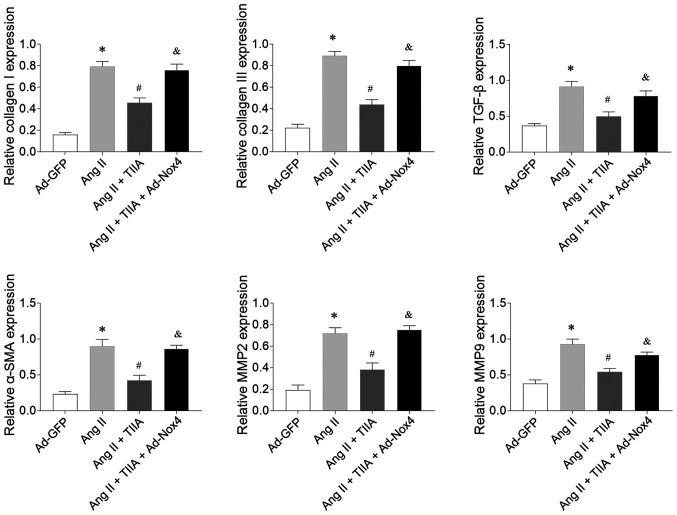
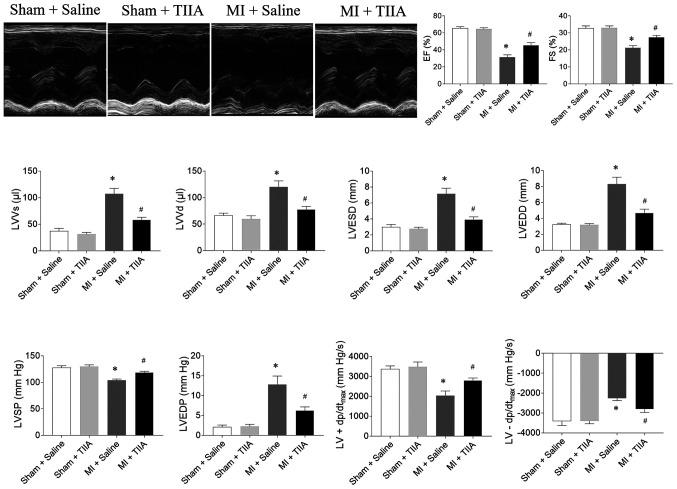
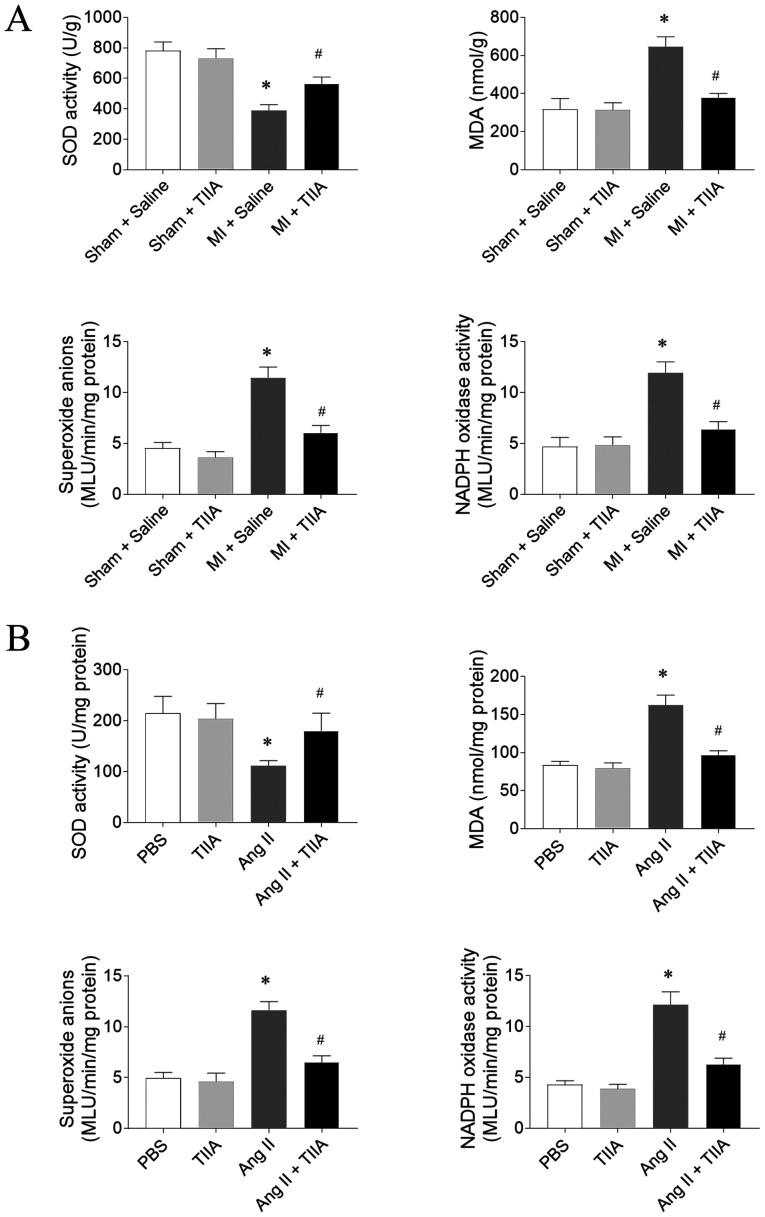
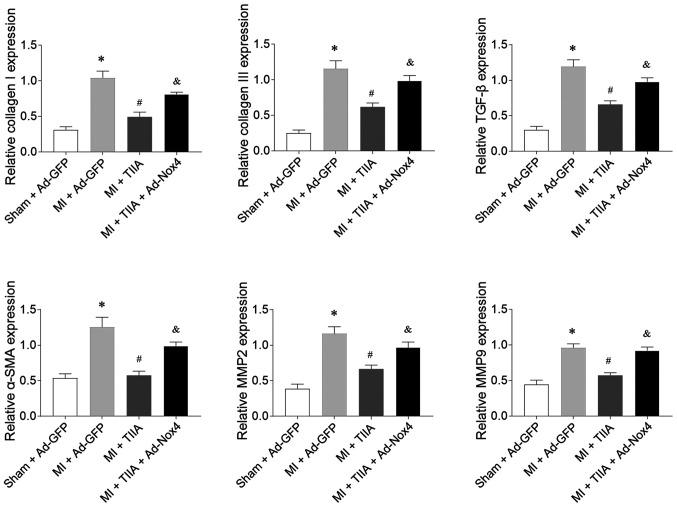
The purpose of the present study was to evaluate whether tanshinone IIA (TIIA) could treat cardiac dysfunction and fibrosis in heart failure (HF) by inhibiting oxidative stress. An HF model was induced by ligation of the left anterior descending artery to cause ischemia myocardial infarction (MI) in Sprague‑Dawley rats. Cardiac fibrosis was evaluated using Masson's staining, and the levels of collagen I, collagen III, TGF‑β, α‑smooth muscle actin (α‑SMA), matrix metalloproteinase (MMP) 2 and MMP9 were determined using PCR or western blotting. TIIA treatment reversed the decreases of left ventricular (LV) ejection fraction, fractional shortening (FS), LV systolic pressure and the maximum of the first differentiation of LV pressure (LV ± dp/dt), the increases of LV volume in systole, LV volume in diastole, LV end‑systolic diameter and LV end‑diastolic diameter in MI rats. TIIA administration also reversed the increases of expression levels of collagen I, collagen III, TGF‑β, α‑SMA, MMP2 and MMP9 in the heart of MI rats and in angiotensin (Ang) II‑treated cardiac fibroblasts (CFs). TIIA reversed the decreases of superoxide dismutase activity and malondialdehyde and the increases of superoxide anions and NADPH oxidase (Nox) activity in both MI rats and Ang II‑treated CFs. Nox4 overexpression inhibited the effects of TIIA of improving cardiac dysfunction and fibrosis in MI rats and Ang II‑treated CFs. These results demonstrated that TIIA improved cardiac dysfunction and fibrosis via inhibiting oxidative stress in HF rats. Nox4 could regulate the inhibitory effects of TIIA on HF and cardiac fibrosis.
本研究旨在评估丹参酮Ⅱ A(TIIA)是否通过抑制氧化应激来治疗心力衰竭(HF)中的心脏功能障碍和纤维化。通过结扎左前降支在 Sprague-Dawley 大鼠中诱导 HF 模型,导致缺血性心肌梗死(MI)。使用 Masson 染色评估心肌纤维化,并使用 PCR 或 Western blot 测定胶原 I、胶原 III、TGF-β、α-平滑肌肌动蛋白(α-SMA)、基质金属蛋白酶(MMP)2 和 MMP9 的水平。TIIA 治疗逆转了 MI 大鼠左心室(LV)射血分数、缩短分数(FS)、LV 收缩压和 LV 压力最大一阶导数(LV±dp/dt)降低、LV 收缩期容积增加、LV 舒张期容积增加、LV 收缩末期直径和 LV 舒张末期直径的增加。TIIA 给药还逆转了 MI 大鼠心脏和血管紧张素(Ang)II 处理的心肌成纤维细胞(CFs)中胶原 I、胶原 III、TGF-β、α-SMA、MMP2 和 MMP9 表达水平的升高。TIIA 逆转了 MI 大鼠和 Ang II 处理的 CFs 中超氧化物歧化酶活性和丙二醛降低以及超氧阴离子和 NADPH 氧化酶(Nox)活性升高。Nox4 过表达抑制了 TIIA 改善 MI 大鼠和 Ang II 处理的 CFs 中心脏功能障碍和纤维化的作用。这些结果表明,TIIA 通过抑制 HF 大鼠中的氧化应激改善了心脏功能障碍和纤维化。Nox4 可以调节 TIIA 对 HF 和心脏纤维化的抑制作用。



 Zotero 插件