
慢性病毒性肝炎期间的促纤维化信号与肝癌风险:生物标志物的开发
Profibrotic Signaling and HCC Risk during Chronic Viral Hepatitis: Biomarker Development.
作者信息
Virzì Alessia, Gonzalez-Motos Victor, Tripon Simona, Baumert Thomas F, Lupberger Joachim
机构信息
Université de Strasbourg, 67000 Strasbourg, France.
Institut National de la Santé et de la Recherche Médicale, U1110, Institut de Recherche sur les Maladies Virales et Hépatiques (IVH), 67000 Strasbourg, France.
出版信息
J Clin Med. 2021 Mar 2;10(5):977. doi: 10.3390/jcm10050977.
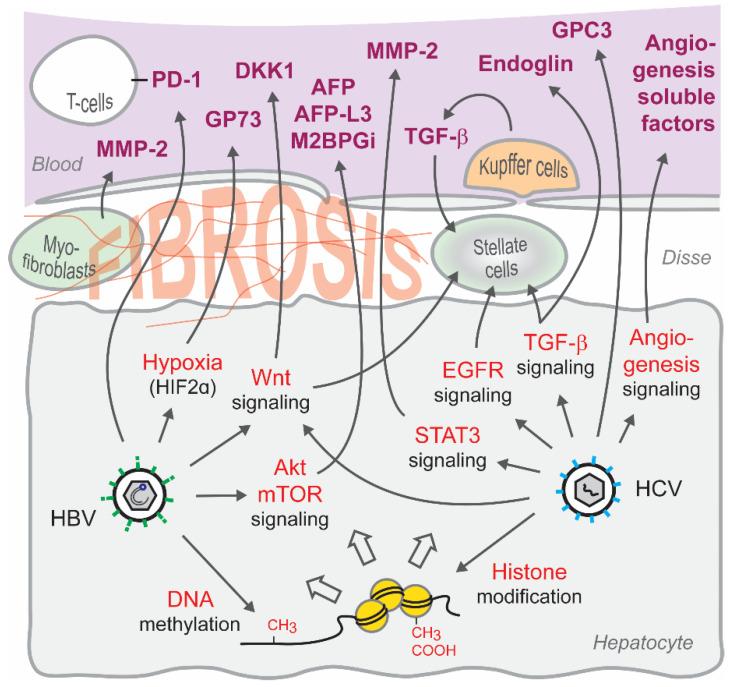
Despite breakthroughs in antiviral therapies, chronic viral hepatitis B and C are still the major causes of liver fibrosis and hepatocellular carcinoma (HCC). Importantly, even in patients with controlled infection or viral cure, the cancer risk cannot be fully eliminated, highlighting a persisting oncogenic pressure imposed by epigenetic imprinting and advanced liver disease. Reliable and minimally invasive biomarkers for early fibrosis and for residual HCC risk in HCV-cured patients are urgently needed. Chronic infection with HBV and/or HCV dysregulates oncogenic and profibrogenic signaling within the host, also displayed in the secretion of soluble factors to the blood. The study of virus-dysregulated signaling pathways may, therefore, contribute to the identification of reliable minimally invasive biomarkers for the detection of patients at early-stage liver disease potentially complementing existing noninvasive methods in clinics. With a focus on virus-induced signaling events, this review provides an overview of candidate blood biomarkers for liver disease and HCC risk associated with chronic viral hepatitis and epigenetic viral footprints.
尽管抗病毒治疗取得了突破,但慢性乙型和丙型病毒性肝炎仍然是肝纤维化和肝细胞癌(HCC)的主要病因。重要的是,即使在感染得到控制或病毒被清除的患者中,癌症风险也无法完全消除,这突出了表观遗传印记和晚期肝病所施加的持续致癌压力。迫切需要用于早期纤维化以及丙型肝炎治愈患者残余肝癌风险的可靠且微创的生物标志物。慢性乙型肝炎病毒(HBV)和/或丙型肝炎病毒(HCV)感染会使宿主内的致癌和促纤维化信号失调,这也体现在向血液中分泌可溶性因子上。因此,对病毒失调信号通路的研究可能有助于识别可靠的微创生物标志物,用于检测处于早期肝病阶段的患者,这可能会补充临床上现有的非侵入性方法。本文聚焦于病毒诱导的信号事件,概述了与慢性病毒性肝炎和表观遗传病毒印记相关的肝病和肝癌风险的候选血液生物标志物。
 Zotero 插件