
定量光谱芯片耦合侧向流动免疫测定法显示出克服2019冠状病毒病大流行筛查挑战的临床潜力。
Quantitative Spectrochip-Coupled Lateral Flow Immunoassay Demonstrates Clinical Potential for Overcoming Coronavirus Disease 2019 Pandemic Screening Challenges.
作者信息
Hung Kai-Feng, Hung Chih-Hsing, Hong Chitsung, Chen Szu-Chia, Sun Yi-Chen, Wen Jyun-Wei, Kuo Chao-Hung, Ko Cheng-Hao, Cheng Chao-Min
机构信息
Division of Translational Research, Department of Medical Research, Taipei Veterans General Hospital, Taipei 112, Taiwan.
Department of Dentistry, School of Dentistry, National Yang-Ming University, Taipei 112, Taiwan.
出版信息
Micromachines (Basel). 2021 Mar 18;12(3):321. doi: 10.3390/mi12030321.
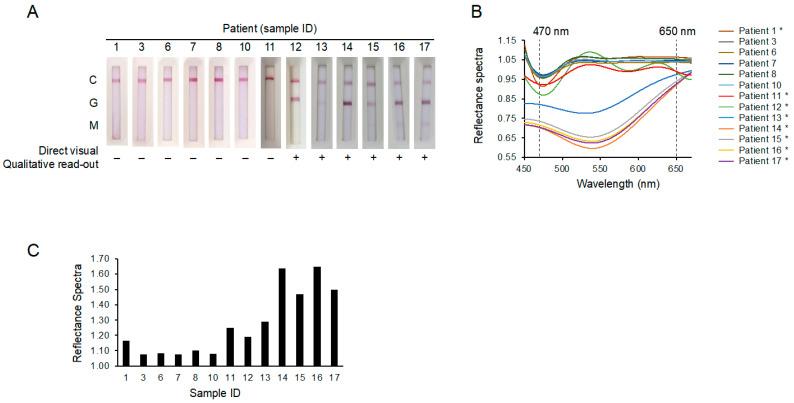
As coronavirus disease 2019 (COVID-19) continues to spread around the world, the establishment of decentralized severe acute respiratory syndrome coronavirus-2 (SARS-CoV-2) diagnostics and point-of-care testing is invaluable. While polymerase chain reaction (PCR) has been the gold standard for COVID-19 screening, serological assays detecting anti-SARS-CoV-2 antibodies in response to past and/or current infection remain vital tools. In particular, lateral flow immunoassay devices are easy to produce, scale, distribute, and use; however, they are unable to provide quantitative information. To enable quantitative analysis of lateral flow immunoassay device results, microgating technology was used to develop an innovative spectrochip that can be integrated into a portable, palm-sized device that was capable of capturing high-resolution reflectance spectrum data for quantitative immunoassay diagnostics. Using predefined spiked concentrations of recombinant anti-SARS-CoV-2 immunoglobulin G (IgG), this spectrochip-coupled immunoassay provided extraordinary sensitivity, with a detection limit as low as 186 pg/mL. Furthermore, this platform enabled the detection of anti-SARS-CoV-2 IgG in all PCR-confirmed patients as early as day 3 after symptom onset, including two patients whose spectrochip tests would be regarded as negative for COVID-19 using a direct visual read-out without spectral analysis. Therefore, the quantitative lateral flow immunoassay with an exceptionally low detection limit for SARS-CoV-2 is of value. An increase in the number of patients tested with this novel device may reveal its true clinical potential.
随着2019冠状病毒病(COVID-19)在全球持续蔓延,建立分散式严重急性呼吸综合征冠状病毒2(SARS-CoV-2)诊断方法和即时检测至关重要。虽然聚合酶链反应(PCR)一直是COVID-19筛查的金标准,但检测针对既往和/或当前感染产生的抗SARS-CoV-2抗体的血清学检测仍然是重要工具。特别是,侧向流动免疫分析装置易于生产、扩大规模、分发和使用;然而,它们无法提供定量信息。为了能够对侧向流动免疫分析装置的结果进行定量分析,微门控技术被用于开发一种创新的光谱芯片,该芯片可集成到一个便携式手掌大小的设备中,该设备能够捕获高分辨率反射光谱数据用于定量免疫分析诊断。使用预定义的重组抗SARS-CoV-2免疫球蛋白G(IgG)加标浓度,这种光谱芯片偶联免疫分析具有非凡的灵敏度,检测限低至186 pg/mL。此外,该平台能够在症状出现后第3天就检测出所有PCR确诊患者中的抗SARS-CoV-2 IgG,包括两名患者,若使用直接目视读数而不进行光谱分析,其光谱芯片检测结果会被视为COVID-19阴性。因此,对SARS-CoV-2检测限极低的定量侧向流动免疫分析具有重要价值。使用这种新型设备进行检测的患者数量增加可能会揭示其真正的临床潜力。


 Zotero 插件