
结肠癌患者结肠肿瘤组织预测分期的潜力及其与口腔微生物丰度的相互作用。
The Potential of Colonic Tumor Tissue to Predict Staging and Its Interplay with Oral Abundance in Colon Cancer Patients.
作者信息
Pignatelli Pamela, Iezzi Lorena, Pennese Martina, Raimondi Paolo, Cichella Anna, Bondi Danilo, Grande Rossella, Cotellese Roberto, Di Bartolomeo Nicola, Innocenti Paolo, Piattelli Adriano, Curia Maria Cristina
机构信息
Department of Medical, Oral and Biotechnological Sciences, "G. d'Annunzio" University of Chieti-Pescara, Via dei Vestini, 66100 Chieti, Italy.
Department of General Surgery, Private Hospital "Villa Serena", Città Sant'Angelo, 65013 Pescara, Italy.
出版信息
Cancers (Basel). 2021 Mar 1;13(5):1032. doi: 10.3390/cancers13051032.
BACKGROUND
Intestinal microbiota dysbiosis may enhance the carcinogenicity of colon cancer (CC) by the proliferation and differentiation of epithelial cells. Oral () and () have the ability to invade the gut epithelium, promoting tumor progression. The aim of the study was to assess whether the abundance of these odontopathogenic bacteria was associated with colon cancer. We also investigated how lifestyle factors could influence the oral and abundance and CC.
METHODS
Thirty-six CC patients were included in the study to assess the and oral and colon tissue abundance by qPCR. Oral health data, food habits and lifestyles were also recorded.
RESULTS
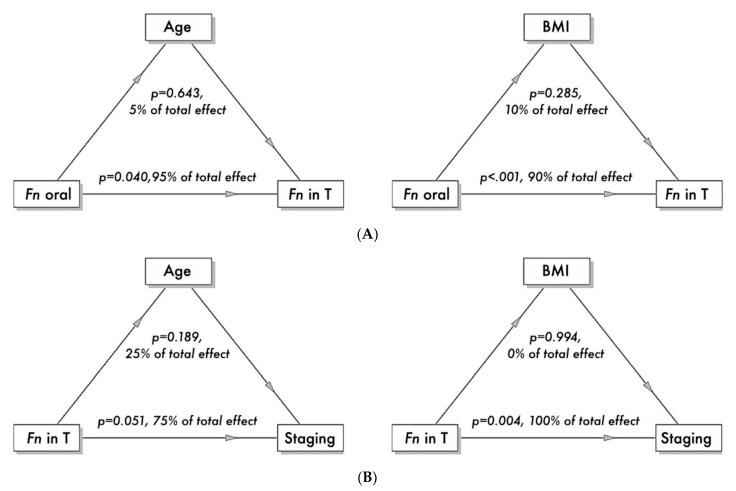
Patients had a greater quantity of in the oral cavity than matched CC and adjacent non-neoplastic mucosa (adj t) tissues ( = 0.004 and < 0.001). Instead, was not significantly detected in colonic tissues. There was an association between the quantity in the oral and CC tissue and a statistically significant relation between the abundance in adenocarcinoma (ADK) and staging ( = 0.016). The statistical analysis revealed a tendency towards a greater quantity in CC ( = 0.073, η = 0.12) for high-meat consumers.
CONCLUSION
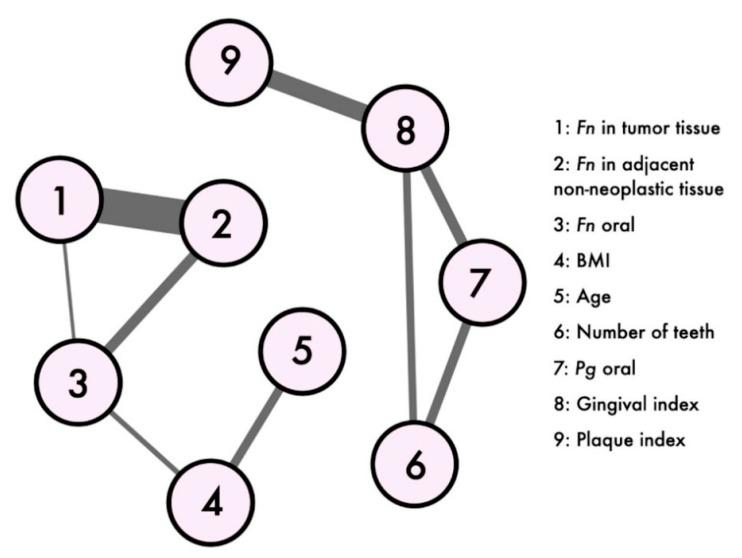
In our study, was absent in colon tissues but was correlated with the oral inflammation gingival and plaque indices. For the first time, there was evidence that the oral concentration can influence colon tissue concentrations and predict CC prognosis.
背景
肠道微生物群失调可能通过上皮细胞的增殖和分化增强结肠癌(CC)的致癌性。口腔()和()具有侵入肠道上皮的能力,促进肿瘤进展。本研究的目的是评估这些致龋病原菌的丰度是否与结肠癌相关。我们还研究了生活方式因素如何影响口腔()和()的丰度以及结肠癌。
方法
本研究纳入了36例结肠癌患者,通过定量聚合酶链反应(qPCR)评估口腔和结肠组织中()和()的丰度。还记录了口腔健康数据、饮食习惯和生活方式。
结果
患者口腔中的()数量高于匹配的结肠癌组织和相邻的非肿瘤性黏膜(adj t)组织(=0.004,<0.001)。相反,在结肠组织中未显著检测到()。口腔中()的数量与结肠癌组织之间存在关联,腺癌(ADK)中()的丰度与分期之间存在统计学显著关系(=0.016)。统计分析显示,高肉类消费者的结肠癌组织中()数量有增加的趋势(=0.073,η=0.12)。
结论
在我们的研究中,结肠组织中不存在(),但其与口腔炎症牙龈指数和菌斑指数相关。首次有证据表明,口腔中()的浓度可影响结肠组织浓度并预测结肠癌预后。

 Zotero 插件