
免疫功能正常个体中 CMV 相关性前葡萄膜炎的自然杀伤细胞分子特征:一种新型 CMV 诱导疾病。
Molecular Signatures of Natural Killer Cells in CMV-Associated Anterior Uveitis, A New Type of CMV-Induced Disease in Immunocompetent Individuals.
机构信息
Department of Ocular Pathology and Imaging Science, Kyushu University, Fukuoka 812-8582, Japan.
Singapore Eye Research Institute, Singapore 168751, Singapore.
出版信息
Int J Mol Sci. 2021 Mar 31;22(7):3623. doi: 10.3390/ijms22073623.
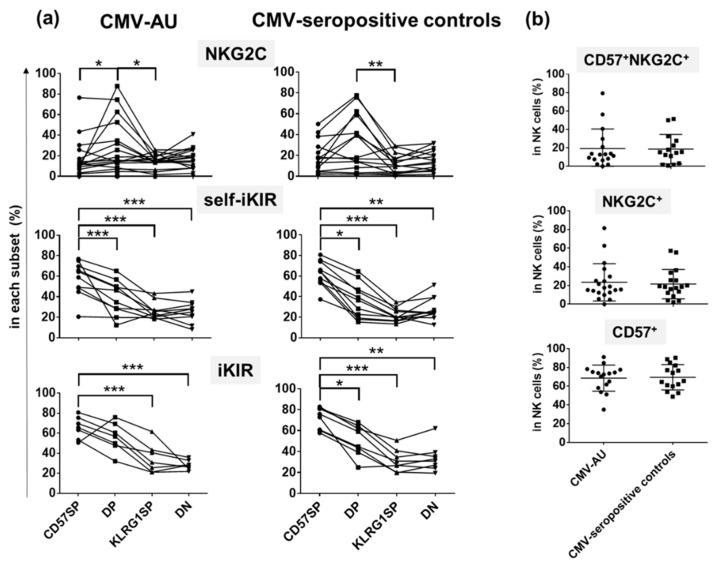
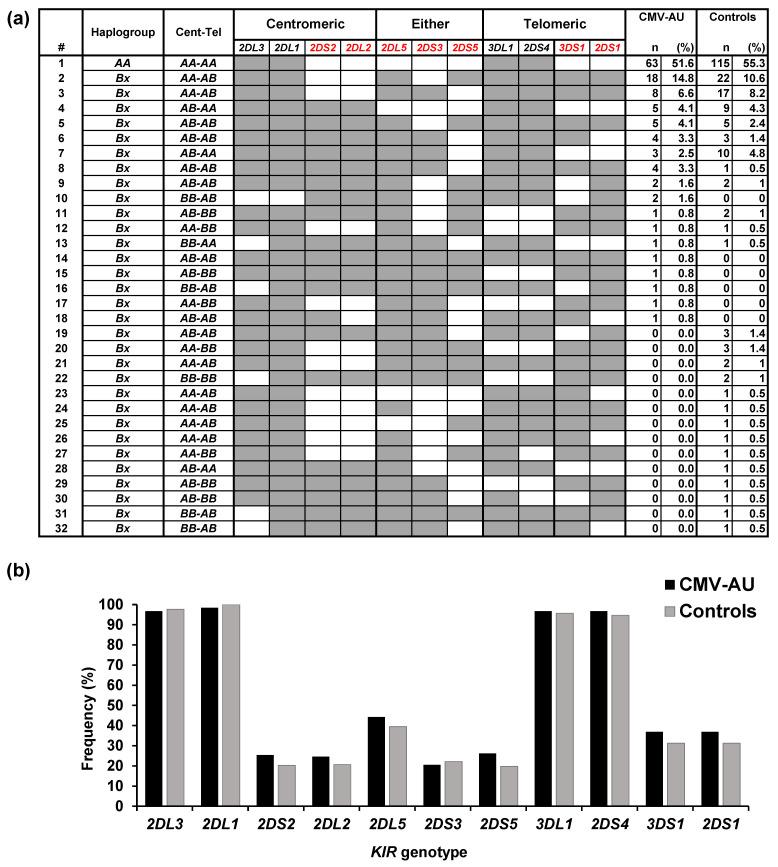
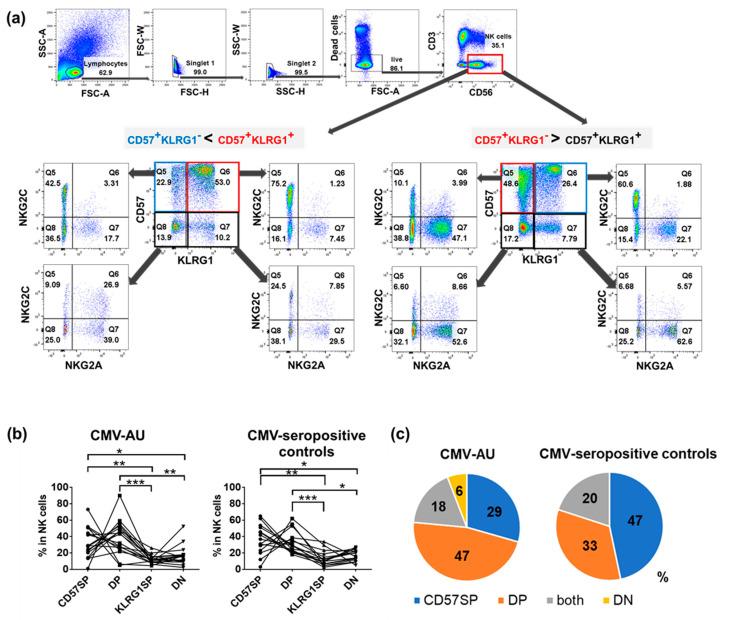
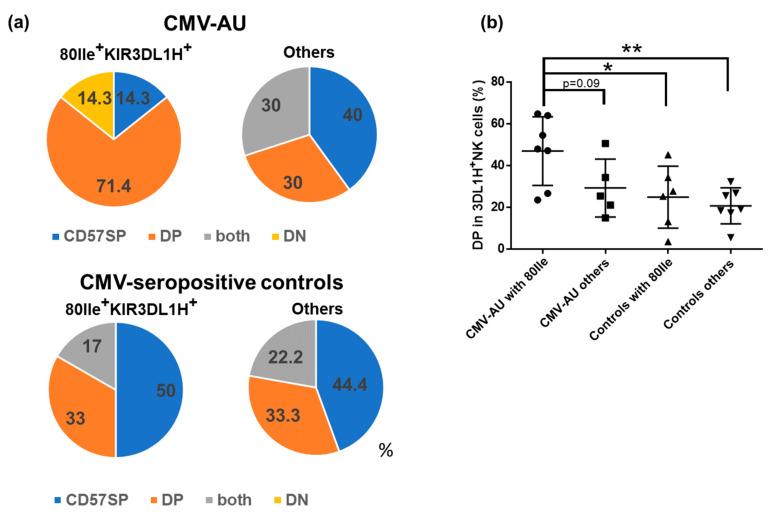
Cytomegalovirus (CMV) causes clinical issues primarily in immune-suppressed conditions. CMV-associated anterior uveitis (CMV-AU) is a notable new disease entity manifesting recurrent ocular inflammation in immunocompetent individuals. As patient demographics indicated contributions from genetic background and immunosenescence as possible underlying pathological mechanisms, we analyzed the immunogenetics of the cohort in conjunction with cell phenotypes to identify molecular signatures of CMV-AU. Among the immune cell types, natural killer (NK) cells are main responders against CMV. Therefore, we first characterized variants of polymorphic genes that encode differences in CMV-related human NK cell responses (Killer cell Immunoglobulin-like Receptors () and ) in 122 CMV-AU patients. The cases were then stratified according to their genetic features and NK cells were analyzed for human CMV-related markers (CD57, KLRG1, NKG2C) by flow cytometry. and combinations encoding strong receptor-ligand interactions were present at substantially higher frequencies in CMV-AU. In these cases, NK cell profiling revealed expansion of the subset co-expressing CD57 and KLRG1, and together with KIR3DL1 and the CMV-recognizing NKG2C receptor. The findings imply that a mechanism of CMV-AU pathogenesis likely involves CMV-responding NK cells co-expressing CD57/KLRG1/NKG2C that develop on a genetic background of KIR3DL1/HLA-B allotypes encoding strong receptor-ligand interactions.
巨细胞病毒 (CMV) 主要在免疫抑制条件下引起临床问题。与巨细胞病毒相关的前葡萄膜炎 (CMV-AU) 是一种新的显著疾病实体,表现为免疫功能正常个体的复发性眼内炎症。由于患者人群表明遗传背景和免疫衰老可能是潜在的病理机制,我们分析了队列的免疫遗传学与细胞表型相结合,以确定 CMV-AU 的分子特征。在免疫细胞类型中,自然杀伤 (NK) 细胞是针对 CMV 的主要反应细胞。因此,我们首先描述了编码与 CMV 相关的人类 NK 细胞反应差异的多态基因(杀伤细胞免疫球蛋白样受体 (KIR) 和 )的变体,在 122 例 CMV-AU 患者中。然后根据其遗传特征对病例进行分层,并通过流式细胞术分析人类 CMV 相关标志物(CD57、KLRG1、NKG2C)的 NK 细胞。编码强受体-配体相互作用的 和 组合在 CMV-AU 中以高得多的频率存在。在这些情况下,NK 细胞分析显示共表达 CD57 和 KLRG1 的亚群扩增,以及与 KIR3DL1 和识别 CMV 的 NKG2C 受体一起。这些发现表明,CMV-AU 发病机制的一种机制可能涉及共表达 CD57/KLRG1/NKG2C 的 CMV 反应性 NK 细胞,这些细胞在编码强受体-配体相互作用的 KIR3DL1/HLA-B 同种异型的遗传背景上发展。
 Zotero 插件