
MAMs 结构及其在细胞死亡中的作用。
The MAMs Structure and Its Role in Cell Death.
机构信息
China Japan Union Hospital, Jilin University, Changchun 130031, China.
Key Laboratory of Pathobiology, Ministry of Education, Department of Pathophysiology, College of Basic Medical Sciences, Jilin University, Changchun 130012, China.
出版信息
Cells. 2021 Mar 16;10(3):657. doi: 10.3390/cells10030657.
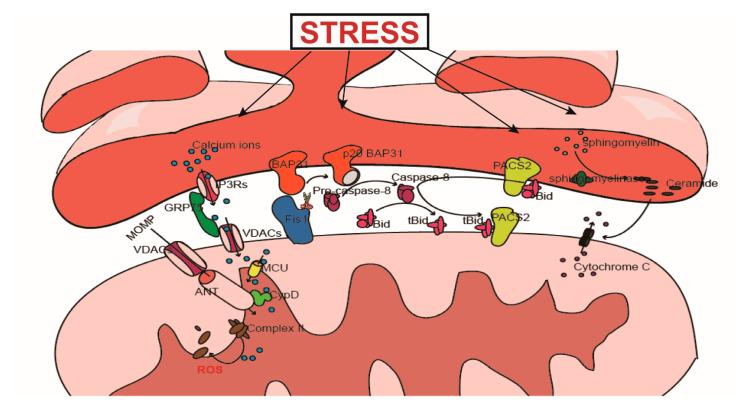
The maintenance of cellular homeostasis involves the participation of multiple organelles. These organelles are associated in space and time, and either cooperate or antagonize each other with regards to cell function. Crosstalk between organelles has become a significant topic in research over recent decades. We believe that signal transduction between organelles, especially the endoplasmic reticulum (ER) and mitochondria, is a factor that can influence the cell fate. As the cellular center for protein folding and modification, the endoplasmic reticulum can influence a range of physiological processes by regulating the quantity and quality of proteins. Mitochondria, as the cellular "energy factory," are also involved in cell death processes. Some researchers regard the ER as the sensor of cellular stress and the mitochondria as an important actuator of the stress response. The scientific community now believe that bidirectional communication between the ER and the mitochondria can influence cell death. Recent studies revealed that the death signals can shuttle between the two organelles. Mitochondria-associated membranes (MAMs) play a vital role in the complex crosstalk between the ER and mitochondria. MAMs are known to play an important role in lipid synthesis, the regulation of Ca homeostasis, the coordination of ER-mitochondrial function, and the transduction of death signals between the ER and the mitochondria. Clarifying the structure and function of MAMs will provide new concepts for studying the pathological mechanisms associated with neurodegenerative diseases, aging, and cancers. Here, we review the recent studies of the structure and function of MAMs and its roles involved in cell death, especially in apoptosis.
细胞内稳态的维持涉及多个细胞器的参与。这些细胞器在空间和时间上相互关联,在细胞功能方面既相互合作又相互拮抗。细胞器之间的串扰是近几十年来研究的一个重要课题。我们认为细胞器之间的信号转导,特别是内质网(ER)和线粒体之间的信号转导,是影响细胞命运的一个因素。作为细胞内蛋白质折叠和修饰的中心,内质网可以通过调节蛋白质的数量和质量来影响多种生理过程。线粒体作为细胞的“能量工厂”,也参与细胞死亡过程。一些研究人员将内质网视为细胞应激的传感器,将线粒体视为应激反应的重要执行器。科学界现在认为,内质网和线粒体之间的双向通讯可以影响细胞死亡。最近的研究表明,死亡信号可以在这两个细胞器之间穿梭。内质网-线粒体连接相关膜(MAMs)在 ER 和线粒体之间的复杂串扰中起着至关重要的作用。MAMs 已知在脂质合成、Ca 离子稳态的调节、ER-线粒体功能的协调以及 ER 和线粒体之间的死亡信号转导中发挥着重要作用。阐明 MAMs 的结构和功能将为研究与神经退行性疾病、衰老和癌症相关的病理机制提供新的概念。在这里,我们回顾了 MAMs 的结构和功能及其在细胞死亡,特别是细胞凋亡中的作用的最新研究。

 Zotero 插件