
关于Th1/Th2效应细胞选择认识的最新进展。
Recent advances in understanding the Th1/Th2 effector choice.
作者信息
Butcher Matthew J, Zhu Jinfang
机构信息
Molecular and Cellular Immunoregulation Section, Laboratory of Immune System Biology, National Institute of Allergy and Infectious Diseases, National Institutes of Health, Bethesda, MD, USA.
出版信息
Fac Rev. 2021 Mar 15;10:30. doi: 10.12703/r/10-30. eCollection 2021.
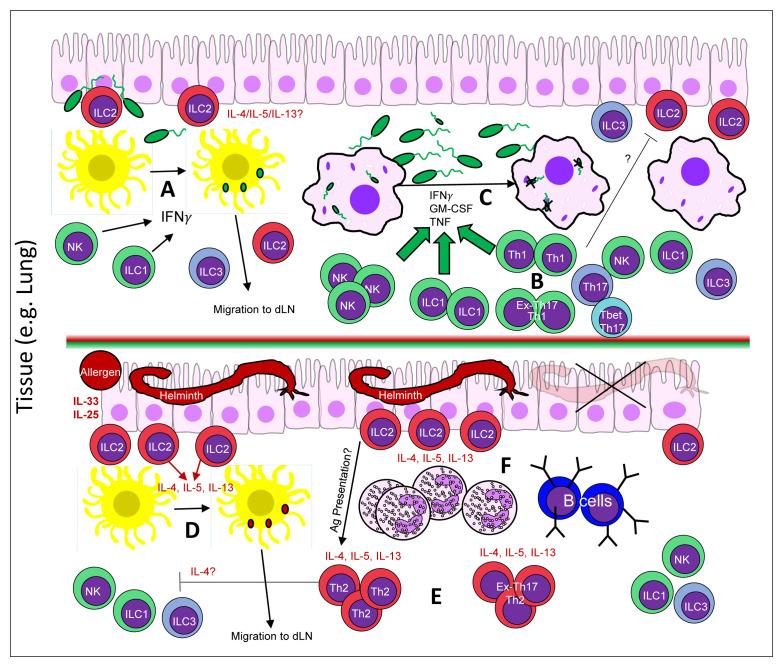
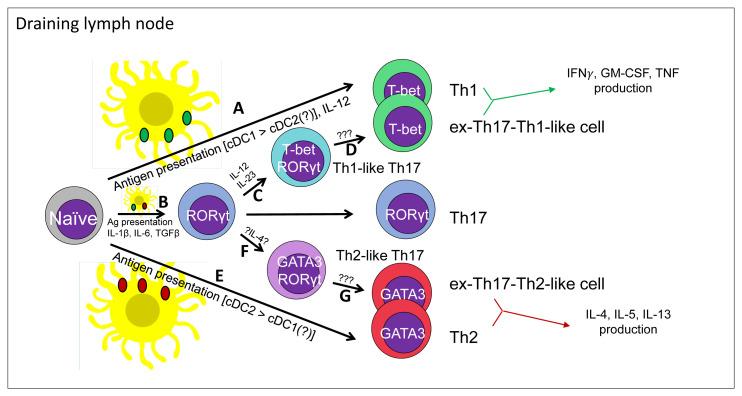
For over 35 years since Mosmann and Coffman proposed the seminal "type 1 T helper (Th1)/type 2 T helper (Th2)" hypothesis in 1986, the immunological community has appreciated that naïve CD4 T cells need to make important decisions upon their activation, namely to differentiate towards a Th1, Th2, Th17 (interleukin-17-producing T helper), follicular T helper (Tfh), or regulatory T cell (Treg) fate to orchestrate a variety of adaptive immune responses. The major molecular underpinnings of the Th1/Th2 effector fate choice had been initially characterized using excellent reductionist culture systems, through which the transcription factors T-bet and GATA3 were identified as the master regulators for the differentiation of Th1 and Th2 cells, respectively. However, Th1/Th2 cell differentiation and their cellular heterogeneity are usually determined by a combinatorial expression of multiple transcription factors, particularly , where dendritic cell (DC) and innate lymphoid cell (ILC) subsets can also influence T helper lineage choices. In addition, inflammatory cytokines that are capable of inducing Th17 cell differentiation are also found to be induced during typical Th1- or Th2-related immune responses, resulting in an alternative differentiation pathway, transiting from a Th17 cell phenotype towards Th1 or Th2 cells. In this review, we will discuss the recent advances in the field, focusing on some new players in the transcriptional network, contributions of DCs and ILCs, and alternative differentiation pathways towards understanding the Th1/Th2 effector choice .
自1986年莫斯曼和科夫曼提出开创性的“1型辅助性T细胞(Th1)/2型辅助性T细胞(Th2)”假说以来的35年多时间里,免疫学界已经认识到,初始CD4 T细胞在激活后需要做出重要决定,即向Th1、Th2、Th17(产生白细胞介素-17的辅助性T细胞)、滤泡辅助性T细胞(Tfh)或调节性T细胞(Treg)命运分化,以协调各种适应性免疫反应。Th1/Th2效应细胞命运选择的主要分子基础最初是通过优秀的简化培养系统来表征的,通过该系统,转录因子T-bet和GATA3分别被确定为Th1和Th2细胞分化的主要调节因子。然而,Th1/Th2细胞分化及其细胞异质性通常由多种转录因子的组合表达决定,特别是树突状细胞(DC)和固有淋巴细胞(ILC)亚群也会影响辅助性T细胞谱系选择。此外,在典型的Th1或Th2相关免疫反应中也发现能够诱导Th17细胞分化的炎性细胞因子,从而产生一条从Th17细胞表型向Th1或Th2细胞转变的替代分化途径。在这篇综述中,我们将讨论该领域的最新进展,重点关注转录网络中的一些新参与者、DC和ILC的作用以及替代分化途径,以理解Th1/Th2效应细胞的选择。
 Zotero 插件