
5-氟尿嘧啶阻断生物膜嵌入的耐甲氧西林金黄色葡萄球菌在小鼠体内的群体感应。
5-Fluorouracil blocks quorum-sensing of biofilm-embedded methicillin-resistant Staphylococcus aureus in mice.
机构信息
Department of Biosystems Science and Engineering, ETH Zürich, Mattenstrasse 26, CH-4058 Basel, Switzerland.
Laboratory of Infection Biology, Department of Biomedicine, University and University Hospital Basel, Hebelstrasse 20, CH-4031 Basel, Switzerland.
出版信息
Nucleic Acids Res. 2021 Jul 21;49(13):e73. doi: 10.1093/nar/gkab251.
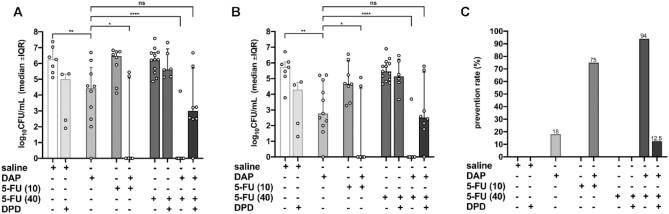
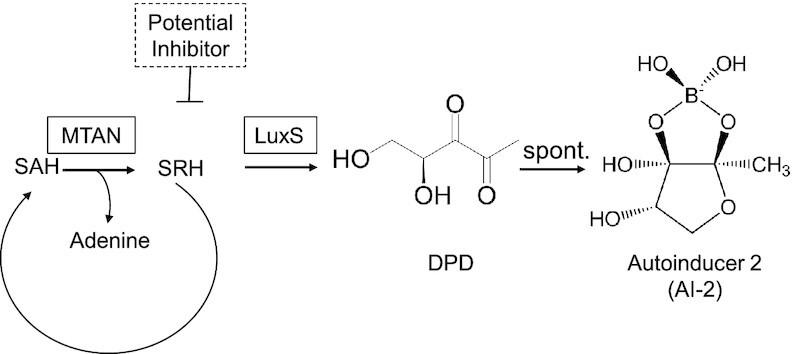
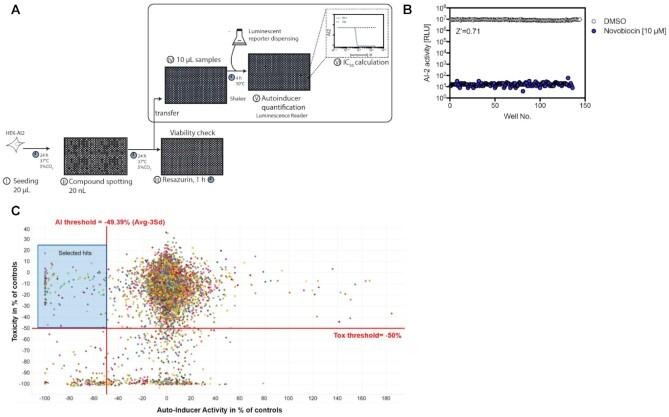
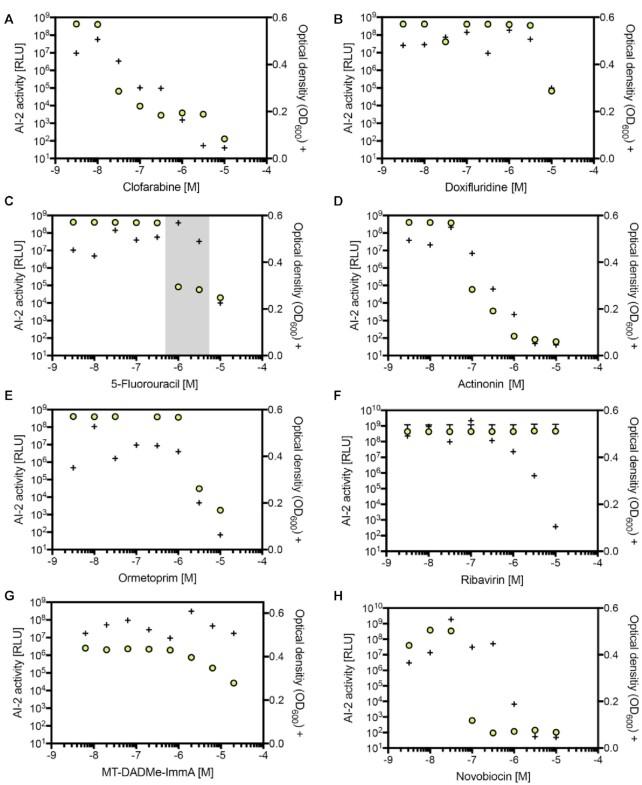
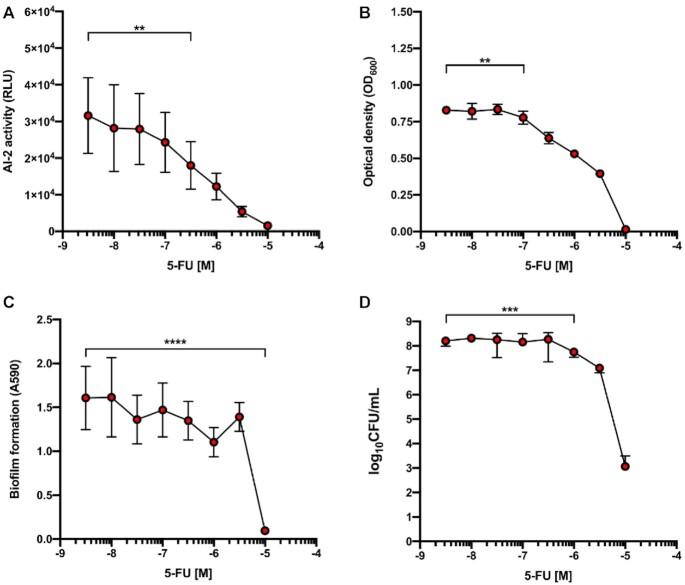
Antibiotic-resistant pathogens often escape antimicrobial treatment by forming protective biofilms in response to quorum-sensing communication via diffusible autoinducers. Biofilm formation by the nosocomial pathogen methicillin-resistant Staphylococcus aureus (MRSA) is triggered by the quorum-sensor autoinducer-2 (AI-2), whose biosynthesis is mediated by methylthioadenosine/S-adenosylhomocysteine nucleosidase (MTAN) and S-ribosylhomocysteine lyase (LuxS). Here, we present a high-throughput screening platform for small-molecular inhibitors of either enzyme. This platform employs a cell-based assay to report non-toxic, bioavailable and cell-penetrating inhibitors of AI-2 production, utilizing engineered human cells programmed to constitutively secrete AI-2 by tapping into the endogenous methylation cycle via ectopic expression of codon-optimized MTAN and LuxS. Screening of a library of over 5000 commercial compounds yielded 66 hits, including the FDA-licensed cytostatic anti-cancer drug 5-fluorouracil (5-FU). Secondary screening and validation studies showed that 5-FU is a potent quorum-quencher, inhibiting AI-2 production and release by MRSA, Staphylococcus epidermidis, Escherichia coli and Vibrio harveyi. 5-FU efficiently reduced adherence and blocked biofilm formation of MRSA in vitro at an order-of-magnitude-lower concentration than that clinically relevant for anti-cancer therapy. Furthermore, 5-FU reestablished antibiotic susceptibility and enabled daptomycin-mediated prevention and clearance of MRSA infection in a mouse model of human implant-associated infection.
抗生素耐药病原体通常通过形成保护性生物膜来逃避抗菌治疗,以响应通过可扩散自诱导物进行的群体感应通讯。医院病原体耐甲氧西林金黄色葡萄球菌 (MRSA) 的生物膜形成是由群体感应传感器自诱导物-2 (AI-2) 触发的,其生物合成由甲基硫腺苷/S-腺苷同型半胱氨酸核苷酶 (MTAN) 和 S-核糖同型半胱氨酸裂解酶 (LuxS) 介导。在这里,我们提出了一种用于两种酶的小分子抑制剂的高通量筛选平台。该平台采用基于细胞的测定法来报告非毒性、可生物利用和细胞穿透的 AI-2 产生抑制剂,利用经过工程改造的人类细胞,通过异位表达密码子优化的 MTAN 和 LuxS 利用内源性甲基化循环,持续分泌 AI-2。对超过 5000 种商业化合物文库进行筛选,得到了 66 个阳性化合物,包括美国食品和药物管理局 (FDA) 批准的细胞毒性抗癌药物 5-氟尿嘧啶 (5-FU)。二次筛选和验证研究表明,5-FU 是一种有效的群体感应淬灭剂,可抑制 MRSA、表皮葡萄球菌、大肠杆菌和哈维氏弧菌的 AI-2 产生和释放。与抗癌治疗相关的临床相关浓度相比,5-FU 在体外以数量级降低的浓度有效降低了 MRSA 的黏附和阻止了生物膜的形成。此外,5-FU 恢复了抗生素敏感性,并使达托霉素能够预防和清除人植入物相关感染的 MRSA 感染的小鼠模型中的感染。

 Zotero 插件