
在资源匮乏环境下,医疗保健提供者对远程医疗的接受程度和对模式的偏好:UTAUT 模型的扩展。
Healthcare providers' acceptance of telemedicine and preference of modalities during COVID-19 pandemics in a low-resource setting: An extended UTAUT model.
机构信息
Health Informatics Department, College of Medicine and Health Science, Debre Markos University, Debre Markos, Ethiopia.
School of Business, Institute of Business, History & Social Sciences, University of South-Eastern Norway, Notodden, Norway.
出版信息
PLoS One. 2021 Apr 22;16(4):e0250220. doi: 10.1371/journal.pone.0250220. eCollection 2021.
BACKGROUND
In almost all lower and lower middle-income countries, the healthcare system is structured in the customary model of in-person or face to face model of care. With the current global COVID-19 pandemics, the usual health care service has been significantly altered in many aspects. Given the fragile health system and high number of immunocompromised populations in lower and lower-middle income countries, the economic impacts of COVID-19 are anticipated to be worse. In such scenarios, technological solutions like, Telemedicine which is defined as the delivery of healthcare service remotely using telecommunication technologies for exchange of medical information, diagnosis, consultation and treatment is critical. The aim of this study was to assess healthcare providers' acceptance and preferred modality of telemedicine and factors thereof among health professionals working in Ethiopia.
METHODS
A multi-centric online survey was conducted via social media platforms such as telegram channels, Facebook groups/pages and email during Jul 1- Sep 21, 2020. The questionnaire was adopted from previously validated model in low income setting. Internal consistency of items was assessed using Cronbach alpha (α), composite reliability (CR) and average variance extracted (AVE) to evaluate both discriminant and convergent validity of constructs. The extent of relationship among variables were evaluated by Structural equation modeling (SEM) using SPSS Amos version 23.
RESULTS
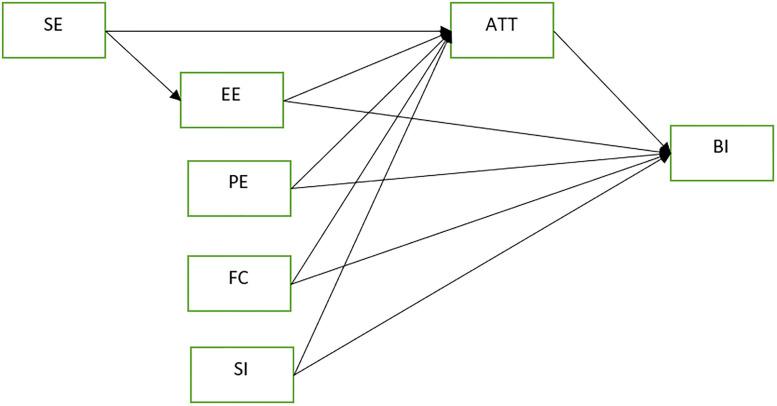
From the expected 423 responses, 319 (75.4%) participants responded to the survey questionnaire during the data collection period. The majority of participants were male (78.1%), age <30 (76.8%) and had less than five years of work experience (78.1%). The structural model result confirmed the hypothesis "self-efficacy has a significant positive effect on effort expectancy" with a standardized coefficient estimate (β) of 0.76 and p-value <0.001. The result also indicated that self-efficacy, effort expectancy, performance expectancy, facilitating conditions and social influence have a significant direct effect on user's attitude toward using telemedicine. User's behavioral intention to use telemedicine was also influenced by effort expectancy and attitude. The model also ruled out that performance expectancy, facilitating conditions and social influence does not directly influence user's intention to use telemedicine. The squared multiple correlations (r2) value indicated that 57.1% of the variance in attitude toward using telemedicine and 63.6% of the variance in behavioral intention to use telemedicine is explained by the current structural model.
CONCLUSION
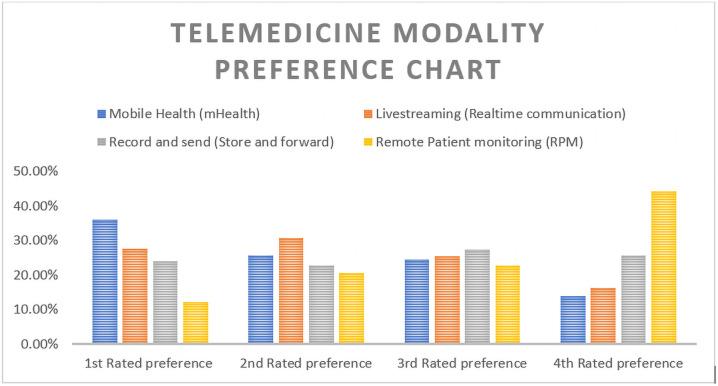
This study found that effort expectancy and attitude were significantly predictors of healthcare professionals' acceptance of telemedicine. Attitude toward using telemedicine systems was also highly influenced by performance expectancy, self-efficacy and facilitating conditions. effort expectancy and attitude were also significant mediators in predicting users' acceptance of telemedicine. In addition, mHealth approach was the most preferred modality of telemedicine and this opens an opportunity to integrate telemedicine systems in the health system during and post pandemic health services in low-income countries.
背景
在几乎所有的中低收入国家,医疗体系都是按照传统的医患面对面模式构建的。在当前全球 COVID-19 大流行的情况下,许多方面的常规医疗服务都发生了重大变化。鉴于中低收入国家脆弱的医疗体系和大量免疫功能低下的人群,预计 COVID-19 的经济影响会更严重。在这种情况下,远程医疗等技术解决方案至关重要,远程医疗是指通过远程通信技术提供医疗服务,以交换医疗信息、诊断、咨询和治疗。本研究旨在评估医疗保健提供者在埃塞俄比亚工作的卫生专业人员对远程医疗的接受程度和首选模式及其影响因素。
方法
2020 年 7 月 1 日至 9 月 21 日,通过电报频道、脸书群组/页面和电子邮件等社交媒体平台进行了多中心在线调查。问卷采用了先前在低收入环境中验证过的模型。使用 Cronbach alpha(α)、综合可靠性(CR)和平均方差提取(AVE)评估项目的内部一致性,以评估结构的辨别和收敛效度。使用 SPSS Amos 版本 23 的结构方程建模(SEM)评估变量之间的关系程度。
结果
在预期的 423 份回复中,有 319 份(75.4%)在数据收集期间回复了调查问卷。大多数参与者是男性(78.1%),年龄<30 岁(76.8%),工作经验不足五年(78.1%)。结构模型结果证实了假设“自我效能对努力期望有显著的积极影响”,标准化系数估计值(β)为 0.76,p 值<0.001。结果还表明,自我效能、努力期望、绩效期望、促进条件和社会影响对用户使用远程医疗的态度有显著的直接影响。用户使用远程医疗的行为意向也受到努力期望和态度的影响。该模型还排除了绩效期望、促进条件和社会影响不会直接影响用户使用远程医疗的意图的假设。平方多重相关(r2)值表明,远程医疗使用态度的 57.1%和远程医疗使用行为意向的 63.6%的方差可以由当前的结构模型解释。
结论
本研究发现,努力期望和态度是医疗保健专业人员接受远程医疗的重要预测因素。远程医疗系统的使用态度也受到绩效期望、自我效能和促进条件的高度影响。努力期望和态度也是预测用户接受远程医疗的重要中介因素。此外,移动医疗方法是远程医疗的首选模式,这为中低收入国家在大流行期间和之后将远程医疗系统整合到卫生系统中提供了机会。
 Zotero 插件