
俯卧位通气在非插管急性低氧性呼吸衰竭和 ARDS 患者中的疗效和耐受性:一项荟萃分析。
The efficacy and tolerance of prone positioning in non-intubation patients with acute hypoxemic respiratory failure and ARDS: a meta-analysis.
机构信息
Department of Respiratory and Critical Care Medicine, The First Affiliated Hospital of China Medical University, Shenyang, China.
Department of Respiratory and Critical Care Medicine, The First Affiliated Hospital of China Medical University, No. 155, Nanjing North Street, Heping District, Shenyang, Liaoning 110001, China.
出版信息
Ther Adv Respir Dis. 2021 Jan-Dec;15:17534666211009407. doi: 10.1177/17534666211009407.
BACKGROUND AND AIMS
The application of prone positioning with acute hypoxemic respiratory failure (AHRF) or acute respiratory distress syndrome (ARDS) in non-intubation patients is increasing gradually, applying prone positioning for more high-flow nasal oxygen therapy (HFNC) and non-invasive ventilation (NIV) patients. This meta-analysis evaluates the efficacy and tolerance of prone positioning combined with non-invasive respiratory support in patients with AHRF or ARDS.
METHODS
We searched randomized controlled trials (RCTs) (prospective or retrospective cohort studies, RCTs and case series) published in , and the from 1 January 2000 to 1 July 2020. We included studies that compared prone and supine positioning with non-invasive respiratory support in awake patients with AHRF or ARDS. The meta-analyses used random effects models. The methodological quality of the RCTs was evaluated using the Newcastle-Ottawa quality assessment scale.
RESULTS
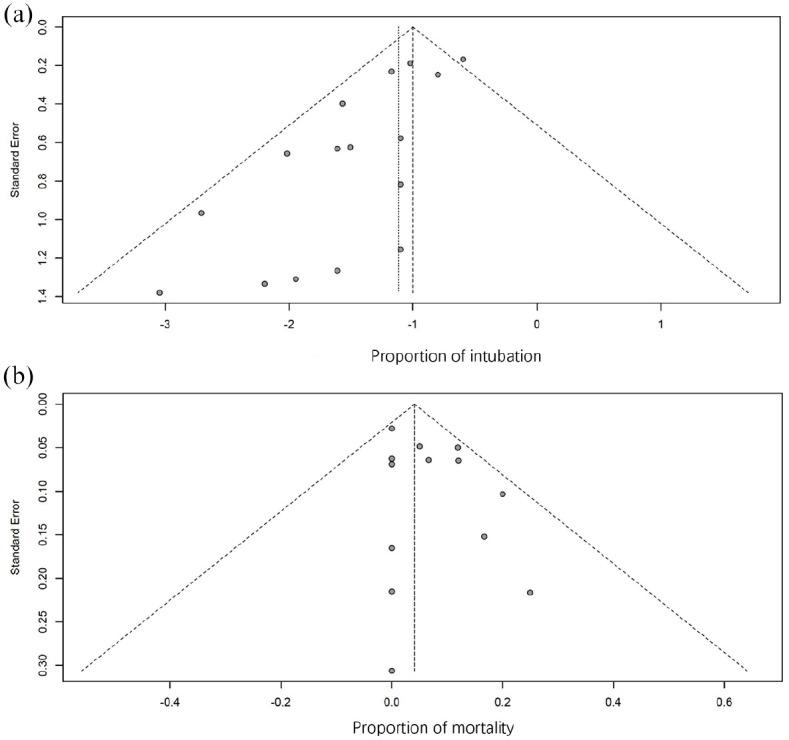
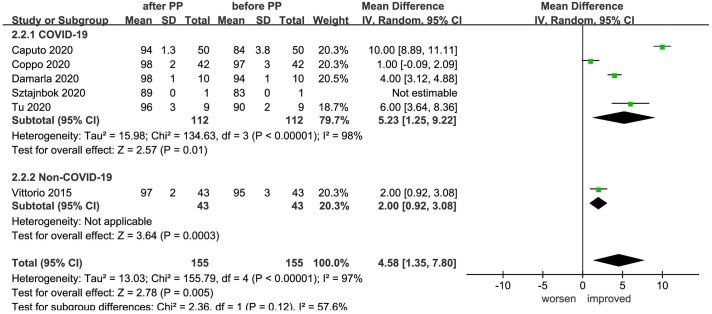
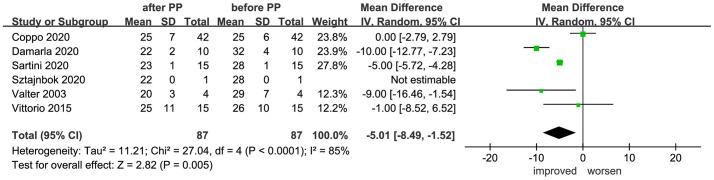
A total of 16 studies fulfilled selection criteria and included 243 patients. The aggregated intubation rate and mortality rate were 33% [95% confidence interval (CI): 0.26-0.42, = 25%], 4% (95% CI: 0.01-0.07, = 0%), respectively, and the intolerance rate was 7% (95% CI: 0.01-0.12, = 5%). Prone positioning increased PaO/FiO [mean difference (MD) = 47.89, 95% CI: 28.12-67.66; < 0.00001, = 67%] and SpO (MD = 4.58, 95% CI: 1.35-7.80, = 0.005, = 97%), whereas it reduced respiratory rate (MD = -5.01, 95% CI: -8.49 to -1.52, = 0.005, = 85%). Subgroup analyses demonstrated that the intubation rate of shorter duration prone (⩽5 h/day) and longer duration prone (>5 h/day) were 34% and 21%, respectively; and the mortality rate of shorter duration prone (⩽5 h/day) and longer duration prone (>5 h/day) were 6% and 0%, respectively. PaO/FiO and SpO were significantly improved in COVID-19 patients and non-COVID-19 patients.
CONCLUSION
Prone positioning could improve the oxygenation and reduce respiratory rate in both COVID-19 patients and non-COVID-19 patients with non-intubated AHRF or ARDS.
背景与目的
急性低氧性呼吸衰竭(AHRF)或急性呼吸窘迫综合征(ARDS)患者中俯卧位的应用逐渐增多,越来越多的高流量鼻氧疗(HFNC)和无创通气(NIV)患者采用俯卧位。本荟萃分析评估了俯卧位联合无创呼吸支持在 AHRF 或 ARDS 患者中的疗效和耐受性。
方法
我们检索了 2000 年 1 月 1 日至 2020 年 7 月 1 日发表在 、 和 中的随机对照试验(RCT)(前瞻性或回顾性队列研究、RCT 和病例系列)。我们纳入了比较 AHRF 或 ARDS 清醒患者俯卧位和仰卧位与无创呼吸支持的研究。荟萃分析采用随机效应模型。使用纽卡斯尔-渥太华质量评估量表评估 RCT 的方法学质量。
结果
共有 16 项研究符合入选标准,纳入了 243 名患者。汇总的插管率和死亡率分别为 33%(95%可信区间:0.26-0.42, = 25%)和 4%(95%可信区间:0.01-0.07, = 0%),不耐受率为 7%(95%可信区间:0.01-0.12, = 5%)。俯卧位可提高 PaO/FiO[平均差值(MD)=47.89,95%可信区间:28.12-67.66; < 0.00001, = 67%]和 SpO(MD=4.58,95%可信区间:1.35-7.80, = 0.005, = 97%),而呼吸频率降低(MD=-5.01,95%可信区间:-8.49 至-1.52, = 0.005, = 85%)。亚组分析显示,较短时间俯卧(≤5 h/d)和较长时间俯卧(>5 h/d)的插管率分别为 34%和 21%,较短时间俯卧(≤5 h/d)和较长时间俯卧(>5 h/d)的死亡率分别为 6%和 0%。俯卧位可改善 COVID-19 患者和非 COVID-19 患者的氧合和降低呼吸频率。
结论
俯卧位可改善非插管 AHRF 或 ARDS 患者的氧合和降低呼吸频率,无论是 COVID-19 患者还是非 COVID-19 患者。



 Zotero 插件