
俯卧位通气用于无插管自主呼吸的急性低氧性呼吸衰竭患者:系统评价和荟萃分析。
Prone positioning for non-intubated spontaneously breathing patients with acute hypoxaemic respiratory failure: a systematic review and meta-analysis.
机构信息
Adult Critical Care Unit, The Royal London Hospital, Barts Health NHS Trust, London, UK.
Adult Critical Care Unit, The Royal London Hospital, Barts Health NHS Trust, London, UK.
出版信息
Br J Anaesth. 2022 Feb;128(2):352-362. doi: 10.1016/j.bja.2021.09.031. Epub 2021 Oct 14.
BACKGROUND
Prone positioning in non-intubated spontaneously breathing patients is becoming widely applied in practice alongside noninvasive respiratory support. This systematic review and meta-analysis evaluates the effect, timing, and populations that might benefit from awake proning regarding oxygenation, mortality, and tracheal intubation compared with supine position in hypoxaemic acute respiratory failure.
METHODS
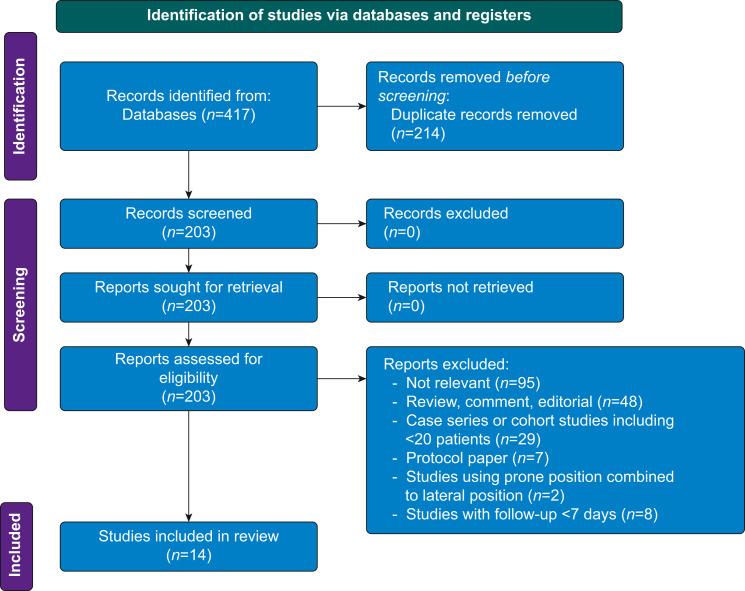
We conducted a systematic literature search of PubMed/MEDLINE, Cochrane Library, Embase, CINAHL, and BMJ Best Practice until August 2021 (International Prospective Register of Systematic Reviews [PROSPERO] registration: CRD42021250322). Studies included comprise least-wise 20 adult patients with hypoxaemic respiratory failure secondary to acute respiratory distress syndrome or coronavirus disease (COVID-19). Preferred Reporting Items for Systematic Reviews and Meta-Analyses (PRISMA) guidelines were followed, and study quality was assessed using the Newcastle-Ottawa Scale and the Cochrane risk-of-bias tool.
RESULTS
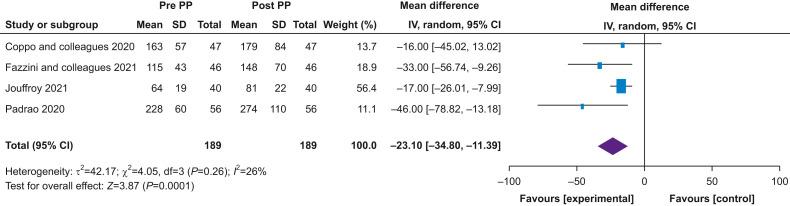
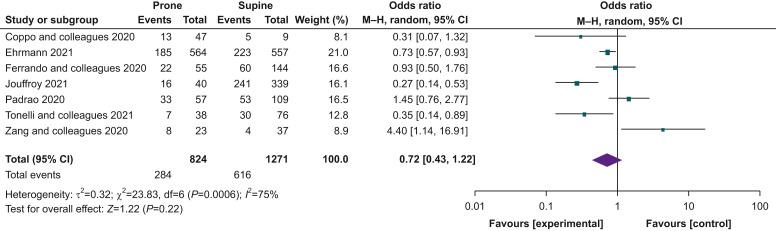
Fourteen studies fulfilled the selection criteria and 2352 patients were included; of those patients, 99% (n=2332/2352) had COVID-19. Amongst 1041 (44%) patients who were placed in the prone position, 1021 were SARS-CoV-2 positive. The meta-analysis revealed significant improvement in the PaO/FiO ratio (mean difference -23.10; 95% confidence interval [CI]: -34.80 to 11.39; P=0.0001; I=26%) after prone positioning. In patients with COVID-19, lower mortality was found in the group placed in the prone position (150/771 prone vs 391/1457 supine; odds ratio [OR] 0.51; 95% CI: 0.32-0.80; P=0.003; I=48%), but the tracheal intubation rate was unchanged (284/824 prone vs 616/1271 supine; OR 0.72; 95% CI: 0.43-1.22; P=0.220; I=75%). Overall proning was tolerated for a median of 4 h (inter-quartile range: 2-16).
CONCLUSIONS
Prone positioning can improve oxygenation amongst non-intubated patients with acute hypoxaemic respiratory failure when applied for at least 4 h over repeated daily episodes. Awake proning appears safe, but the effect on tracheal intubation rate and survival remains uncertain.
背景
俯卧位通气在非插管自主呼吸患者中的应用越来越广泛,与无创性呼吸支持一起应用。本系统评价和荟萃分析评估了与仰卧位相比,在急性低氧性呼吸衰竭患者中,清醒俯卧位在氧合、死亡率和气管插管方面的效果、时机和可能受益的人群。
方法
我们对 PubMed/MEDLINE、Cochrane 图书馆、Embase、CINAHL 和 BMJ Best Practice 进行了系统的文献检索,检索时间截至 2021 年 8 月(国际前瞻性系统评价注册 [PROSPERO] 登记号:CRD42021250322)。纳入的研究包括至少 20 例继发于急性呼吸窘迫综合征或冠状病毒病(COVID-19)的低氧性呼吸衰竭的成年患者。本研究遵循系统评价和荟萃分析的首选报告项目(PRISMA)指南,并使用纽卡斯尔-渥太华量表和 Cochrane 偏倚风险工具评估研究质量。
结果
有 14 项研究符合入选标准,共纳入 2352 例患者;其中 99%(n=2332/2352)的患者患有 COVID-19。在 1041 例(44%)接受俯卧位的患者中,有 1021 例 SARS-CoV-2 阳性。荟萃分析显示,俯卧位后 PaO/FiO 比值显著改善(平均差异-23.10;95%置信区间[CI]:-34.80 至 11.39;P=0.0001;I=26%)。在 COVID-19 患者中,俯卧位组的死亡率较低(150/771 例俯卧位 vs 391/1457 例仰卧位;比值比[OR]0.51;95%CI:0.32-0.80;P=0.003;I=48%),但气管插管率无变化(284/824 例俯卧位 vs 616/1271 例仰卧位;OR 0.72;95%CI:0.43-1.22;P=0.220;I=75%)。俯卧位总体上耐受中位数为 4 小时(四分位距:2-16)。
结论
在急性低氧性呼吸衰竭非插管患者中,至少 4 小时重复每日发作的清醒俯卧位可以改善氧合。清醒俯卧位似乎是安全的,但对气管插管率和生存率的影响仍不确定。

 Zotero 插件