
程序性死亡受体 1/程序性死亡配体 1 轴阻断在复发性或转移性头颈部鳞状细胞癌中按人乳头瘤病毒状态分层:系统评价和荟萃分析。
Programmed Death-1/Programmed Death-Ligand 1-Axis Blockade in Recurrent or Metastatic Head and Neck Squamous Cell Carcinoma Stratified by Human Papillomavirus Status: A Systematic Review and Meta-Analysis.
机构信息
Department of Otolaryngology-Head and Neck Surgery, Xiangya Hospital, Central South University, Changsha, China.
Clinical Research Center for Pharyngolaryngeal Diseases and Voice Disorders in Hunan Province, Changsha, China.
出版信息
Front Immunol. 2021 Apr 7;12:645170. doi: 10.3389/fimmu.2021.645170. eCollection 2021.
BACKGROUND
Programmed death-1/programmed death-ligand 1 (PD-1/PD-L1) inhibitors have provided clinical benefit to head and neck squamous cell carcinoma (HNSCC) patients in recent clinical trials. However, it remains unclear as to whether human papillomavirus (HPV) status is associated with improved clinical outcome of anti-PD-1 or anti-PD-L1 immunotherapy in HNSCC.
METHODS
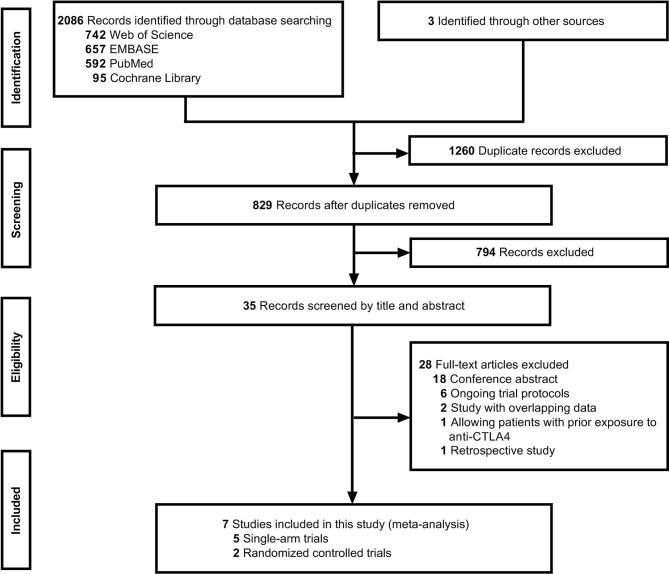
PubMed, EMBASE, Cochrane Library, and Web of Science were systematically searched up to February 28, 2021. Published clinical trials of HNSCC patients treated with only PD-1 or PD-L1 inhibitors were selected. The primary or secondary outcome of these studies included objective response rate (ORR) stratified by HPV status. The pooled odds ratio (OR) and hazard ratio (HR) were estimated using a fixed-effect model.
RESULTS
A total of seven eligible studies comprising 814 patients were included. The ORR of HPV positive HNSCC patients was significantly higher than that of HPV negative HNSCC patients (OR = 1.77; 95%CI = 1.14-2.74; = 0.01), and this favorable effect occurred in pooled anti-PD-L1 trials (OR = 2.66; 95%CI = 1.16-6.11; = 0.02). In comparison, the pooled OR was 1.51 in anti-PD-1 trials (95%CI = 0.90-2.54; = 0.12). Survival analysis indicated that HPV positive HNSCC patients had a lower risk of overall death as compared to HPV negative HNSCC patients (HR = 0.77; 95%CI = 0.60-0.99; = 0.04).
CONCLUSIONS
HPV positive HNSCC patients display improved outcomes with PD-1/PD-L1 axis blockade as compared to HPV negative HNSCC patients. These improved outcomes are likely driven to a greater extent by anti-PD-L1 inhibitors. However, randomized controlled trials with greater numbers of patients are needed for validation of these early findings.
背景
程序性死亡受体-1/程序性死亡受体配体 1(PD-1/PD-L1)抑制剂在最近的临床试验中为头颈部鳞状细胞癌(HNSCC)患者带来了临床获益。然而,HPV 状态是否与 HNSCC 患者抗 PD-1 或抗 PD-L1 免疫治疗的临床结局改善相关仍不清楚。
方法
系统检索了 PubMed、EMBASE、Cochrane 图书馆和 Web of Science 数据库,检索时间截至 2021 年 2 月 28 日。纳入仅接受 PD-1 或 PD-L1 抑制剂治疗的 HNSCC 患者的临床试验。这些研究的主要或次要结局包括按 HPV 状态分层的客观缓解率(ORR)。使用固定效应模型估计合并的优势比(OR)和风险比(HR)。
结果
共纳入 7 项符合条件的研究,包括 814 例患者。HPV 阳性 HNSCC 患者的 ORR 明显高于 HPV 阴性 HNSCC 患者(OR=1.77;95%CI=1.14-2.74; = 0.01),这种有利影响发生在抗 PD-L1 试验的汇总分析中(OR=2.66;95%CI=1.16-6.11; = 0.02)。相比之下,抗 PD-1 试验的汇总 OR 为 1.51(95%CI=0.90-2.54; = 0.12)。生存分析表明,HPV 阳性 HNSCC 患者的总死亡风险低于 HPV 阴性 HNSCC 患者(HR=0.77;95%CI=0.60-0.99; = 0.04)。
结论
与 HPV 阴性 HNSCC 患者相比,HPV 阳性 HNSCC 患者接受 PD-1/PD-L1 轴阻断治疗的结局改善。这些改善的结果可能在更大程度上归因于抗 PD-L1 抑制剂。然而,需要更多患者的随机对照试验来验证这些早期发现。


 Zotero 插件