
使用深度度量学习和多模态学习预测 TCR 表位结合特异性。
Predicting TCR-Epitope Binding Specificity Using Deep Metric Learning and Multimodal Learning.
机构信息
Department of Physics, University of Illinois at Urbana-Champaign, Urbana, IL 61801, USA.
Carl R. Woese Institute for Genomic Biology, University of Illinois at Urbana-Champaign, Urbana, IL 61801, USA.
出版信息
Genes (Basel). 2021 Apr 15;12(4):572. doi: 10.3390/genes12040572.
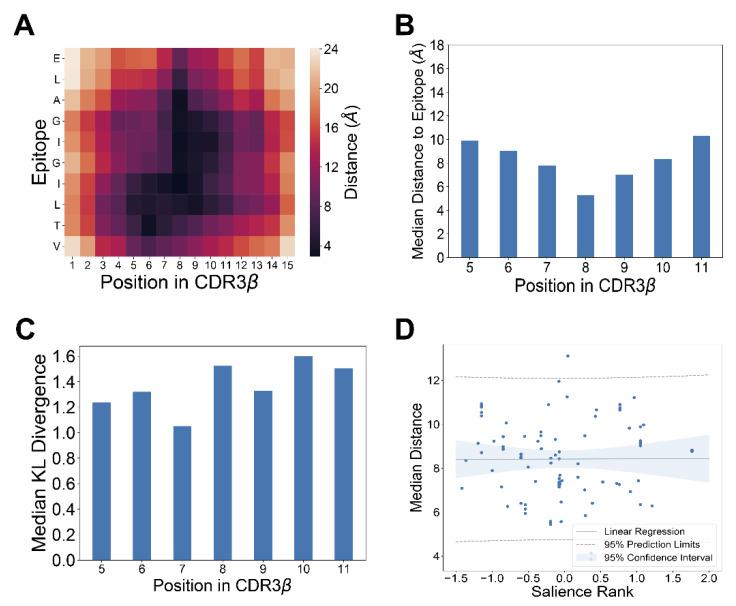
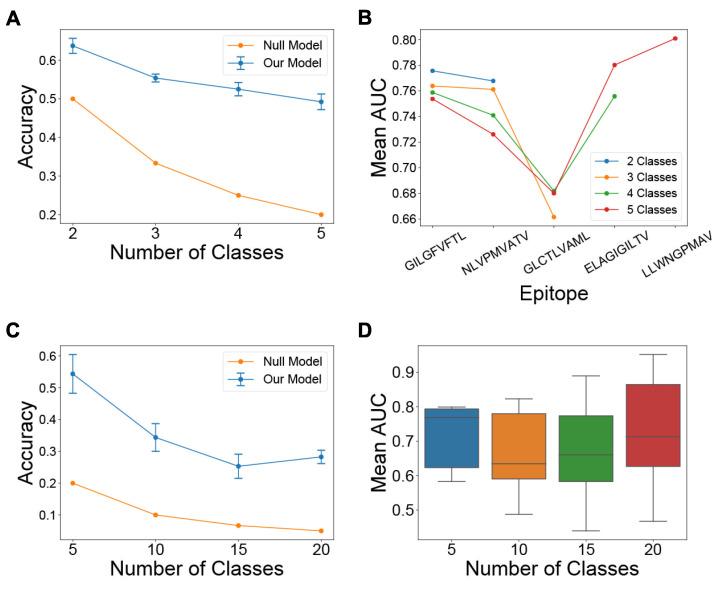
Understanding the recognition of specific epitopes by cytotoxic T cells is a central problem in immunology. Although predicting binding between peptides and the class I Major Histocompatibility Complex (MHC) has had success, predicting interactions between T cell receptors (TCRs) and MHC class I-peptide complexes (pMHC) remains elusive. This paper utilizes a convolutional neural network model employing deep metric learning and multimodal learning to perform two critical tasks in TCR-epitope binding prediction: identifying the TCRs that bind a given epitope from a TCR repertoire, and identifying the binding epitope of a given TCR from a list of candidate epitopes. Our model can perform both tasks simultaneously and reveals that inconsistent preprocessing of TCR sequences can confound binding prediction. Applying a neural network interpretation method identifies key amino acid sequence patterns and positions within the TCR, important for binding specificity. Contrary to common assumption, known crystal structures of TCR-pMHC complexes show that the predicted salient amino acid positions are not necessarily the closest to the epitopes, implying that physical proximity may not be a good proxy for importance in determining TCR-epitope specificity. Our work thus provides an insight into the learned predictive features of TCR-epitope binding specificity and advances the associated classification tasks.
理解细胞毒性 T 细胞对特定表位的识别是免疫学的一个核心问题。虽然预测肽与 I 类主要组织相容性复合物 (MHC) 之间的结合已经取得了成功,但预测 T 细胞受体 (TCR) 与 MHC 类 I-肽复合物 (pMHC) 之间的相互作用仍然难以捉摸。本文利用卷积神经网络模型,采用深度度量学习和多模态学习,来执行 TCR-表位结合预测中的两个关键任务:从 TCR 库中识别与给定表位结合的 TCR,以及从候选表位列表中识别给定 TCR 的结合表位。我们的模型可以同时执行这两个任务,并揭示出 TCR 序列不一致的预处理可能会混淆结合预测。应用神经网络解释方法可以识别 TCR 中与结合特异性相关的关键氨基酸序列模式和位置。与常见的假设相反,已知的 TCR-pMHC 复合物晶体结构表明,预测的显著氨基酸位置不一定与表位最接近,这意味着在确定 TCR-表位特异性方面,物理接近度可能不是一个很好的代理。因此,我们的工作深入了解了 TCR-表位结合特异性的学习预测特征,并推进了相关的分类任务。



 Zotero 插件