
一种用于控制 COVID-19 大流行的预防措施和医疗保健因素的非线性生物统计图形建模。
A Non-Linear Biostatistical Graphical Modeling of Preventive Actions and Healthcare Factors in Controlling COVID-19 Pandemic.
机构信息
Department of Statistics, Faculty of Sciences, Islamic University, Kushtia 7003, Bangladesh.
Research, Training and Management (RTM) International, Mirpur, Dhaka 1216, Bangladesh.
出版信息
Int J Environ Res Public Health. 2021 Apr 23;18(9):4491. doi: 10.3390/ijerph18094491.
BACKGROUND
With the insurgence of the COVID-19 pandemic, many people died in the past several months, and the situation is ongoing with increasing health, social, and economic panic and vulnerability. As most of the countries relying on different preventive actions to control the outcomes of COVID-19, it is necessary to boost the knowledge about the effectiveness of such actions so that the policymakers take their country-based appropriate actions. This study generates evidence of taking the most impactful actions to combat COVID-19.
OBJECTIVE
In order to generate community-based scientific evidence, this study analyzed the outcome of COVID-19 in response to different control measures, healthcare facilities, life expectancy, and prevalent diseases.
METHODS
It used more than a hundred countries' data collected from different databases. We performed a comparative graphical analysis with non-linear correlation estimation using R.
RESULTS
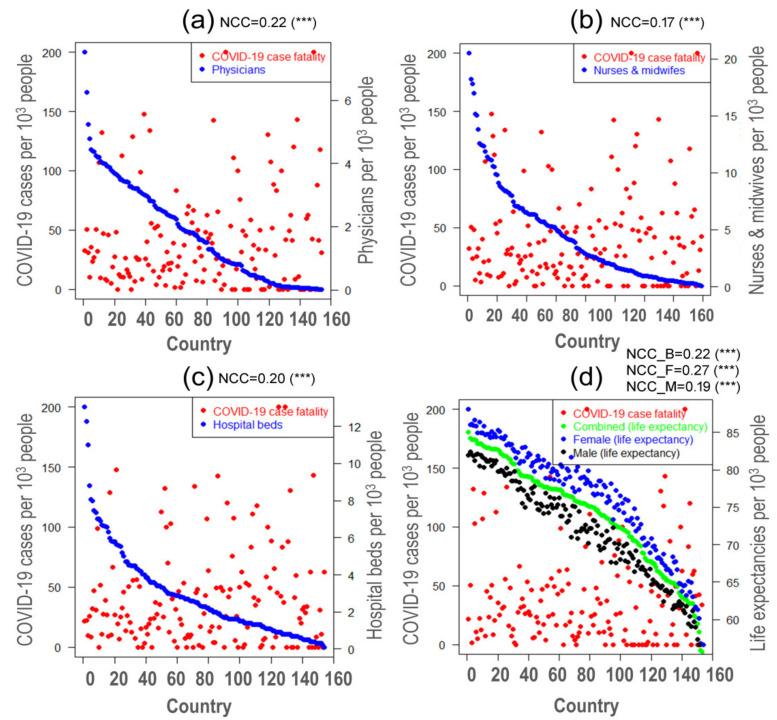
The reduction of COVID-19 cases is strongly correlated with the earliness of preventive initiation. The apathy of taking nationwide immediate precaution measures has been identified as one of the critical reasons to make the circumstances worse. There is significant non-linear relationship between COVID-19 case fatality and number of physicians (NCC = 0.22; -value ≤ 0.001), nurses and midwives (NCC = 0.17; -value ≤ 0.001), hospital beds (NCC = 0.20; -value ≤ 0.001), life expectancy of both sexes (NCC = 0.22; -value ≤ 0.001), life expectancy of female (NCC = 0.27; -value ≤ 0.001), and life expectancy of male (NCC = 0.19; -value ≤ 0.001). COVID-19 deaths were found to be reduced with increased medical personnel and hospital beds. Interestingly, no association between the comorbidities and severity of COVID-19 was found excluding asthma, cancer, Alzheimer's, and smoking.
CONCLUSIONS
Enhancing healthcare facilities and early imposing the control measures could be valuable to prevent the COVID-19 pandemic. No association between COVID-19 and other comorbidities warranted further investigation at the pathobiological level.
背景
随着 COVID-19 大流行的爆发,过去几个月有许多人死亡,目前疫情仍在持续,人们面临着越来越多的健康、社会和经济恐慌和脆弱性。由于大多数国家依赖不同的预防措施来控制 COVID-19 的结果,因此有必要提高人们对这些措施有效性的认识,以便决策者根据本国情况采取适当的行动。本研究旨在提供抗击 COVID-19 的最具影响力的行动依据。
目的
为了生成基于社区的科学证据,本研究分析了不同控制措施、医疗保健设施、预期寿命和常见疾病对 COVID-19 结果的影响。
方法
它使用了来自不同数据库的一百多个国家的数据。我们使用 R 进行了非线性相关估计的比较图形分析。
结果
COVID-19 病例的减少与预防措施的早期启动密切相关。人们发现,对采取全国性的即时预防措施漠不关心是使情况恶化的一个关键原因。COVID-19 病死率与医生人数(NCC = 0.22;-值 ≤ 0.001)、护士和助产士人数(NCC = 0.17;-值 ≤ 0.001)、医院床位数量(NCC = 0.20;-值 ≤ 0.001)、男女预期寿命(NCC = 0.22;-值 ≤ 0.001)、女性预期寿命(NCC = 0.27;-值 ≤ 0.001)和男性预期寿命(NCC = 0.19;-值 ≤ 0.001)之间存在显著的非线性关系。发现增加医务人员和医院床位可以降低 COVID-19 死亡人数。有趣的是,除了哮喘、癌症、阿尔茨海默病和吸烟外,COVID-19 与其他合并症之间没有关联。
结论
加强医疗保健设施和早期实施控制措施可能有助于预防 COVID-19 大流行。COVID-19 与其他合并症之间没有关联,这需要在病理生物学层面进一步研究。



 Zotero 插件