
环境相关剂量水平下幼年大鼠口腔共暴露双酚 A(BPA)和邻苯二甲酸二(2-乙基己基)酯(DEHP)的毒理学评估:协同、相加或拮抗作用的评价。
Toxicological Assessment of Oral Co-Exposure to Bisphenol A (BPA) and Bis(2-ethylhexyl) Phthalate (DEHP) in Juvenile Rats at Environmentally Relevant Dose Levels: Evaluation of the Synergic, Additive or Antagonistic Effects.
机构信息
Center for Gender-Specific Medicine, Istituto Superiore di Sanità, 00161 Rome, Italy.
Experimental Animal Welfare Sector, Istituto Superiore di Sanità, 00161 Rome, Italy.
出版信息
Int J Environ Res Public Health. 2021 Apr 26;18(9):4584. doi: 10.3390/ijerph18094584.
BACKGROUND
The general population (including children) is exposed to chemical mixtures. Plasticizers such as Bisphenol A (BPA) and Phthalates (mainly Bis(2-ethylhexyl) phthalate-DEHP) are widespread contaminants classified as endocrine disrupters which share some toxicological profiles and coexist in food and environment.
METHODS
To identify hazards of DEHP and BPA mixtures, the juvenile toxicity test-where rodents are in peripubertal phase of development, resembling childhood-was selected using exposure data from biomonitoring study in children. Biological activity and potential enhanced and/or reduced toxicological effects of mixtures due to common mechanisms were studied, considering endpoints of metabolic, endocrine and reproductive systems. The degree of synergy or antagonism was evaluated by synergy score calculation, using present data and results from the single compound individually administered.
RESULTS
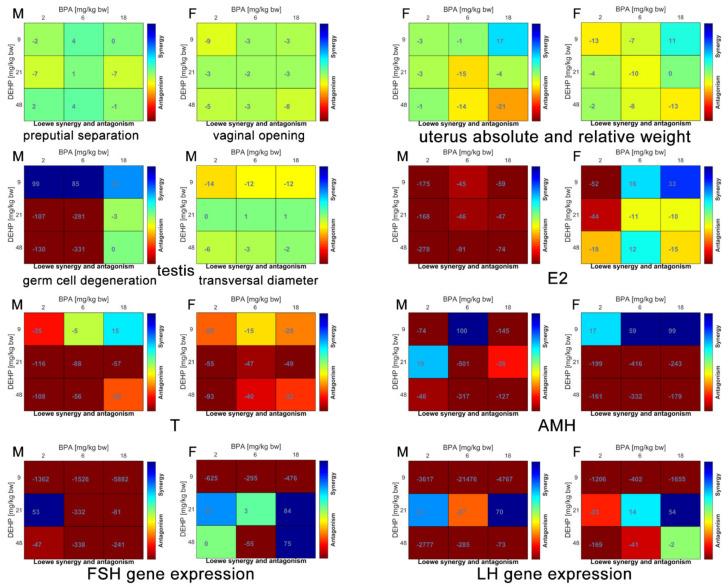
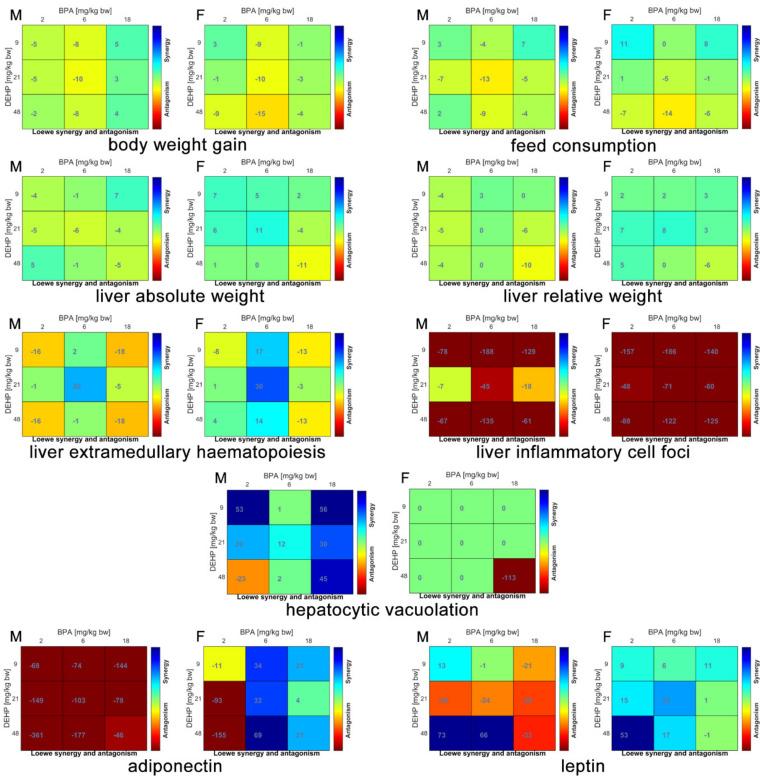
In metabolic system, synergic interaction predominates in female and additive in male rats; in the reproductive and endocrine systems, the co-exposure of BPA and DEHP showed interactions mainly of antagonism type.
CONCLUSIONS
The present approach allows to evaluate, for all the endpoints considered, the type of interaction between contaminants relevant for human health. Although the mode of action and biological activities of the mixtures are not completely addressed, it can be of paramount usefulness to support a more reliable risk assessment.
背景
普通人群(包括儿童)会接触到化学混合物。增塑剂如双酚 A(BPA)和邻苯二甲酸酯(主要是邻苯二甲酸二(2-乙基己基)酯-DEHP)是广泛存在的污染物,被归类为内分泌干扰物,它们具有一些毒理学特征,并共同存在于食品和环境中。
方法
为了确定 DEHP 和 BPA 混合物的危害,选择了幼鼠毒性测试,即啮齿动物处于青春期发育阶段,类似于儿童期,使用儿童生物监测研究中的暴露数据。研究了由于共同机制导致混合物的生物活性和潜在增强和/或降低的毒性作用,考虑了代谢、内分泌和生殖系统的终点。通过协同评分计算,使用现有数据和单独给予单一化合物的结果,评估协同或拮抗作用的程度。
结果
在代谢系统中,女性中协同作用占主导地位,男性中则为相加作用;在生殖和内分泌系统中,BPA 和 DEHP 的共同暴露主要表现为拮抗作用类型的相互作用。
结论
本方法允许评估对于所有考虑的终点,对于人类健康相关的污染物之间的相互作用类型。尽管混合物的作用模式和生物活性尚未完全解决,但它对于支持更可靠的风险评估非常有用。


 Zotero 插件