
在英格兰 690 万人中,体重指数与 COVID-19 严重程度的关联:一项前瞻性、基于社区的队列研究。
Associations between body-mass index and COVID-19 severity in 6·9 million people in England: a prospective, community-based, cohort study.
机构信息
University of Oxford, Nuffield Department of Primary Care Health Sciences, Radcliffe Observatory Quarter, Oxford, UK; School of Public Health, Peking University Health Science Center, Beijing, China.
University of Oxford, Nuffield Department of Primary Care Health Sciences, Radcliffe Observatory Quarter, Oxford, UK.
出版信息
Lancet Diabetes Endocrinol. 2021 Jun;9(6):350-359. doi: 10.1016/S2213-8587(21)00089-9. Epub 2021 Apr 28.
BACKGROUND
Obesity is a major risk factor for adverse outcomes after infection with SARS-CoV-2. We aimed to examine this association, including interactions with demographic and behavioural characteristics, type 2 diabetes, and other health conditions.
METHODS
In this prospective, community-based, cohort study, we used de-identified patient-level data from the QResearch database of general practices in England, UK. We extracted data for patients aged 20 years and older who were registered at a practice eligible for inclusion in the QResearch database between Jan 24, 2020 (date of the first recorded infection in the UK) and April 30, 2020, and with available data on BMI. Data extracted included demographic, clinical, clinical values linked with Public Health England's database of positive SARS-CoV-2 test results, and death certificates from the Office of National Statistics. Outcomes, as a proxy measure of severe COVID-19, were admission to hospital, admission to an intensive care unit (ICU), and death due to COVID-19. We used Cox proportional hazard models to estimate the risk of severe COVID-19, sequentially adjusting for demographic characteristics, behavioural factors, and comorbidities.
FINDINGS
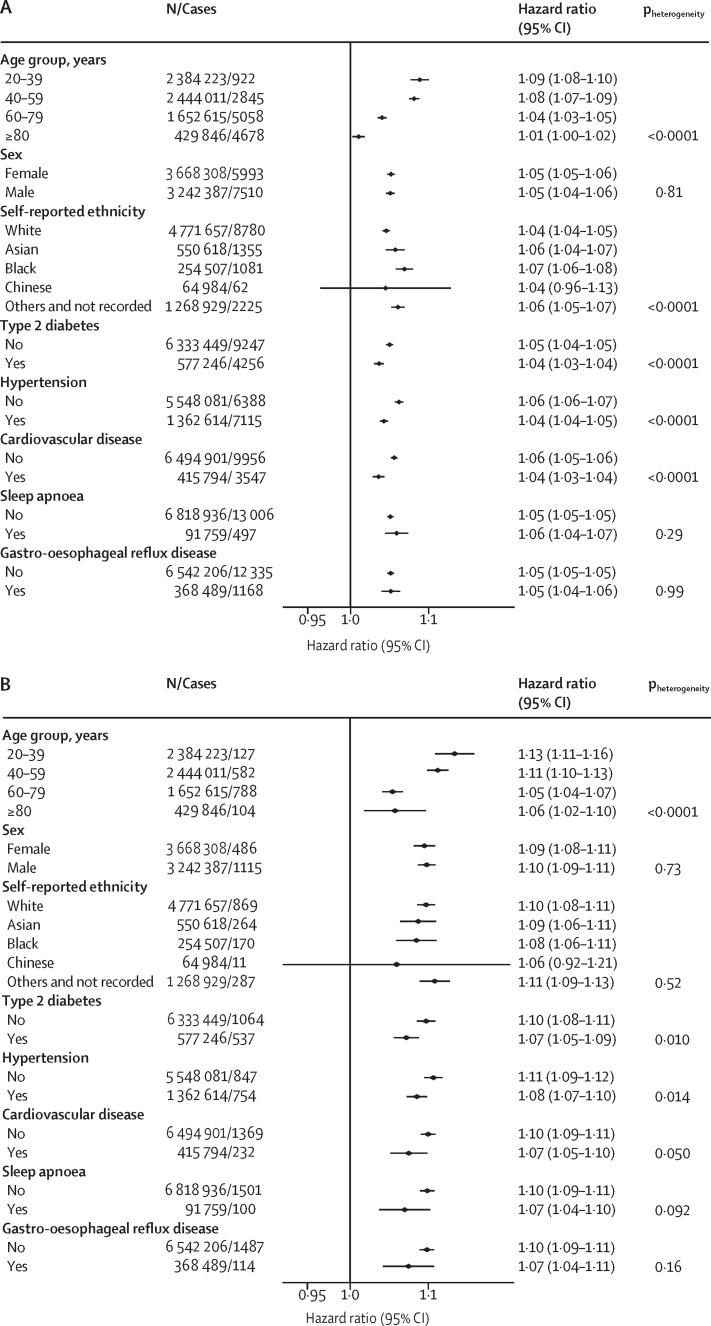
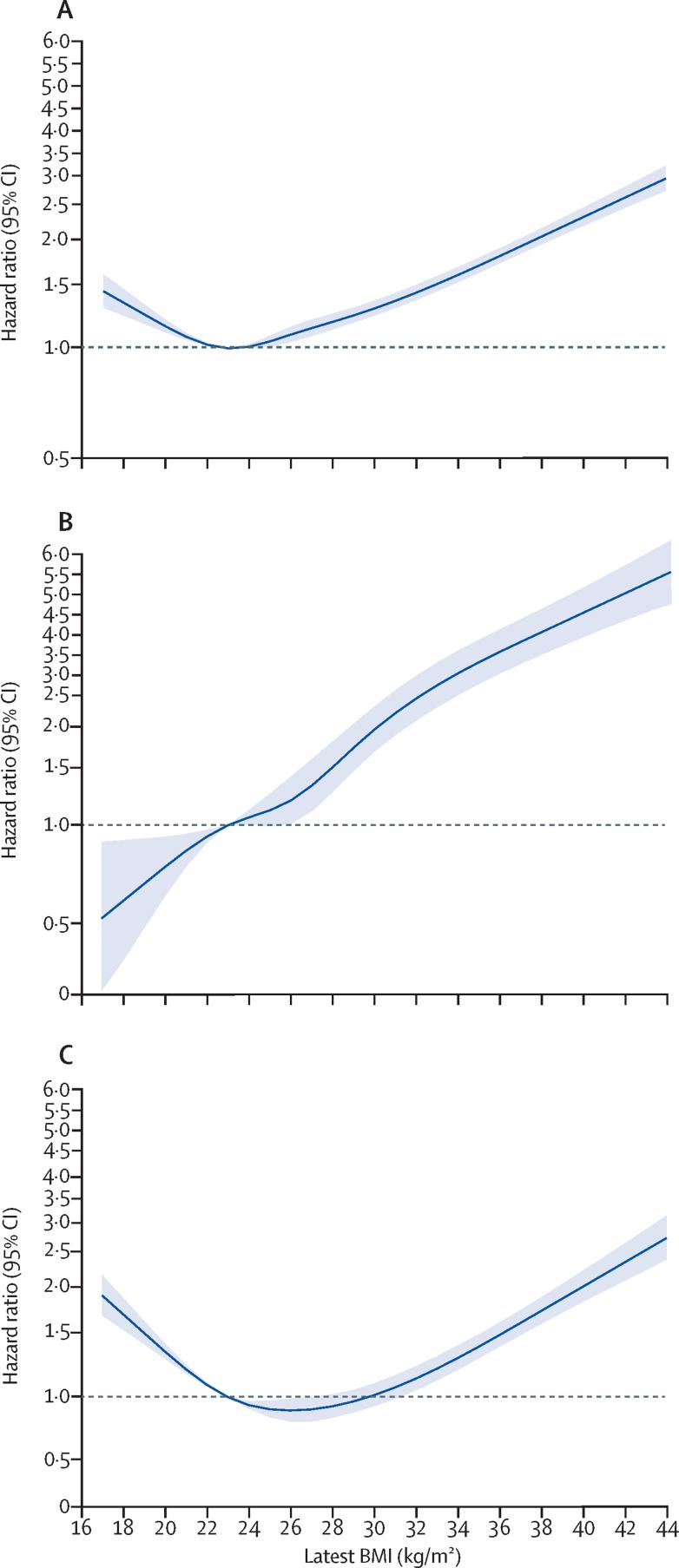
Among 6 910 695 eligible individuals (mean BMI 26·78 kg/m [SD 5·59]), 13 503 (0·20%) were admitted to hospital, 1601 (0·02%) to an ICU, and 5479 (0·08%) died after a positive test for SARS-CoV-2. We found J-shaped associations between BMI and admission to hospital due to COVID-19 (adjusted hazard ratio [HR] per kg/m from the nadir at BMI of 23 kg/m of 1·05 [95% CI 1·05-1·05]) and death (1·04 [1·04-1·05]), and a linear association across the whole BMI range with ICU admission (1·10 [1·09-1·10]). We found a significant interaction between BMI and age and ethnicity, with higher HR per kg/m above BMI 23 kg/m for younger people (adjusted HR per kg/m above BMI 23 kg/m for hospital admission 1·09 [95% CI 1·08-1·10] in 20-39 years age group vs 80-100 years group 1·01 [1·00-1·02]) and Black people than White people (1·07 [1·06-1·08] vs 1·04 [1·04-1·05]). The risk of admission to hospital and ICU due to COVID-19 associated with unit increase in BMI was slightly lower in people with type 2 diabetes, hypertension, and cardiovascular disease than in those without these morbidities.
INTERPRETATION
At a BMI of more than 23 kg/m, we found a linear increase in risk of severe COVID-19 leading to admission to hospital and death, and a linear increase in admission to an ICU across the whole BMI range, which is not attributable to excess risks of related diseases. The relative risk due to increasing BMI is particularly notable people younger than 40 years and of Black ethnicity.
FUNDING
NIHR Oxford Biomedical Research Centre.
背景
肥胖是感染 SARS-CoV-2 后出现不良后果的一个主要危险因素。我们旨在研究这种关联,包括与人口统计学和行为特征、2 型糖尿病和其他健康状况的相互作用。
方法
在这项前瞻性、基于社区的队列研究中,我们使用了来自英国 QResearch 普通实践数据库的去识别患者级别的数据。我们提取了年龄在 20 岁及以上的患者的数据,这些患者在 2020 年 1 月 24 日(英国首次记录感染 SARS-CoV-2 的日期)至 2020 年 4 月 30 日期间在有资格被纳入 QResearch 数据库的实践中注册,并且有 BMI 数据。提取的数据包括人口统计学、临床、与英格兰公共卫生署 SARS-CoV-2 检测结果数据库相关的临床值,以及来自国家统计局的死亡证明。作为严重 COVID-19 的替代指标,结果是因 COVID-19 住院、入住重症监护病房(ICU)和因 COVID-19 死亡。我们使用 Cox 比例风险模型来估计严重 COVID-19 的风险,依次调整人口统计学特征、行为因素和合并症。
发现
在 6910695 名符合条件的个体中(平均 BMI 为 26.78kg/m[SD 5.59]),有 13503 人(0.20%)因 COVID-19 住院,1601 人(0.02%)入住 ICU,5479 人(0.08%)因 SARS-CoV-2 检测呈阳性而死亡。我们发现 BMI 与 COVID-19 住院(BMI 为 23kg/m 时的最低点每增加 1kg/m 的调整后危险比[HR]为 1.05[95%CI 1.05-1.05])和死亡(1.04[1.04-1.05])之间呈 J 形关联,而在整个 BMI 范围内与 ICU 入院呈线性关联(1.10[1.09-1.10])。我们发现 BMI 与年龄和种族之间存在显著的相互作用,对于年龄较轻的人,每增加 1kg/m 的 BMI 以上的 HR 更高(因 COVID-19 住院的每增加 1kg/m 的 HR 为 20-39 岁年龄组 1.09[95%CI 1.08-1.10]比 80-100 岁年龄组 1.01[1.00-1.02]),黑人比白人更高(因 COVID-19 住院的 HR 为 1.07[1.06-1.08]比 1.04[1.04-1.05])。与 BMI 增加相关的因 COVID-19 导致的住院和 ICU 入院的风险在患有 2 型糖尿病、高血压和心血管疾病的人群中略低于没有这些疾病的人群。
解释
在 BMI 超过 23kg/m 时,我们发现因 COVID-19 导致的严重程度增加与住院和死亡的风险呈线性增加,而在整个 BMI 范围内 ICU 入院的风险呈线性增加,这并非归因于相关疾病的风险增加。由于 BMI 增加而导致的相对风险在年龄小于 40 岁和黑人种族的人群中尤为显著。
资金
英国牛津大学国家卫生研究院生物医学研究中心。
 Zotero 插件