
一线治疗应答可预测安罗替尼治疗小细胞肺癌患者的无进展生存期获益。
Response to first-line treatment predicts progression-free survival benefit of small-cell lung cancer patients treated with anlotinib.
机构信息
Department of Oncology, General Hospital of Chinese PLA, Beijing, China.
Department of Gynaecology and Obstetrics, PLA Rocket Force Characteristic Medical Center, Beijing, China.
出版信息
Cancer Med. 2021 Jun;10(12):3896-3904. doi: 10.1002/cam4.3941. Epub 2021 May 6.
BACKGROUND
Anlotinib significantly extended progression-free survival (PFS) and overall survival (OS) in small-cell lung cancer (SCLC) as third or later line treatment.
METHODS
In this study, we retrospectively analyzed the efficacy and safety of anlotinib in the clinical practice and aimed to identify risk factors for predicting the clinical benefit of anlotinib in SCLC patients. 29 SCLC patients treated with anlotinib monotherapy or combination therapy as second or later line treatment were included. PFS, OS, objective response rate (ORR), disease control rate (DCR), and adverse events (AEs) were analyzed.
RESULTS
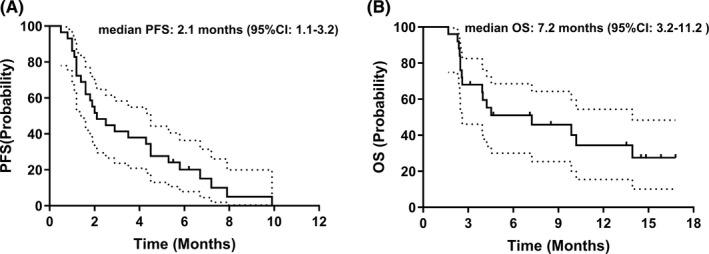
In whole patients, the median PFS was 2.1 months (95% confidence interval (CI): 1.1-3.2 months); The ORR and DCR were 10.3% and 48.3%, respectively; The median OS was 7.2 months (95%CI: 3.2-11.2 months). Cox regression analysis demonstrated that response to first-line treatment was the independent risk factor for PFS. The ORR (20.0% vs. 0%) and DCR (53.3% vs. 42.9%) were promoted in patients treated with anlotinib combination therapy comparing to anlotinib monotherapy. The most common AEs were hoarseness, fatigue, decreased appetite, oral mucositis, and anemia. No treatment-related AEs graded 3 or more.
CONCLUSION
Anlotinib is an effective option for SCLC patients with tolerable toxicity as second or later line treatment. Patients sensitive to first-line treatment had longer PFS when treated with anlotinib. Anloitnib combined with other therapy increased the efficacy without adding toxicity.
背景
安罗替尼作为三线或后线治疗方案,显著延长了小细胞肺癌(SCLC)患者的无进展生存期(PFS)和总生存期(OS)。
方法
本研究回顾性分析了安罗替尼在 SCLC 患者中的临床疗效和安全性,并旨在确定预测安罗替尼临床获益的风险因素。共纳入 29 例接受安罗替尼单药或联合治疗作为二线或后线治疗的 SCLC 患者。分析了 PFS、OS、客观缓解率(ORR)、疾病控制率(DCR)和不良事件(AEs)。
结果
在全组患者中,中位 PFS 为 2.1 个月(95%置信区间[CI]:1.1-3.2 个月);ORR 和 DCR 分别为 10.3%和 48.3%;中位 OS 为 7.2 个月(95%CI:3.2-11.2 个月)。Cox 回归分析表明,一线治疗的反应是 PFS 的独立危险因素。与安罗替尼单药治疗相比,联合治疗组的 ORR(20.0%比 0%)和 DCR(53.3%比 42.9%)得到了提高。最常见的 AEs 为声音嘶哑、乏力、食欲下降、口腔黏膜炎和贫血。无治疗相关的 3 级及以上 AEs。
结论
安罗替尼作为二线或后线治疗方案,对 SCLC 患者是一种有效的选择,且毒性可耐受。一线治疗敏感的患者在接受安罗替尼治疗时 PFS 更长。安罗替尼联合其他治疗方法可提高疗效而不增加毒性。


 Zotero 插件