
11-酮睾酮是去势后前列腺癌患者的主要活性雄激素。
11-Ketotestosterone is the predominant active androgen in prostate cancer patients after castration.
机构信息
Department of Internal Medicine, Section of Endocrinology, Erasmus MC, Rotterdam, Netherlands.
Department of Medical Oncology, Erasmus MC Cancer Institute, Erasmus MC, Rotterdam, Netherlands.
出版信息
JCI Insight. 2021 Jun 8;6(11):148507. doi: 10.1172/jci.insight.148507.
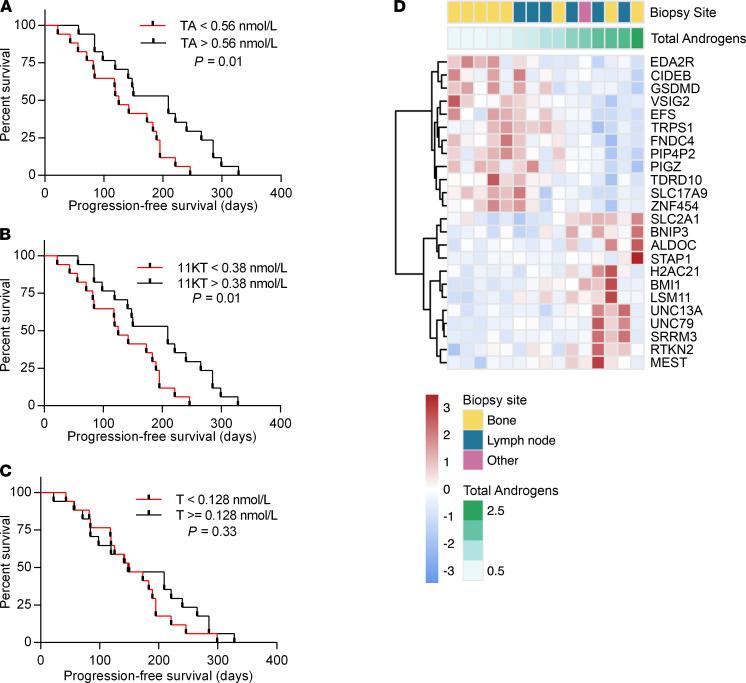
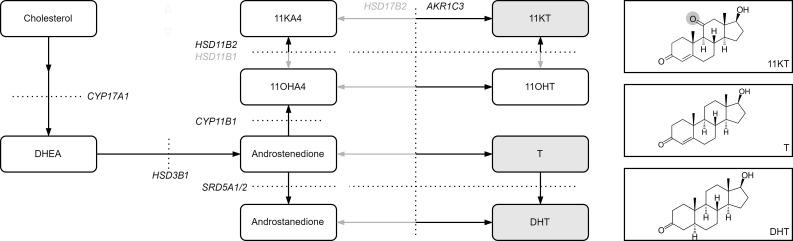
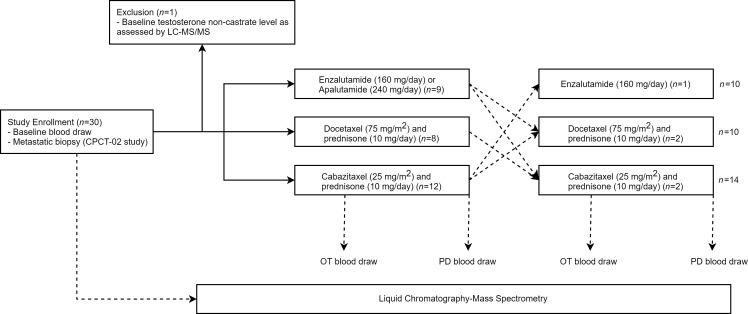
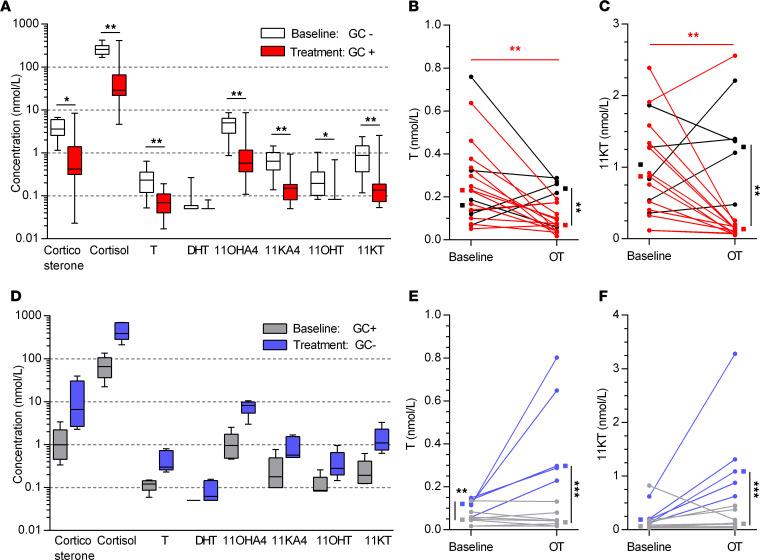
BACKGROUNDContinued androgen receptor (AR) signaling constitutes a key target for treatment in metastatic castration-resistant prostate cancer (CRPC). Studies have identified 11-ketotestosterone (11KT) as a potent AR agonist, but it is unknown if 11KT is present at physiologically relevant concentrations in patients with CRPC to drive AR activation. The goal of this study was to investigate the circulating steroid metabolome including all active androgens in patients with CRPC.METHODSPatients with metastatic CRPC (n = 29) starting a new line of systemic therapy were included. Sequential plasma samples were obtained for measurement of circulating steroid concentrations by multisteroid profiling employing liquid chromatography-tandem mass spectrometry. Metastatic tumor biopsy samples were obtained at baseline and subjected to RNA sequencing.RESULTS11KT was the most abundant circulating active androgen in 97% of patients with CRPC (median 0.39 nmol/L, range: 0.03-2.39 nmol/L), constituting 60% (IQR 43%-79%) of the total active androgen (TA) pool. Treatment with glucocorticoids reduced 11KT by 84% (49%-89%) and testosterone by 68% (38%-79%). Circulating TA concentrations at baseline were associated with a distinct intratumor gene expression signature comprising AR-regulated genes.CONCLUSIONThe potent AR agonist 11KT is the predominant circulating active androgen in patients with CRPC and, therefore, one of the potential drivers of AR activation in CRPC. Assessment of androgen status should be extended to include 11KT, as current clinical approaches likely underestimate androgen abundance in patients with CRPC.TRIAL REGISTRATIONNetherlands Trial Register: NL5625 (NTR5732).FUNDINGDaniel den Hoed Foundation and Wellcome Trust (Investigator Award WT209492/Z/17/Z).
背景
持续的雄激素受体(AR)信号转导是转移性去势抵抗性前列腺癌(CRPC)治疗的一个关键靶点。研究已经确定 11-酮睾酮(11KT)是一种有效的 AR 激动剂,但目前尚不清楚在 CRPC 患者中是否存在生理相关浓度的 11KT 来驱动 AR 激活。本研究的目的是调查包括所有活性雄激素在内的 CRPC 患者循环类固醇代谢组学。
方法
纳入开始新线全身治疗的转移性 CRPC 患者(n = 29)。通过液相色谱-串联质谱法进行多类固醇分析,获得连续的血浆样本,以测量循环类固醇浓度。在基线时获得转移性肿瘤活检样本,并进行 RNA 测序。
结果
11KT 是 97%的 CRPC 患者中最丰富的循环活性雄激素(中位数 0.39 nmol/L,范围:0.03-2.39 nmol/L),占总活性雄激素(TA)池的 60%(IQR 43%-79%)。糖皮质激素治疗使 11KT 降低 84%(49%-89%),使睾酮降低 68%(38%-79%)。基线时的循环 TA 浓度与一个独特的肿瘤内基因表达特征相关,包括 AR 调节的基因。
结论
强效 AR 激动剂 11KT 是 CRPC 患者中主要的循环活性雄激素,因此是 CRPC 中 AR 激活的潜在驱动因素之一。雄激素状态的评估应扩展到包括 11KT,因为目前的临床方法可能低估了 CRPC 患者的雄激素丰度。
试验注册
荷兰临床试验注册处:NL5625(NTR5732)。
基金
Daniel den Hoed 基金会和惠康信托基金会(研究员奖 WT209492/Z/17/Z)。

 Zotero 插件