
全球、区域和国家层面宫颈癌的发病趋势:来自《2019年全球疾病负担研究》的数据。
Trends of cervical cancer at global, regional, and national level: data from the Global Burden of Disease study 2019.
作者信息
Zhang Xingxing, Zeng Qingle, Cai Wenwen, Ruan Weiqing
机构信息
Huiqiao Medical Center, Nanfang Hospital, Southern Medical University, Guangzhou, Guangdong, China.
Department of Interventional Radiology, Nanfang Hospital, Southern Medical University, Guangzhou, China.
出版信息
BMC Public Health. 2021 May 12;21(1):894. doi: 10.1186/s12889-021-10907-5.
BACKGROUND
Cervical cancer is an important global health problem. In this study we aimed to analyze trends in cervical cancer at the global, regional, and national levels from 1990 to 2019, to inform health service decision-making.
METHODS
Data on cervical cancer was extracted from the Global Burden of Disease study, 2019. Trends in cervical cancer burden were assessed based on estimated annual percentage change (EAPC) and age-standardized rate (ASR).
RESULTS
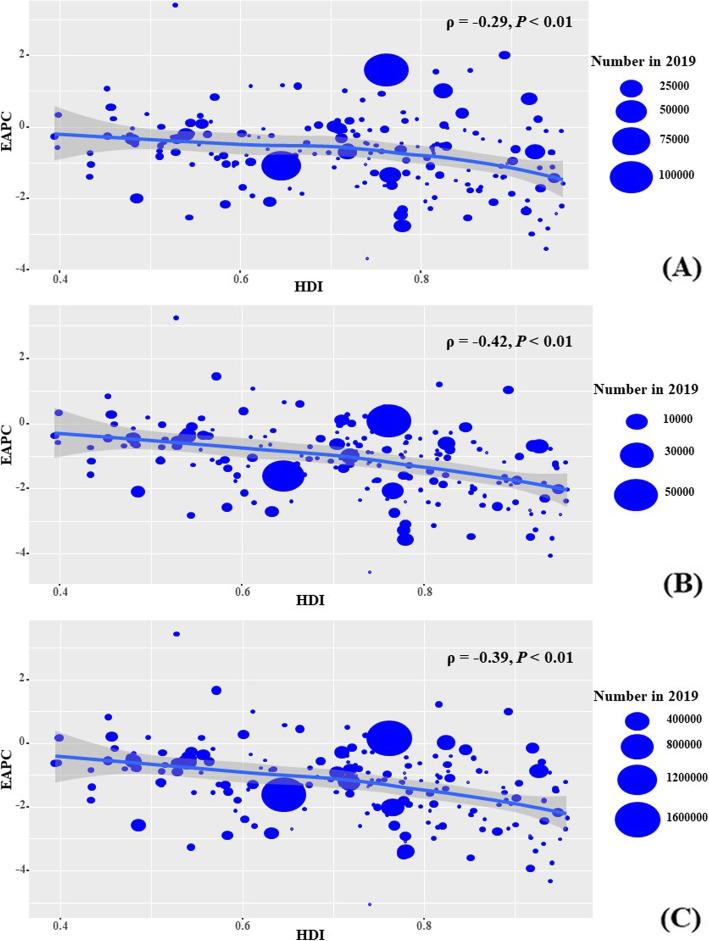
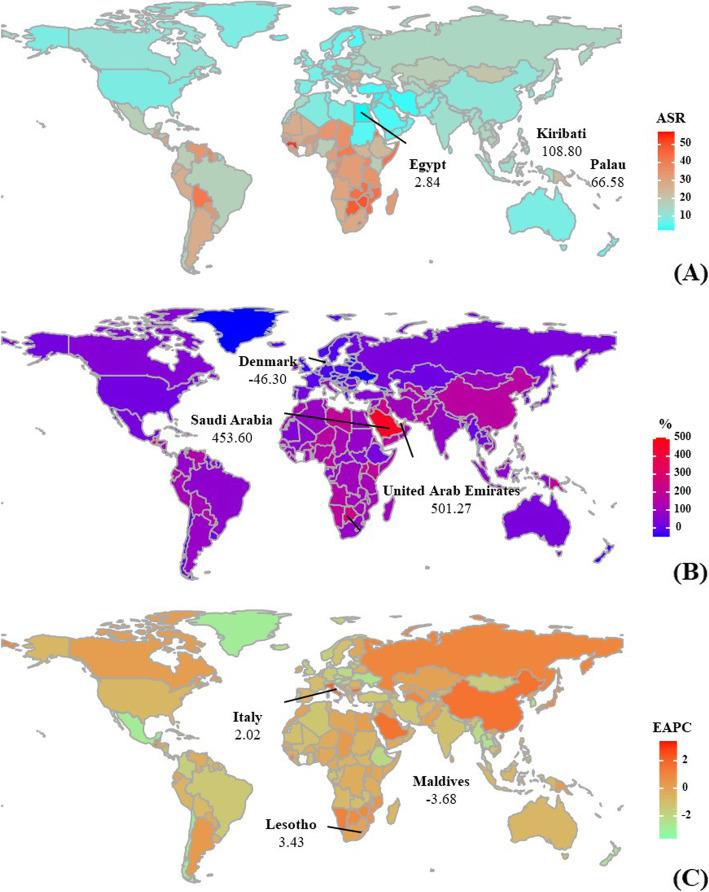
Globally, decreasing trends were observed in incidence, death, and disability adjusted life years (DALYs) of cervical cancer from 1990 to 2019, with respective EAPCs of - 0.38 (95% confidence interval [CI]: - 0.41 to - 0.34), - 0.93 (95%CI: - 0.98 to - 0.88), and - 0.95 (95 CI%: - 1.00 to - 0.90). Meanwhile, decreasing trends were detected in most sociodemographic index (SDI) areas and geographic regions, particularly death and DALYs in Central Latin America, with respective EAPCs of - 2.61 (95% CI: - 2.76 to - 2.46) and - 2.48 (95% CI: - 2.63 to - 2.32); hhowever, a pronounced increasing trend in incidence occurred in East Asia (EAPC = 1.33; 95% CI: 1.12 to 1.55). At the national level, decreasing trends in cervical cancer were observed in most countries/territories, particularly DALYs in the Maldives (EAPC = - 5.06; 95% CI: - 5.40 to - 4.72), Whereas increasing trends were detected in Lesotho, Zimbabwe, and Bulgaria.
CONCLUSIONS
Slowly decreasing trends in cervical cancer were detected worldwide from 1990 to 2019. Cervical cancer remains a substantial health problem for women globally, requiring more effective prevention and control strategies.
背景
宫颈癌是一个重要的全球健康问题。在本研究中,我们旨在分析1990年至2019年全球、区域和国家层面宫颈癌的趋势,以为卫生服务决策提供信息。
方法
从《2019年全球疾病负担研究》中提取宫颈癌数据。基于估计的年度百分比变化(EAPC)和年龄标准化率(ASR)评估宫颈癌负担趋势。
结果
在全球范围内,1990年至2019年宫颈癌的发病率、死亡率和伤残调整生命年(DALY)呈下降趋势,EAPC分别为-0.38(95%置信区间[CI]:-0.41至-0.34)、-0.93(95%CI:-0.98至-0.88)和-0.95(95%CI:-1.00至-0.90)。同时,在大多数社会人口指数(SDI)地区和地理区域发现了下降趋势,特别是在中美洲拉丁地区的死亡率和DALY,EAPC分别为-2.61(95%CI:-2.76至-2.46)和-2.48(95%CI:-2.63至-2.32);然而,东亚地区的发病率出现了明显上升趋势(EAPC = 1.33;95%CI:1.12至1.55)。在国家层面,大多数国家/地区的宫颈癌呈下降趋势,特别是马尔代夫的DALY(EAPC = -5.06;95%CI:-5.40至-4.72),而莱索托、津巴布韦和保加利亚则出现上升趋势。
结论
1990年至2019年全球范围内检测到宫颈癌呈缓慢下降趋势。宫颈癌仍然是全球女性面临的重大健康问题,需要更有效的预防和控制策略。



 Zotero 插件