
激活转录因子4依赖性乳酸脱氢酶激活作为对β-淀粉样蛋白毒性的保护性反应。
Activating transcription factor 4-dependent lactate dehydrogenase activation as a protective response to amyloid beta toxicity.
作者信息
Niccoli Teresa, Kerr Fiona, Snoeren Inge, Fabian Daniel, Aleyakpo Benjamin, Ivanov Dobril, Sofola-Adesakin Oyinkan, Cryar Adam, Adcott Jennifer, Thornton Janet, Partridge Linda
机构信息
Department of Genetics, Evolution and Environment, Institute of Healthy Ageing, University College London, London WC1E 6BT, UK.
Department of Biological and Biomedical Sciences, School of Health & Life Sciences, Glasgow Caledonian University, Glasgow G4 0BA, UK.
出版信息
Brain Commun. 2021 Mar 26;3(2):fcab053. doi: 10.1093/braincomms/fcab053. eCollection 2021.
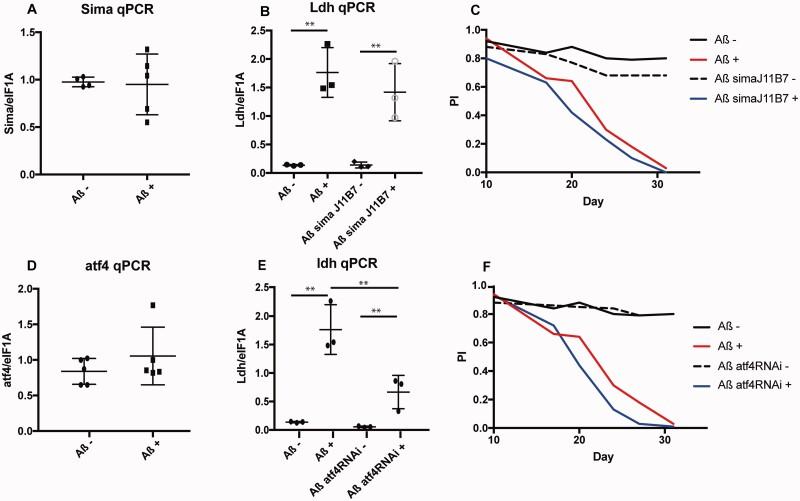
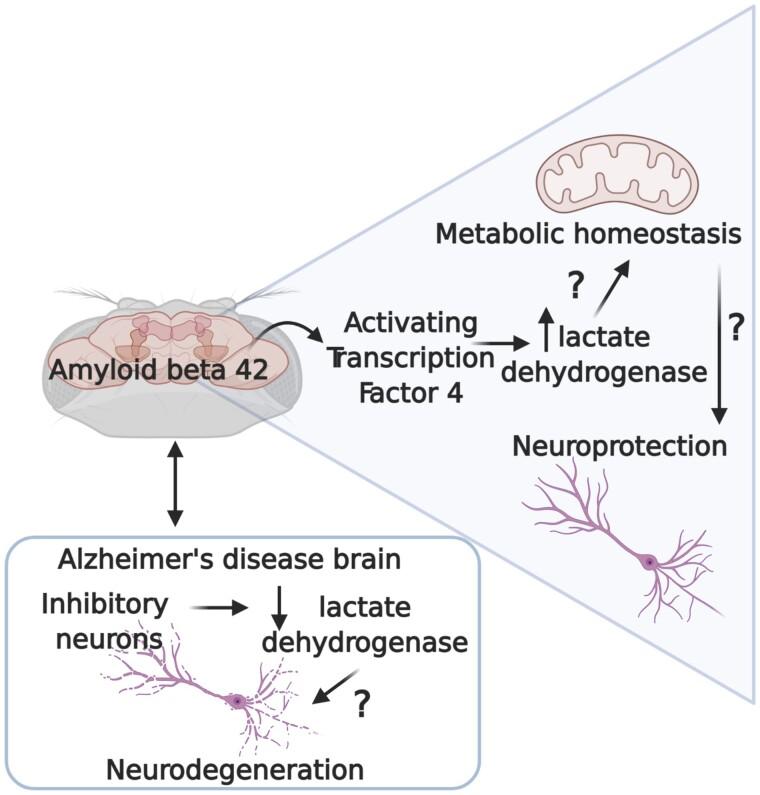
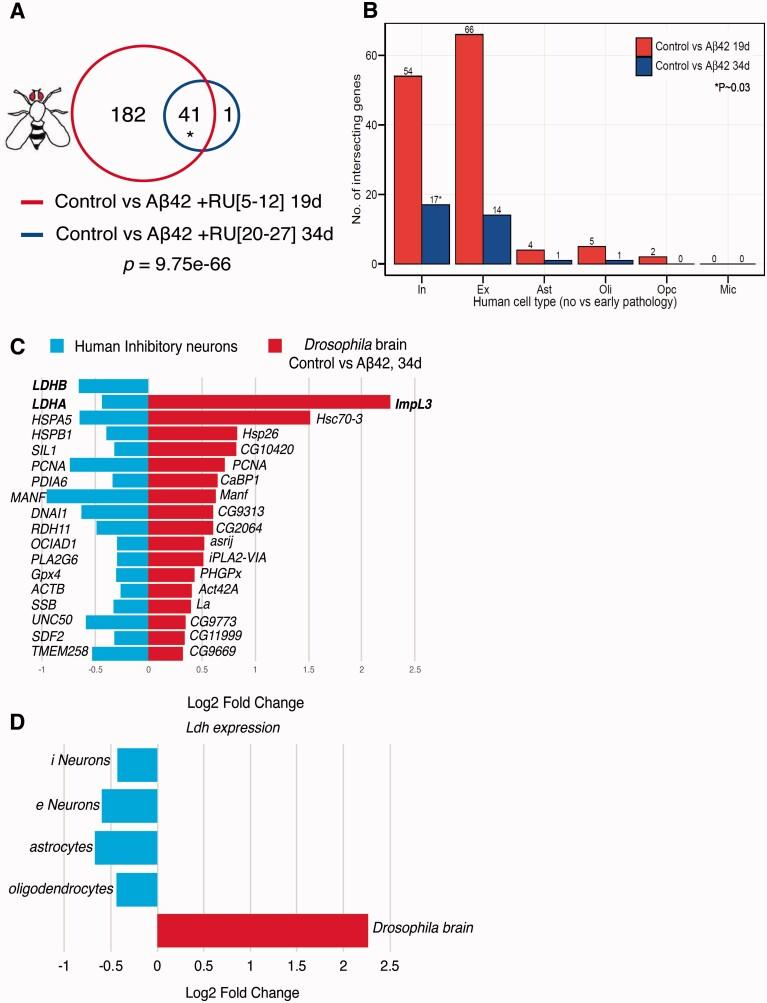
Accumulation of amyloid beta peptides is thought to initiate the pathogenesis of Alzheimer's disease. However, the precise mechanisms mediating their neurotoxicity are unclear. Our microarray analyses show that, in models of amyloid beta 42 toxicity, genes involved in the unfolded protein response and metabolic processes are upregulated in brain. Comparison with the brain transcriptome of early-stage Alzheimer's patients revealed a common transcriptional signature, but with generally opposing directions of gene expression changes between flies and humans. Among these differentially regulated genes, lactate dehydrogenase () was up-regulated by the greatest degree in amyloid beta 42 flies and the human orthologues ( and ) were down-regulated in patients. Functional analyses revealed that either over-expression or inhibition of by RNA interference (RNAi) slightly exacerbated climbing defects in both healthy and amyloid beta 42-induced . This suggests that metabolic responses to lactate dehydrogenase must be finely-tuned, and that its observed upregulation following amyloid beta 42 production could potentially represent a compensatory protection to maintain pathway homeostasis in this model, with further manipulation leading to detrimental effects. The increased expression in amyloid beta 42 flies was regulated partially by unfolded protein response signalling, as RNAi diminished the transcriptional response and enhanced amyloid beta 42-induced climbing phenotypes. Further functional studies are required to determine whether upregulation provides compensatory neuroprotection against amyloid beta 42-induced loss of activating transcription factor 4 activity and endoplasmatic reticulum stress. Our study thus reveals dysregulation of lactate dehydrogenase signalling in models and patients with Alzheimer's disease, which may lead to a detrimental loss of metabolic homeostasis. Importantly, we observed that down-regulation of -dependent endoplasmic reticulum-stress signalling in this context appears to prevent compensation and to exacerbate amyloid beta 42-dependent neuronal toxicity. Our findings, therefore, suggest caution in the use of therapeutic strategies focussed on down-regulation of this pathway for the treatment of Alzheimer's disease, since its natural response to the toxic peptide may induce beneficial neuroprotective effects.
β淀粉样肽的积累被认为是引发阿尔茨海默病发病机制的起始因素。然而,介导其神经毒性的确切机制尚不清楚。我们的微阵列分析表明,在β淀粉样蛋白42毒性模型中,参与未折叠蛋白反应和代谢过程的基因在大脑中上调。与早期阿尔茨海默病患者的大脑转录组比较显示出共同的转录特征,但果蝇和人类之间基因表达变化的方向通常相反。在这些差异调节的基因中,乳酸脱氢酶()在β淀粉样蛋白42果蝇中上调程度最大,而其人类同源物(和)在患者中下调。功能分析表明,通过RNA干扰(RNAi)过表达或抑制在健康和β淀粉样蛋白42诱导的果蝇中均轻微加剧了攀爬缺陷。这表明对乳酸脱氢酶的代谢反应必须进行精细调节,并且在β淀粉样蛋白42产生后观察到的其上调可能潜在地代表一种补偿性保护,以维持该模型中的通路稳态,进一步的操作会导致有害影响。β淀粉样蛋白42果蝇中增加的表达部分受未折叠蛋白反应信号调节,因为RNAi减少了转录反应并增强了β淀粉样蛋白42诱导攀爬表型。需要进一步的功能研究来确定上调是否能提供针对β淀粉样蛋白42诱导的激活转录因子4活性丧失和内质网应激的补偿性神经保护作用。因此,我们的研究揭示了阿尔茨海默病模型和患者中乳酸脱氢酶信号的失调,这可能导致代谢稳态的有害丧失。重要的是,我们观察到在这种情况下,依赖于的内质网应激信号下调似乎会阻止补偿并加剧β淀粉样蛋白42依赖性神经元毒性。因此,我们的研究结果表明,在使用专注于下调该通路的治疗策略来治疗阿尔茨海默病时应谨慎,因为其对毒性肽的自然反应可能诱导有益的神经保护作用。


 Zotero 插件