
癌症患者脓毒症和脓毒性休克的结局:聚焦乳酸
Outcomes of Sepsis and Septic Shock in Cancer Patients: Focus on Lactate.
作者信息
López René, Pérez-Araos Rodrigo, Baus Fernanda, Moscoso Camila, Salazar Álvaro, Graf Jerónimo, Montes José Miguel, Samtani Suraj
机构信息
Departamento de Paciente Crítico, Clínica Alemana de Santiago, Santiago, Chile.
Escuela de Medicina, Facultad de Medicina Clínica Alemana - Universidad del Desarrollo, Santiago, Chile.
出版信息
Front Med (Lausanne). 2021 Apr 26;8:603275. doi: 10.3389/fmed.2021.603275. eCollection 2021.
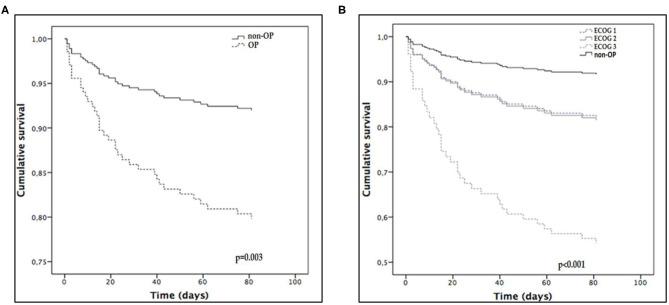
The number of oncological patients (OP) admitted to intensive care units (ICU) for sepsis/septic shock has dramatically increased in recent years. The definition of septic shock has been modified, adding hyperlactatemia as a severity biomarker for mortality. However, it remains poorly reported in septic OP. We performed a retrospective analysis from a prospective database of sepsis/septic shock patients admitted to our ICU between September 2017 and September 2019 and followed until day 90. We identified 251 patients and 31.9% had active oncological comorbidity, mainly solid tumor (81.3%). Septic shock criteria were met for 112 (44.6%). Hyperlactatemia was observed in 136 (54.2%) patients and this was associated with a lower survival rate. Overall 90-day mortality was 15.1%. In OP vs. non-OP, hyperlactatemia was more frequent (65% vs. 49.1%, = 0.013) and associated with lower survival (65.4% vs. 85.7%, = 0.046). In OP, poor performance status was also associated with lower survival (HR 7.029 [1.998-24.731], = 0.002) In an adjusted analysis, cancer was associated with lower 90-day survival (HR 2.690 [1.402-5.160], = 0.003). In conclusion, septic OP remains a high mortality risk group in whom lactate levels and performance status could help with better risk stratification.
近年来,因脓毒症/脓毒性休克入住重症监护病房(ICU)的肿瘤患者数量急剧增加。脓毒性休克的定义已有所修改,增加了高乳酸血症作为死亡率的严重程度生物标志物。然而,在脓毒症肿瘤患者中对此的报道仍然很少。我们对2017年9月至2019年9月入住我院ICU的脓毒症/脓毒性休克患者的前瞻性数据库进行了回顾性分析,并随访至第90天。我们确定了251例患者,其中31.9%有活动性肿瘤合并症,主要为实体瘤(81.3%)。112例(44.6%)符合脓毒性休克标准。136例(54.2%)患者观察到高乳酸血症,这与较低的生存率相关。总体90天死亡率为15.1%。在肿瘤患者与非肿瘤患者中,高乳酸血症更常见(65%对49.1%,P = 0.013),且与较低的生存率相关(65.4%对85.7%,P = 0.046)。在肿瘤患者中,较差的体能状态也与较低的生存率相关(风险比7.029 [1.998 - 24.731],P = 0.002)。在多因素分析中,癌症与较低的90天生存率相关(风险比2.690 [1.402 - 5.160],P = 0.003)。总之,脓毒症肿瘤患者仍然是高死亡风险群体,其中乳酸水平和体能状态有助于更好地进行风险分层。


 Zotero 插件