
自然杀伤细胞疗法对肺癌继发脓毒症的疗效:一例报告
The effect of NK cell therapy on sepsis secondary to lung cancer: A case report.
作者信息
Tang Jingling, Xie Lulu, Liu Honglin, Wu Liyun, Li Xiaoyang, Du Hang, Wang Xinjun, Li Xiaoyun, Yang Yuan
机构信息
Clinical Research Center, Affiliated Hospital of Guizhou Medical University, Guiyang, Guizhou 550004, China.
The Department of Critical Care Medicine, Affiliated Hospital of Guizhou Medical University, Guiyang, Guizhou 550004, China.
出版信息
Open Life Sci. 2023 Aug 31;18(1):20220702. doi: 10.1515/biol-2022-0702. eCollection 2023.
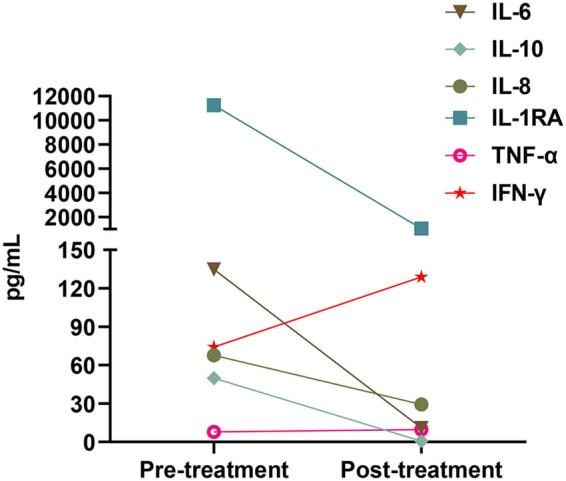
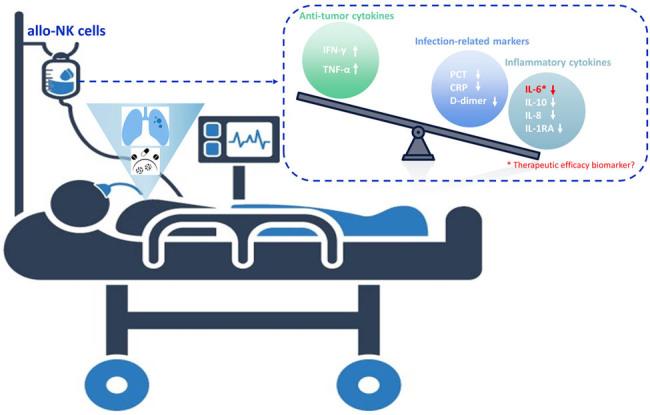
Patients with sepsis face high mortality rates and a bleak prognosis, prompting the need for advanced therapeutic interventions. A male patient diagnosed with moderately low-differentiated squamous cell carcinoma received diverse treatments, including radiotherapy, chemotherapy, immunotherapy, and targeted therapy to inhibit angiogenesis. Subsequently, he developed sepsis after comprehensive treatment, and conventional antibiotic combinations proved ineffective in combating the infection. As an experimental approach, allogeneic natural killer (NK) cell infusion was administered. Following the NK cell infusion, the patient regained consciousness, and laboratory analyses showed reduced infection-related markers, suppressed serum inflammatory cytokines, and elevated anti-tumor cytokines. However, the therapeutic effect only lasted 2-3 days. investigations demonstrated that the allogeneic NK cell product reduced interleukin-6 levels in the patient's serum. Moreover, subsequent co-cultivation of the NK cell product with the patient's serum resulted in a decrease in the proportion of cytotoxic subpopulations of NK cells and a downregulation of the expression of NK-mediated killing molecules. In conclusion, adoptive transfusion of allogeneic NK cells may improve sepsis symptoms in patients with tumor-related sepsis. co-culture tests hold promise in providing predictive biomarkers for treatment effectiveness.
脓毒症患者面临着高死亡率和黯淡的预后,这促使人们需要先进的治疗干预措施。一名被诊断为中低分化鳞状细胞癌的男性患者接受了多种治疗,包括放疗、化疗、免疫治疗以及抑制血管生成的靶向治疗。随后,他在综合治疗后患上了脓毒症,传统的抗生素联合治疗在对抗感染方面被证明无效。作为一种实验性方法,进行了同种异体自然杀伤(NK)细胞输注。在输注NK细胞后,患者恢复了意识,实验室分析显示与感染相关的标志物减少、血清炎性细胞因子受到抑制且抗肿瘤细胞因子升高。然而,治疗效果仅持续了2至3天。研究表明,同种异体NK细胞制品降低了患者血清中的白细胞介素-6水平。此外,随后将NK细胞制品与患者血清共同培养导致NK细胞细胞毒性亚群的比例降低以及NK介导的杀伤分子表达下调。总之,同种异体NK细胞的过继性输血可能改善肿瘤相关性脓毒症患者的脓毒症症状。共同培养试验有望为治疗效果提供预测性生物标志物。

 Zotero 插件