
免疫炎症生物标志物作为预处理晚期尿路上皮癌患者免疫治疗的预后因素:意大利 SAUL 队列分析。
Immune-inflammatory biomarkers as prognostic factors for immunotherapy in pretreated advanced urinary tract cancer patients: an analysis of the Italian SAUL cohort.
机构信息
Medical Oncology Unit 1, IRCCS Ospedale Policlinico San Martino, Genova, Italy.
Medical Oncology Unit 1, IRCCS Ospedale Policlinico San Martino, Genova, Italy; Department of Internal Medicine and Medical Specialties, University of Genoa, Genoa, Italy.
出版信息
ESMO Open. 2021 Jun;6(3):100118. doi: 10.1016/j.esmoop.2021.100118. Epub 2021 May 10.
BACKGROUND
Reliable and affordable prognostic and predictive biomarkers for urothelial carcinoma treated with immunotherapy may allow patients' outcome stratification and drive therapeutic options. The SAUL trial investigated the safety and efficacy of atezolizumab in a real-world setting on 1004 patients with locally advanced or metastatic urothelial carcinoma who progressed to one to three prior systemic therapies.
PATIENTS AND METHODS
Using the SAUL Italian cohort of 267 patients, we investigated the prognostic role of neutrophil-to-lymphocyte ratio (NLR) and systemic immune-inflammation index (SII) and the best performing one of these in combination with programmed death-ligand 1 (PD-L1) with or without lactate dehydrogenase (LDH). Previously reported cut-offs (NLR >3 and NLR >5; SII >1375) in addition to study-defined ones derived from receiver operating characteristic (ROC) analysis were used.
RESULTS
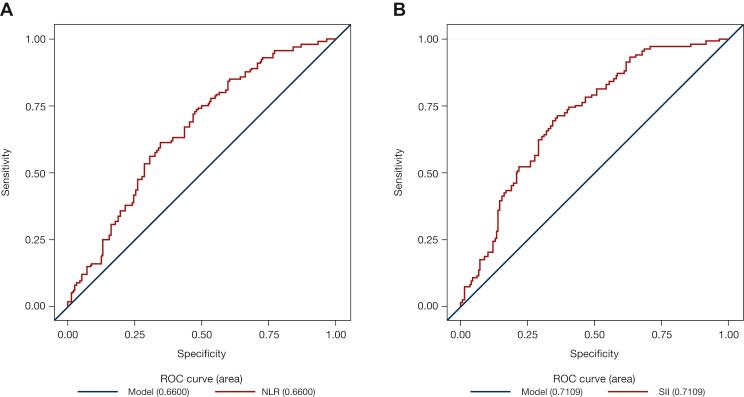
The cut-off values for NLR and SII by the ROC analysis were 3.65 (sensitivity 60.4; specificity 63.0) and 884 (sensitivity 64.4; specificity 67.5), respectively. The median overall survival (OS) was 14.7 months for NLR <3.65 [95% confidence interval (CI) 9.9-not reached (NR)] versus 6.0 months for NLR ≥3.65 (95% CI 3.9-9.4); 14.7 months for SII <884 (95% CI 10.6-NR) versus 6.0 months for SII ≥884 (95% CI 3.7-8.6). The combination of SII, PD-L1, and LDH stratified OS better than SII plus PD-L1 through better identification of patients with intermediate prognosis (77% versus 48%, respectively). Multivariate analyses confirmed significant correlations with OS and progression-free survival for both the SII + PD-L1 + LDH and SII + PD-L1 combinations.
CONCLUSION
The combination of immune-inflammatory biomarkers based on SII, PD-L1, with or without LDH is a potentially useful and easy-to-assess prognostic tool deserving validation to identify patients who may benefit from immunotherapy alone or alternative therapies.
背景
可靠且负担得起的预测和预后生物标志物对于接受免疫治疗的尿路上皮癌患者可能允许进行患者的结果分层,并推动治疗选择。SAUL 试验在 1004 名局部晚期或转移性尿路上皮癌患者中进行了真实环境下的安全性和有效性研究,这些患者在接受了一种至三种先前的全身治疗后进展。
患者和方法
使用来自 SAUL 意大利队列的 267 名患者,我们研究了中性粒细胞与淋巴细胞比值(NLR)和全身免疫炎症指数(SII)的预后作用,以及这两个指标中表现最好的一个与程序性死亡配体 1(PD-L1)结合使用时的效果,无论是否联合乳酸脱氢酶(LDH)。除了基于接收者操作特征(ROC)分析得出的研究定义的截止值外,还使用了之前报道的截止值(NLR>3 和 NLR>5;SII>1375)。
结果
ROC 分析得出的 NLR 和 SII 的截止值分别为 3.65(敏感性 60.4%;特异性 63.0)和 884(敏感性 64.4%;特异性 67.5)。NLR<3.65 的中位总生存期(OS)为 14.7 个月(95%置信区间[CI] 9.9-NR),而 NLR≥3.65 的中位 OS 为 6.0 个月(95% CI 3.9-9.4);SII<884 的中位 OS 为 14.7 个月(95% CI 10.6-NR),而 SII≥884 的中位 OS 为 6.0 个月(95% CI 3.7-8.6)。SII、PD-L1 和 LDH 的组合通过更好地识别具有中间预后的患者(分别为 77%和 48%),优于 SII 加 PD-L1。多变量分析证实了 SII+PD-L1+LDH 和 SII+PD-L1 组合与 OS 和无进展生存期均有显著相关性。
结论
基于 SII、PD-L1 并联合或不联合 LDH 的免疫炎症生物标志物的组合是一种潜在有用且易于评估的预后工具,值得进一步验证,以识别可能从单独免疫治疗或替代治疗中获益的患者。

 Zotero 插件