
应对大量产仔:新生仔猪的管理与母猪繁殖
Coping with large litters: the management of neonatal piglets and sow reproduction.
作者信息
Peltoniemi Olli, Yun Jinhyeon, Björkman Stefan, Han Taehee
机构信息
Department of Production Animal Medicine, Faculty of Veterinary Medicine, University of Helsinki, Saarentaus 04920, Finland.
Department of Animal Science, College of Agriculture and Life Sciences, Chonnam National University, Gwangju 61186, Korea.
出版信息
J Anim Sci Technol. 2021 Jan;63(1):1-15. doi: 10.5187/jast.2021.e3. Epub 2021 Jan 31.
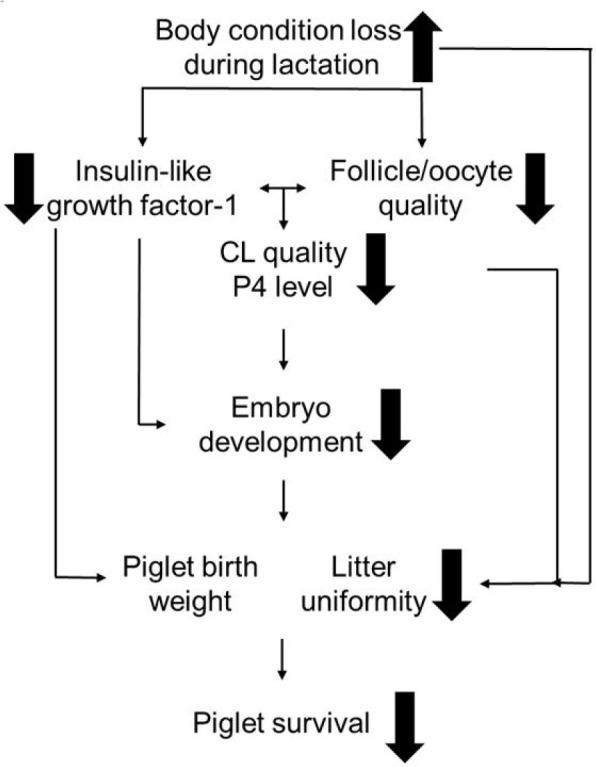
As a result of intensive breeding, litter size has considerably increased in pig production over the last three decades. This has resulted in an increase in farrowing complications. Prolonged farrowing will shorten the window for suckling colostrum and reduce the chances for high-quality colostrum intake. Studies also agree that increasing litter sizes concomitantly resulted in decreased piglet birth weight and increased within-litter birth weight variations. Birth weight, however, is one of the critical factors affecting the prognosis of colostrum intake, and piglet growth, welfare, and survival. Litters of uneven birth weight distribution will suffer and lead to increased piglet mortality before weaning. The proper management is key to handle the situation. Feeding strategies before farrowing, management routines during parturition (e.g., drying and moving piglets to the udder and cross-fostering) and feeding an energy source to piglets after birth may be beneficial management tools with large litters. Insulin-like growth factor 1 (IGF-1)-driven recovery from energy losses during lactation appears critical for supporting follicle development, the viability of oocytes and embryos, and, eventually, litter uniformity. This paper explores certain management routines for neonatal piglets that can lead to the optimization of their colostrum intake and thereby their survival in large litters. In addition, this paper reviews the evidence concerning nutritional factors, particularly lactation feeding that may reduce the loss of sow body reserves, affecting the growth of the next oocyte generation. In conclusion, decreasing birth weight and compromised immunity are subjects warranting investigation in the search for novel management tools. Furthermore, to increase litter uniformity, more focus should be placed on nutritional factors that affect IGF-1-driven follicle development before ovulation.
由于集约化养殖,在过去三十年里,生猪生产中的窝产仔数大幅增加。这导致了分娩并发症的增加。分娩时间延长会缩短仔猪摄入初乳的窗口期,并减少摄入优质初乳的机会。研究还一致认为,窝产仔数增加会导致仔猪出生体重下降以及窝内出生体重差异增大。然而,出生体重是影响初乳摄入、仔猪生长、福利和存活预后的关键因素之一。出生体重分布不均的仔猪会受到影响,并导致断奶前仔猪死亡率增加。恰当的管理是应对这种情况的关键。产前的饲喂策略、分娩期间的管理常规(如擦干仔猪并将其移至乳房处以及交叉寄养)以及产后给仔猪提供能量来源可能是应对多胎仔猪的有益管理手段。胰岛素样生长因子1(IGF-1)驱动的泌乳期能量损失恢复对于支持卵泡发育、卵母细胞和胚胎的活力以及最终的窝内仔猪均匀度似乎至关重要。本文探讨了某些针对新生仔猪的管理常规,这些常规可优化它们的初乳摄入,从而提高它们在多胎仔猪中的存活率。此外,本文回顾了有关营养因素的证据,特别是泌乳期饲喂可能会减少母猪体储备的损失,从而影响下一代卵母细胞的生长。总之,出生体重下降和免疫力受损是寻找新型管理手段时值得研究的课题。此外,为了提高窝内仔猪均匀度,应更加关注排卵前影响IGF-1驱动的卵泡发育的营养因素。

 Zotero 插件