
头颈部鳞状细胞癌的组织病理学图像和基因表达模式分析预测分子特征和预后。
Histopathological image and gene expression pattern analysis for predicting molecular features and prognosis of head and neck squamous cell carcinoma.
机构信息
Department of Biotherapy, Cancer Center, State Key Laboratory of Biotherapy, West China Hospital, Sichuan University, Chengdu, China.
West China School of Medicine, West China Hospital, Sichuan University, Chengdu, China.
出版信息
Cancer Med. 2021 Jul;10(13):4615-4628. doi: 10.1002/cam4.3965. Epub 2021 May 13.
BACKGROUND
Histopathological image features offer a quantitative measurement of cellular morphology, and probably help for better diagnosis and prognosis in head and neck squamous cell carcinoma (HNSCC).
METHODS
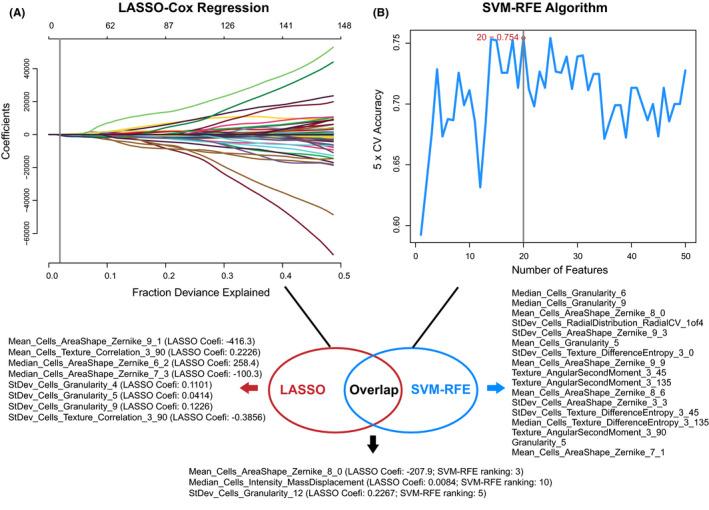
We first used histopathological image features and machine-learning algorithms to predict molecular features of 212 HNSCC patients from The Cancer Genome Atlas (TCGA). Next, we divided TCGA-HNSCC cohort into training set (n = 149) and test set (n = 63), and obtained tissue microarrays as an external validation set (n = 126). We identified the gene expression profile correlated to image features by bioinformatics analysis.
RESULTS
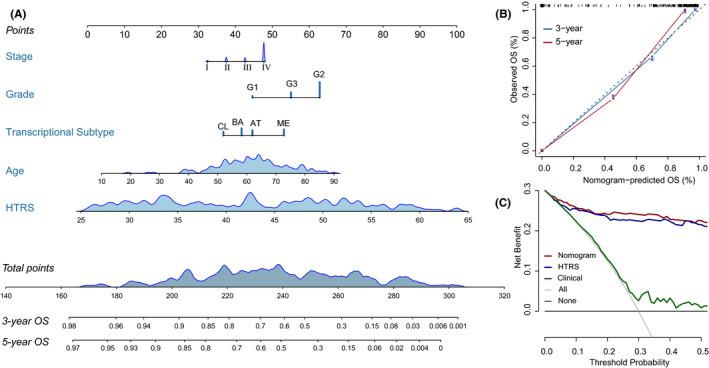
Histopathological image features combined with random forest may predict five somatic mutations, transcriptional subtypes, and methylation subtypes, with area under curve (AUC) ranging from 0.828 to 0.968. The prediction model based on image features could predict overall survival, with 5-year AUC of 0.831, 0.782, and 0.751 in training, test, and validation sets. We next established an integrative prognostic model of image features and gene expressions, which obtained better performance in training set (5-year AUC = 0.860) and test set (5-year AUC = 0.826). According to histopathological transcriptomics risk score (HTRS) generated by the model, high-risk and low-risk patients had different survival in training set (HR = 4.09, p < 0.001) and test set (HR=3.08, p = 0.019). Multivariate analysis suggested that HTRS was an independent predictor in training set (HR = 5.17, p < 0.001). The nomogram combining HTRS and clinical factors had higher net benefit than conventional clinical evaluation.
CONCLUSIONS
Histopathological image features provided a promising approach to predict mutations, molecular subtypes, and prognosis of HNSCC. The integration of image features and gene expression data had potential for improving prognosis prediction in HNSCC.
背景
组织病理学图像特征可提供细胞形态的定量测量,可能有助于对头颈鳞状细胞癌(HNSCC)的更好诊断和预后。
方法
我们首先使用组织病理学图像特征和机器学习算法,从癌症基因组图谱(TCGA)预测 212 名 HNSCC 患者的分子特征。接下来,我们将 TCGA-HNSCC 队列分为训练集(n=149)和测试集(n=63),并获得组织微阵列作为外部验证集(n=126)。我们通过生物信息学分析确定与图像特征相关的基因表达谱。
结果
组织病理学图像特征与随机森林相结合,可以预测五个体细胞突变、转录亚型和甲基化亚型,曲线下面积(AUC)范围为 0.828 至 0.968。基于图像特征的预测模型可以预测总生存期,在训练、测试和验证集中,5 年 AUC 分别为 0.831、0.782 和 0.751。我们随后建立了一个基于图像特征和基因表达的综合预后模型,在训练集(5 年 AUC=0.860)和测试集(5 年 AUC=0.826)中获得了更好的性能。根据模型生成的组织病理学转录组风险评分(HTRS),高风险和低风险患者在训练集(HR=4.09,p<0.001)和测试集(HR=3.08,p=0.019)中的生存情况不同。多变量分析表明,HTRS 是训练集中的独立预测因子(HR=5.17,p<0.001)。结合 HTRS 和临床因素的列线图比传统的临床评估具有更高的净效益。
结论
组织病理学图像特征为预测 HNSCC 的突变、分子亚型和预后提供了一种有前途的方法。图像特征与基因表达数据的整合有可能提高 HNSCC 的预后预测能力。



 Zotero 插件