
头颈部鳞状细胞癌分子特征和亚型的放射组学特征的开发和验证。
Development and validation of radiomic signatures of head and neck squamous cell carcinoma molecular features and subtypes.
机构信息
Chronic Disease Research Institute, School of Public Health, and Women's Hospital, School of Medicine, Zhejiang University, Zhejiang, Hangzhou, China; Department of Nutrition and Food Hygiene, School of Public Health, Zhejiang University, Zhejiang, Hangzhou, China; Department of Medicine, Stanford Center for Biomedical Informatics Research (BMIR), USA.
Department of Medicine, Stanford Center for Biomedical Informatics Research (BMIR), USA; Department of Radiology, Stanford University, USA; Ribeirão Preto Medical School, University of São Paulo, Brazil.
出版信息
EBioMedicine. 2019 Jul;45:70-80. doi: 10.1016/j.ebiom.2019.06.034. Epub 2019 Jun 27.
BACKGROUND
Radiomics-based non-invasive biomarkers are promising to facilitate the translation of therapeutically related molecular subtypes for treatment allocation of patients with head and neck squamous cell carcinoma (HNSCC).
METHODS
We included 113 HNSCC patients from The Cancer Genome Atlas (TCGA-HNSCC) project. Molecular phenotypes analyzed were RNA-defined HPV status, five DNA methylation subtypes, four gene expression subtypes and five somatic gene mutations. A total of 540 quantitative image features were extracted from pre-treatment CT scans. Features were selected and used in a regularized logistic regression model to build binary classifiers for each molecular subtype. Models were evaluated using the average area under the Receiver Operator Characteristic curve (AUC) of a stratified 10-fold cross-validation procedure repeated 10 times. Next, an HPV model was trained with the TCGA-HNSCC, and tested on a Stanford cohort (N = 53).
FINDINGS
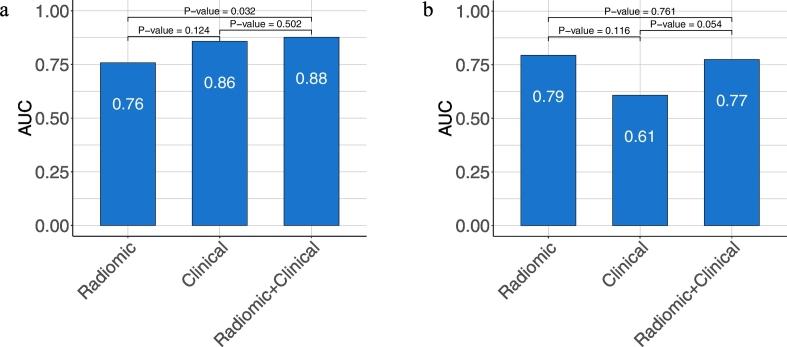
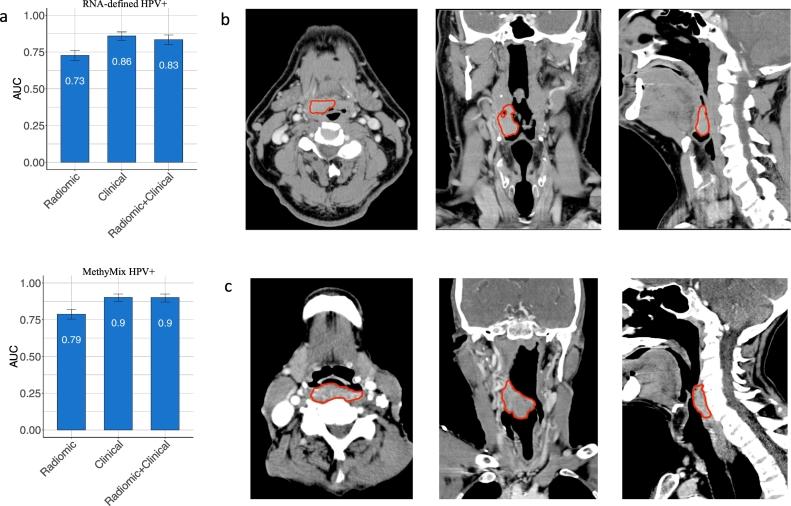
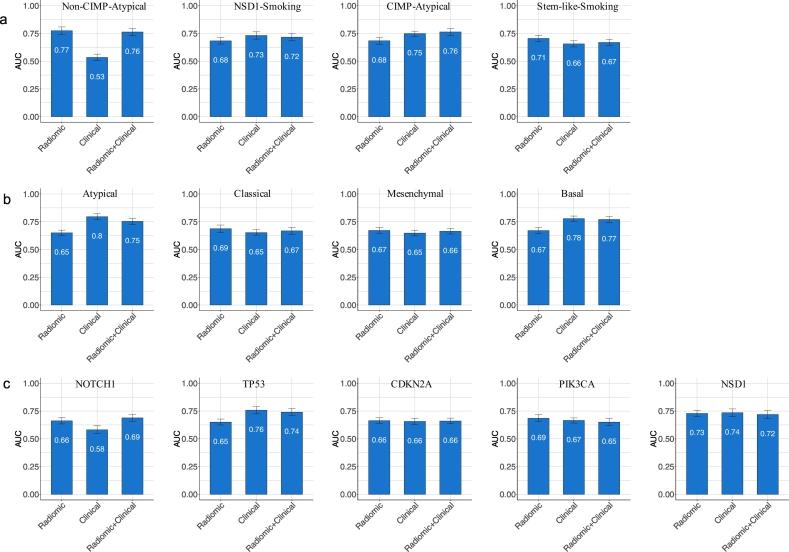
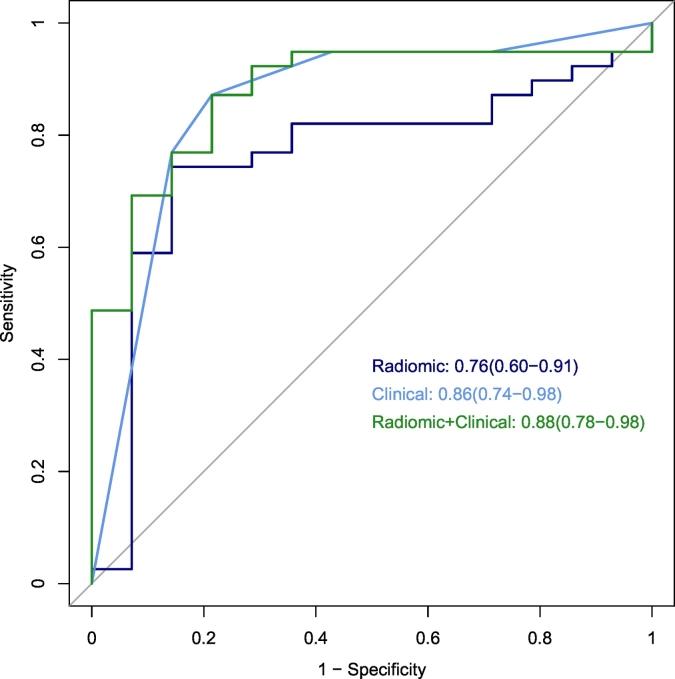
Our results show that quantitative image features are capable of distinguishing several molecular phenotypes. We obtained significant predictive performance for RNA-defined HPV+ (AUC = 0.73), DNA methylation subtypes MethylMix HPV+ (AUC = 0.79), non-CIMP-atypical (AUC = 0.77) and Stem-like-Smoking (AUC = 0.71), and mutation of NSD1 (AUC = 0.73). We externally validated the HPV prediction model (AUC = 0.76) on the Stanford cohort. When compared to clinical models, radiomic models were superior to subtypes such as NOTCH1 mutation and DNA methylation subtype non-CIMP-atypical while were inferior for DNA methylation subtype CIMP-atypical and NSD1 mutation.
INTERPRETATION
Our study demonstrates that radiomics can potentially serve as a non-invasive tool to identify treatment-relevant subtypes of HNSCC, opening up the possibility for patient stratification, treatment allocation and inclusion in clinical trials. FUND: Dr. Gevaert reports grants from National Institute of Dental & Craniofacial Research (NIDCR) U01 DE025188, grants from National Institute of Biomedical Imaging and Bioengineering of the National Institutes of Health (NIBIB), R01 EB020527, grants from National Cancer Institute (NCI), U01 CA217851, during the conduct of the study; Dr. Huang and Dr. Zhu report grants from China Scholarship Council (Grant NO:201606320087), grants from China Medical Board Collaborating Program (Grant NO:15-216), the Cyrus Tang Foundation, and the Zhejiang University Education Foundation during the conduct of the study; Dr. Cintra reports grants from São Paulo State Foundation for Teaching and Research (FAPESP), during the conduct of the study.
背景
基于放射组学的无创生物标志物有望促进治疗相关分子亚型的转化,从而为头颈部鳞状细胞癌(HNSCC)患者的治疗分配提供便利。
方法
我们纳入了来自癌症基因组图谱(TCGA-HNSCC)项目的 113 名 HNSCC 患者。分析的分子表型包括 RNA 定义的 HPV 状态、五种 DNA 甲基化亚型、四种基因表达亚型和五种体细胞基因突变。从治疗前 CT 扫描中提取了 540 个定量图像特征。使用正则化逻辑回归模型选择和使用特征来为每个分子亚型构建二进制分类器。使用重复 10 次的分层 10 倍交叉验证程序的平均接收器工作特征曲线(ROC)下面积(AUC)评估模型。接下来,我们使用 TCGA-HNSCC 训练 HPV 模型,并在斯坦福队列(N=53)上进行测试。
结果
我们的结果表明,定量图像特征能够区分几种分子表型。我们在 RNA 定义的 HPV+(AUC=0.73)、DNA 甲基化亚型 MethylMix HPV+(AUC=0.79)、非-CIMP-非典型(AUC=0.77)和 Stem-like-Smoking(AUC=0.71),以及 NSD1 突变(AUC=0.73)方面获得了显著的预测性能。我们在斯坦福队列上对外验证了 HPV 预测模型(AUC=0.76)。与临床模型相比,放射组学模型在 NOTCH1 突变和 DNA 甲基化亚型非 CIMP-非典型等亚型方面优于临床模型,而在 DNA 甲基化亚型 CIMP-非典型和 NSD1 突变方面则逊于临床模型。
解释
我们的研究表明,放射组学有可能成为一种非侵入性工具,用于识别 HNSCC 的治疗相关亚型,为患者分层、治疗分配和纳入临床试验开辟了可能性。
经费
Gevaert 博士报告了美国国立牙科和颅面研究所(NIDCR)U01 DE025188、美国国立生物医学影像和生物工程研究所(NIBIB)R01 EB020527、美国国立癌症研究所(NCI)U01 CA217851 的拨款,在研究期间;Huang 博士和 Zhu 博士报告了中国国家留学基金委员会(Grant NO:201606320087)、中国医学委员会合作项目(Grant NO:15-216)、赛勒斯·唐基金会和浙江大学教育基金会的拨款,在研究期间;Cintra 博士报告了巴西圣保罗州研究与教学基金会(FAPESP)的拨款,在研究期间。

 Zotero 插件