
中风后外骨骼训练期间感觉运动恢复与代偿的分离
Dissociating Sensorimotor Recovery and Compensation During Exoskeleton Training Following Stroke.
作者信息
Nibras Nadir, Liu Chang, Mottet Denis, Wang Chunji, Reinkensmeyer David, Remy-Neris Olivier, Laffont Isabelle, Schweighofer Nicolas
机构信息
Department of Biomedical Engineering, University of Southern California, Los Angeles, CA, United States.
Euromov Digital Health in Motion, University of Montpellier, IMT Mines Alès, Montpellier, France.
出版信息
Front Hum Neurosci. 2021 Apr 30;15:645021. doi: 10.3389/fnhum.2021.645021. eCollection 2021.
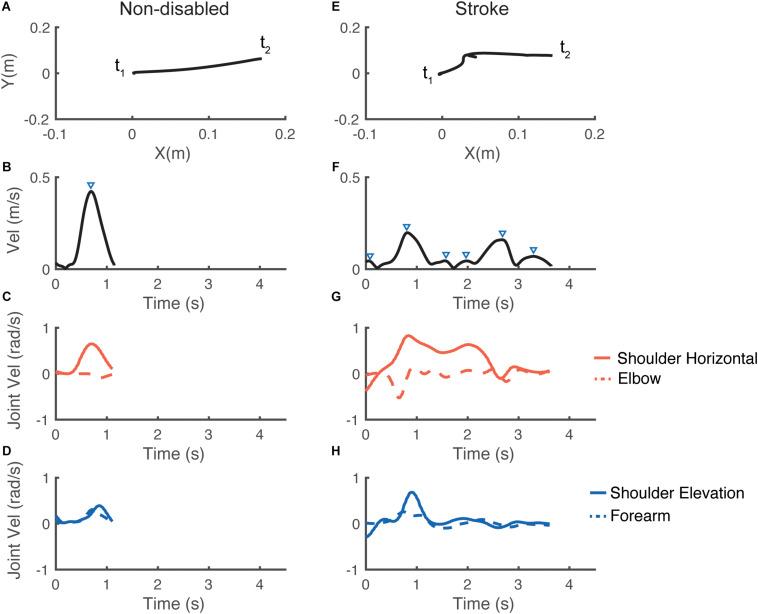
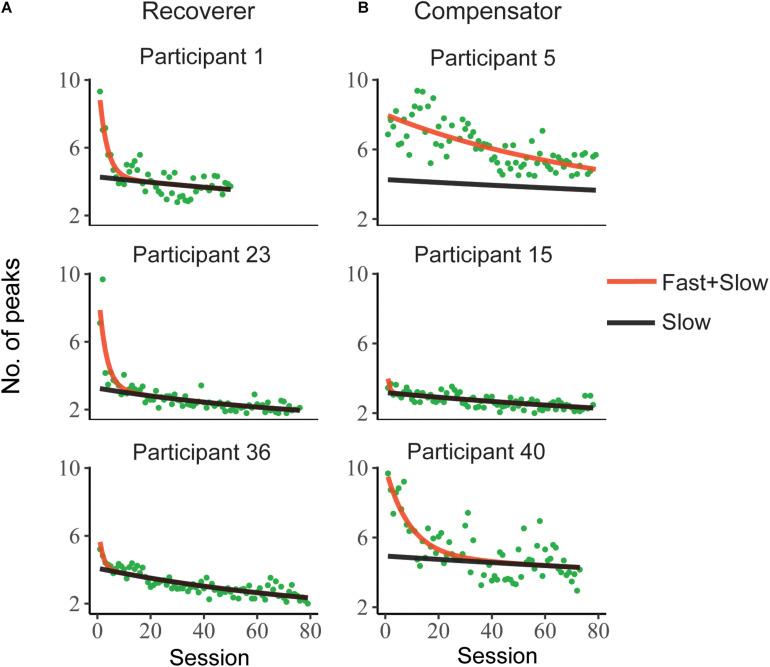
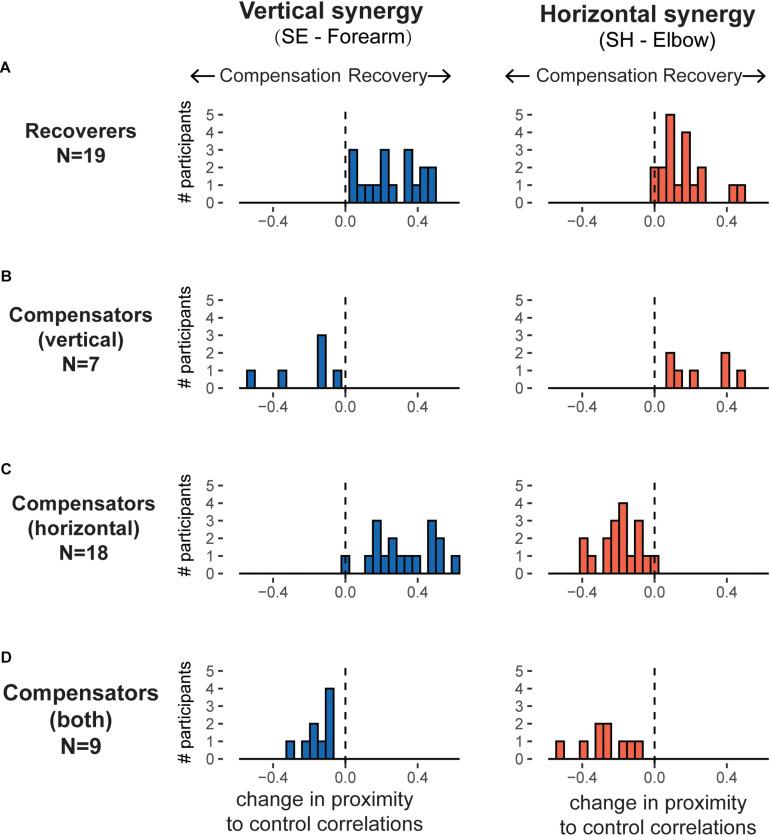
The quality of arm movements typically improves in the sub-acute phase of stroke affecting the upper extremity. Here, we used whole arm kinematic analysis during reaching movements to distinguish whether these improvements are due to true recovery or to compensation. Fifty-three participants with post-acute stroke performed ∼80 reaching movement tests during 4 weeks of training with the ArmeoSpring exoskeleton. All participants showed improvements in end-effector performance, as measured by movement smoothness. Four ArmeoSpring angles, shoulder horizontal (SH) rotation, shoulder elevation (SE), elbow rotation, and forearm rotation, were recorded and analyzed. We first characterized healthy joint coordination patterns by performing a sparse principal component analysis on these four joint velocities recorded during reaching tests performed by young control participants. We found that two dominant joint correlations [SH with elbow rotation and SE with forearm rotation] explained over 95% of variance of joint velocity data. We identified two clusters of stroke participants by comparing the evolution of these two correlations in all tests. In the "Recoverer" cluster ( = 19), both joint correlations converged toward the respective correlations for control participants. Thus, Recoverers relearned how to generate smooth end-effector movements while developing joint movement patterns similar to those of control participants. In the "Compensator" cluster ( = 34), at least one of the two joint correlations diverged from the corresponding correlation of control participants. Compensators relearned how to generate smooth end-effector movements by discovering various new compensatory movement patterns dissimilar to those of control participants. New compensatory patterns included atypical decoupling of the SE and forearm joints, and atypical coupling of the SH rotation and elbow joints. There was no difference in clinical impairment level between the two groups either at the onset or at the end of training as assessed with the Upper Extremity Fugl-Meyer scale. However, at the start of training, the Recoverers showed significantly faster improvements in end-effector movement smoothness than the Compensators. Our analysis can be used to inform neurorehabilitation clinicians on how to provide movement feedback during practice and suggest avenues for refining exoskeleton robot therapy to reduce compensatory patterns.
在影响上肢的中风亚急性期,手臂运动质量通常会有所改善。在此,我们在伸手动作过程中使用全臂运动学分析,以区分这些改善是由于真正的恢复还是代偿。53名急性中风后参与者在使用ArmeoSpring外骨骼进行4周训练期间进行了约80次伸手动作测试。所有参与者的末端执行器性能均有改善,以运动平滑度衡量。记录并分析了四个ArmeoSpring角度,即肩部水平(SH)旋转、肩部抬高(SE)、肘部旋转和前臂旋转。我们首先通过对年轻对照参与者在伸手测试期间记录的这四个关节速度进行稀疏主成分分析,来表征健康的关节协调模式。我们发现两个主要的关节相关性[SH与肘部旋转以及SE与前臂旋转]解释了关节速度数据方差的95%以上。通过比较所有测试中这两个相关性的演变,我们识别出两组中风参与者。在“恢复者”组(n = 19)中,两个关节相关性均趋向于对照参与者的相应相关性。因此,恢复者重新学习如何产生平滑的末端执行器运动,同时发展出与对照参与者相似的关节运动模式。在“代偿者”组(n = 34)中,两个关节相关性中至少有一个与对照参与者的相应相关性不同。代偿者通过发现各种与对照参与者不同的新代偿运动模式,重新学习如何产生平滑的末端执行器运动。新的代偿模式包括SE和前臂关节的非典型解耦,以及SH旋转和肘关节的非典型耦合。用上肢Fugl - Meyer量表评估,两组在训练开始时或结束时的临床损伤水平均无差异。然而,在训练开始时,恢复者在末端执行器运动平滑度方面的改善明显快于代偿者。我们的分析可用于告知神经康复临床医生如何在实践中提供运动反馈,并为改进外骨骼机器人治疗以减少代偿模式提供建议途径。




 Zotero 插件