
上肢多自由度运动的运动学协同及其在康复外骨骼运动规划中的应用
Kinematic Synergy of Multi-DoF Movement in Upper Limb and Its Application for Rehabilitation Exoskeleton Motion Planning.
作者信息
Tang Shangjie, Chen Lin, Barsotti Michele, Hu Lintao, Li Yongqiang, Wu Xiaoying, Bai Long, Frisoli Antonio, Hou Wensheng
机构信息
Key Laboratory of Biorheological Science and Technology, Ministry of Education, Bioengineering College, Chongqing University, Chongqing, China.
Chongqing Key Laboratory of Artificial Intelligence and Service Robot Control Technology, Chongqing, China.
出版信息
Front Neurorobot. 2019 Nov 29;13:99. doi: 10.3389/fnbot.2019.00099. eCollection 2019.
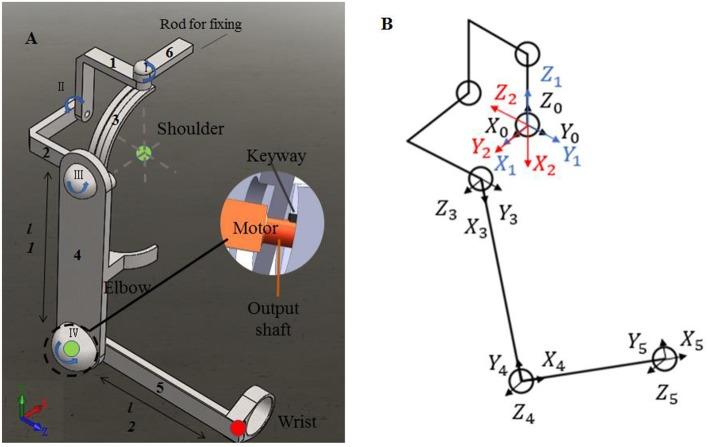
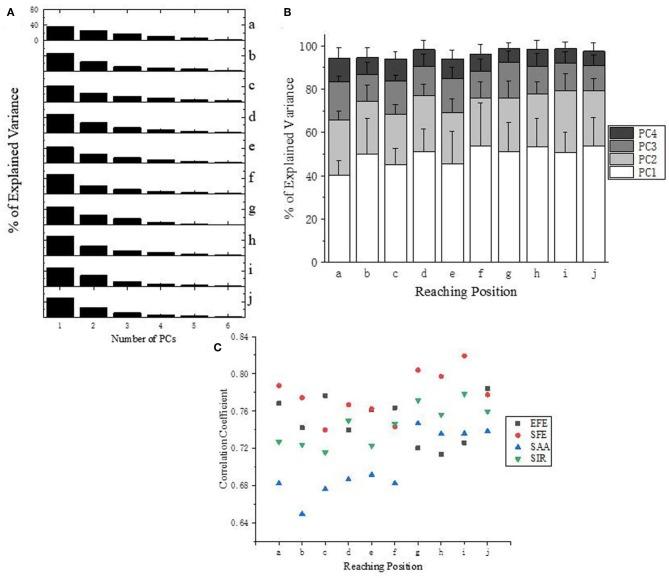
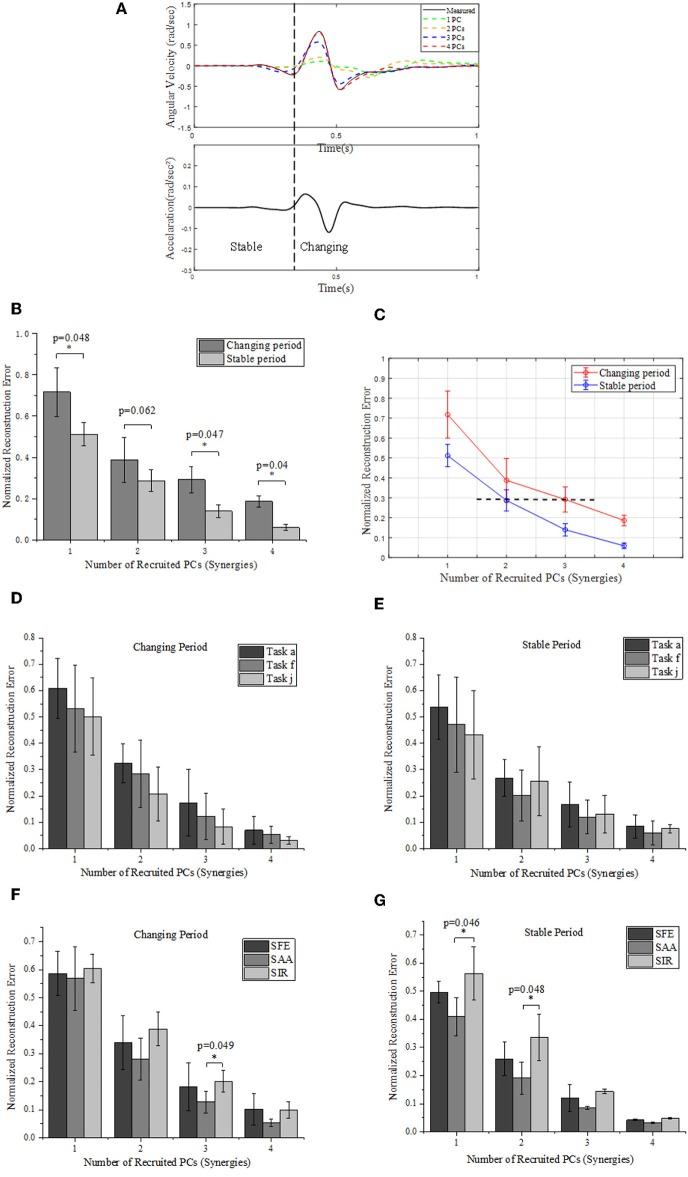
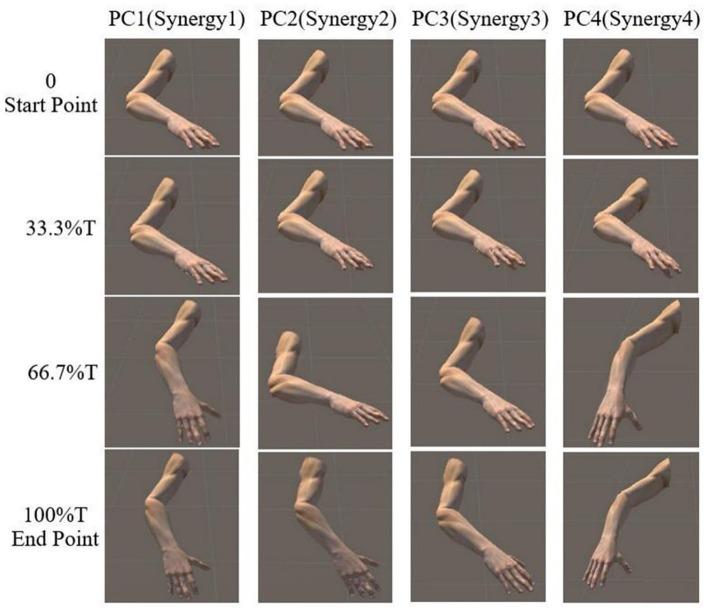
It is important for rehabilitation exoskeletons to move with a spatiotemporal motion patterns that well match the upper-limb joint kinematic characteristics. However, few efforts have been made to manipulate the motion control based on human kinematic synergies. This work analyzed the spatiotemporal kinematic synergies of right arm reaching movement and investigated their potential usage in upper limb assistive exoskeleton motion planning. Ten right-handed subjects were asked to reach 10 target button locations placed on a cardboard in front. The kinematic data of right arm were tracked by a motion capture system. Angular velocities over time for shoulder flexion/extension, shoulder abduction/adduction, shoulder internal/external rotation, and elbow flexion/extension were computed. Principal component analysis (PCA) was used to derive kinematic synergies from the reaching task for each subject. We found that the first four synergies can explain more than 94% of the variance. Moreover, the joint coordination patterns were dynamically regulated over time as the number of kinematic synergy (PC) increased. The synergies with different order played different roles in reaching movement. Our results indicated that the low-order synergies represented the overall trend of motion patterns, while the high-order synergies described the fine motions at specific moving phases. A 4-DoF upper limb assistive exoskeleton was modeled in SolidWorks to simulate assistive exoskeleton movement pattern based on kinematic synergy. An exoskeleton Denavit-Hartenberg (D-H) model was established to estimate the exoskeleton moving pattern in reaching tasks. The results further confirmed that kinematic synergies could be used for exoskeleton motion planning, and different principal components contributed to the motion trajectory and end-point accuracy to some extent. The findings of this study may provide novel but simplified strategies for the development of rehabilitation and assistive robotic systems approximating the motion pattern of natural upper-limb motor function.
康复外骨骼以与上肢关节运动学特征良好匹配的时空运动模式进行运动非常重要。然而,基于人体运动协同作用来操纵运动控制的努力却很少。这项工作分析了右臂伸展运动的时空运动协同作用,并研究了它们在上肢辅助外骨骼运动规划中的潜在用途。十名右利手受试者被要求触及放置在前方纸板上的10个目标按钮位置。右臂的运动学数据由运动捕捉系统跟踪。计算了肩屈伸、肩外展/内收、肩内/外旋和肘屈伸随时间的角速度。主成分分析(PCA)用于从每个受试者的伸手任务中导出运动协同作用。我们发现前四个协同作用可以解释超过94%的方差。此外,随着运动协同作用(主成分)数量的增加,关节协调模式随时间动态调节。不同阶次的协同作用在伸手运动中发挥不同作用。我们的结果表明,低阶协同作用代表了运动模式的总体趋势,而高阶协同作用描述了特定运动阶段的精细运动。在SolidWorks中对一个4自由度的上肢辅助外骨骼进行建模,以基于运动协同作用模拟辅助外骨骼的运动模式。建立了外骨骼的Denavit-Hartenberg(D-H)模型来估计伸手任务中外骨骼的运动模式。结果进一步证实运动协同作用可用于外骨骼运动规划,并且不同的主成分在一定程度上有助于运动轨迹和终点精度。本研究的结果可能为开发近似自然上肢运动功能运动模式的康复和辅助机器人系统提供新颖但简化的策略。



 Zotero 插件