
LINC02257是一种在结肠腺癌中具有预后价值的增强子RNA,与33种癌症的多组学免疫治疗相关分析相关。
LINC02257, an Enhancer RNA of Prognostic Value in Colon Adenocarcinoma, Correlates With Multi-Omics Immunotherapy-Related Analysis in 33 Cancers.
作者信息
Xiao Junbo, Liu Yajun, Yi Jun, Liu Xiaowei
机构信息
Department of Gastroenterology, Xiangya Hospital, Central South University, Changsha, China.
出版信息
Front Mol Biosci. 2021 Apr 30;8:646786. doi: 10.3389/fmolb.2021.646786. eCollection 2021.
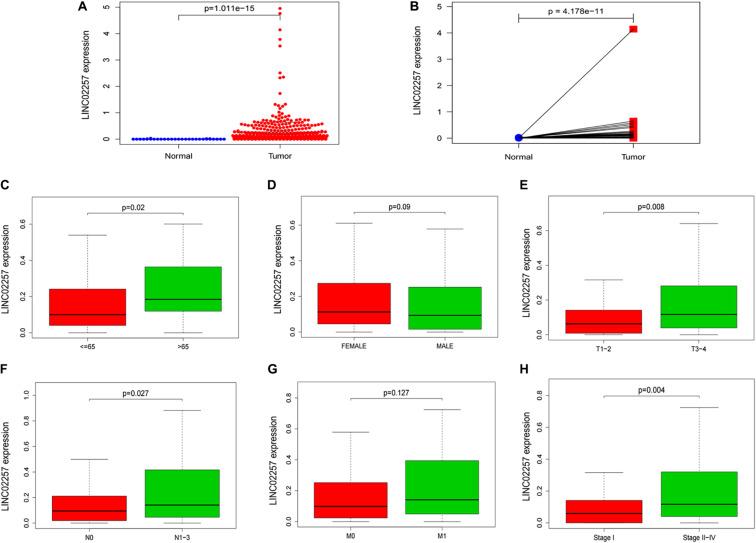
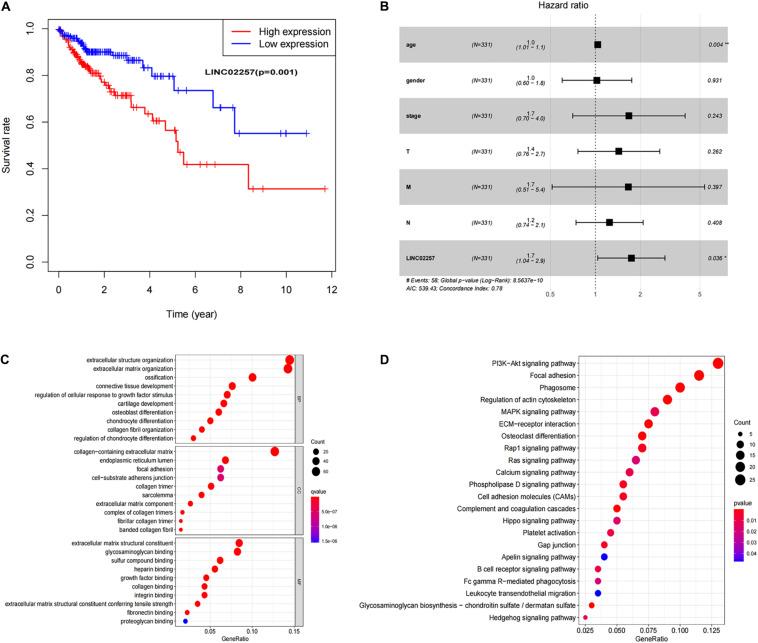
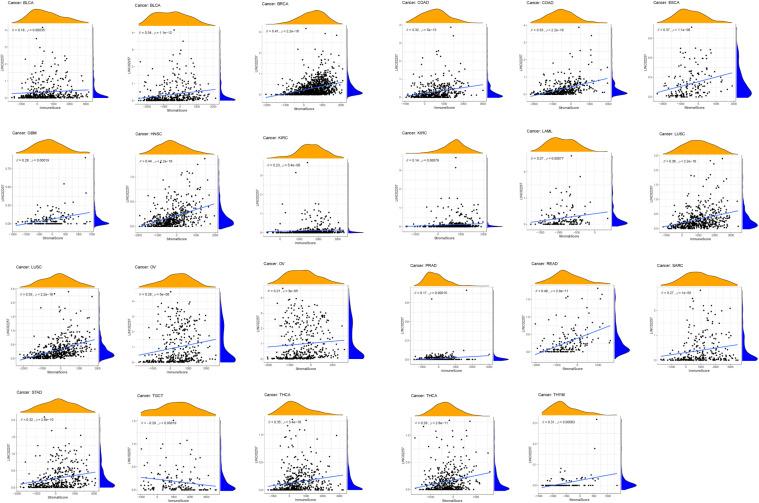
Accumulated evidence supports that long non-coding RNAs (lncRNAs) are involved significantly in the development of human cancers. Enhancer RNAs (eRNAs), a subtype of lncRNAs, have recently attracted much attention about their roles in carcinogenesis. Colon adenocarcinoma is one of the most commonly diagnosed tumors with unfavorable prognosis. It highlights the great significance of screening and identifying novel biomarkers. More importantly, it remains to be elucidated with respect to the function of eRNAs in colon adenocarcinoma, as is in pan-cancers. The expression of LINC02257 was determined based on the data obtained from The Cancer Genome Atlas (TCGA). Further evaluation was performed on the basis of the following analyses: clinicopathology and survival analysis, gene ontology (GO) terms, and Kyoto Encyclopedia of Genes and Genomes (KEGG) pathway analysis, as well as multi-omics immunotherapy-related analysis and co-expression analysis. The statistical analysis was conducted in R software, and immune cell infiltration of LINC02257 expression in cancers was investigated by using the CIBERSORT algorithm. By large-scale data mining, our study highlighted that a total of 39 eRNA genes were associated with colon adenocarcinoma prognosis, among which 25 eRNAs showed significant associations with their predicted target genes. LINC02257 was identified as the most significant survival-associated eRNA, with DUSP10 as its target gene. Besides, the high expression of LINC02257 in colon adenocarcinoma was more vulnerable to unfavorable prognosis and correlated with various clinical characteristics. GO and KEGG analyses revealed that LINC02257 was closely correlated with extracellular matrix organization via the PI3K-Akt signaling pathway. Besides, LINC02257 expression correlated with a multi-omics analysis of 33 cancer types, such as survival analysis [overall survival (OS), disease-specific survival (DSS), disease-free interval (DFI), and progression-free interval (PFI)] and immunotherapy-related analysis [tumor microenvironment (TME), tumor mutational burden (TMB), and microsatellite instability (MSI)]. Finally, we investigated the co-expression genes of LINC02257 and its potential signaling pathways across different cancer types. LINC02257 is screened and can function as an independent prognostic biomarker through the PI3K-Akt signaling pathway for colon adenocarcinoma. Simultaneously, LINC02257 may be a multifaceted and significant immunotherapy-related eRNA in different cancers.
越来越多的证据支持长链非编码RNA(lncRNAs)在人类癌症发展中发挥着重要作用。增强子RNA(eRNAs)作为lncRNAs的一种亚型,其在致癌作用中的角色最近备受关注。结肠腺癌是最常见的诊断肿瘤之一,预后不佳。这凸显了筛选和鉴定新型生物标志物的重大意义。更重要的是,与泛癌情况一样,eRNAs在结肠腺癌中的功能仍有待阐明。基于从癌症基因组图谱(TCGA)获得的数据,确定了LINC02257的表达。基于以下分析进行了进一步评估:临床病理学和生存分析、基因本体(GO)术语、京都基因与基因组百科全书(KEGG)通路分析,以及多组学免疫治疗相关分析和共表达分析。在R软件中进行统计分析,并使用CIBERSORT算法研究癌症中LINC02257表达的免疫细胞浸润情况。通过大规模数据挖掘,我们的研究强调共有39个eRNA基因与结肠腺癌预后相关,其中25个eRNAs与其预测的靶基因显示出显著关联。LINC02257被确定为与生存最相关的eRNA,其靶基因为DUSP10。此外,LINC02257在结肠腺癌中的高表达更容易导致不良预后,并与各种临床特征相关。GO和KEGG分析表明,LINC02257通过PI3K-Akt信号通路与细胞外基质组织密切相关。此外,LINC02257的表达与33种癌症类型的多组学分析相关,如生存分析[总生存期(OS)、疾病特异性生存期(DSS)、无病间期(DFI)和无进展间期(PFI)]以及免疫治疗相关分析[肿瘤微环境(TME)、肿瘤突变负担(TMB)和微卫星不稳定性(MSI)]。最后,我们研究了不同癌症类型中LINC02257的共表达基因及其潜在信号通路。LINC02257被筛选出来,可通过PI3K-Akt信号通路作为结肠腺癌的独立预后生物标志物。同时,LINC02257可能是不同癌症中一个多方面且重要的免疫治疗相关eRNA。





 Zotero 插件