
预测建模在 COVID-19 疫情控制中的应用:来自斯里兰卡海军集群的经验教训。
Predictive modelling for COVID-19 outbreak control: lessons from the navy cluster in Sri Lanka.
机构信息
Disaster Preparedness and Response Division, Ministry of Health, 385, Rev. Baddegama Wimalawansa Thero Mawatha, Colombo, 01000, Sri Lanka.
Epidemiology Unit of the Ministry of Health, Colombo, 01000, Sri Lanka.
出版信息
Mil Med Res. 2021 May 18;8(1):31. doi: 10.1186/s40779-021-00325-4.
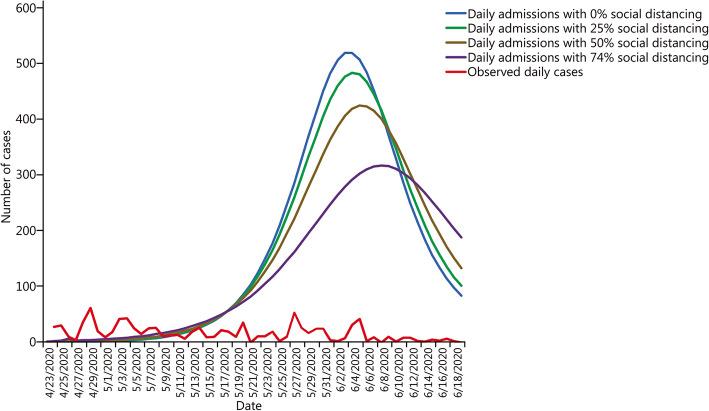
In response to an outbreak of coronavirus disease 2019 (COVID-19) within a cluster of Navy personnel in Sri Lanka commencing from 22nd April 2020, an aggressive outbreak management program was launched by the Epidemiology Unit of the Ministry of Health. To predict the possible number of cases within the susceptible population under four social distancing scenarios, the COVID-19 Hospital Impact Model for Epidemics (CHIME) was used. With increasing social distancing, the epidemiological curve flattened, and its peak shifted to the right. The observed or actually reported number of cases was above the projected number of cases at the onset; however, subsequently, it fell below all predicted trends. Predictive modelling is a useful tool for the control of outbreaks such as COVID-19 in a closed community.
针对 2020 年 4 月 22 日起斯里兰卡海军人员集群中爆发的 2019 年冠状病毒病(COVID-19),卫生部流行病学股启动了一项积极的疫情管理方案。为了预测在四种社会隔离情景下易感人群中可能的病例数,使用了 COVID-19 传染病医院影响模型(CHIME)。随着社会隔离程度的增加,流行病学曲线变平,峰值右移。观察到的或实际报告的病例数高于发病时预测的病例数;然而,随后,它低于所有预测趋势。预测模型是控制 COVID-19 等封闭社区中疫情的有用工具。
 Zotero 插件