
研究饮食脂肪对瘦鼠和饮食诱导肥胖鼠小肠各区域细胞质脂滴的影响。
Characterization of cytoplasmic lipid droplets in each region of the small intestine of lean and diet-induced obese mice in response to dietary fat.
机构信息
Department of Nutrition Science, Purdue University, West Lafayette, Indiana.
出版信息
Am J Physiol Gastrointest Liver Physiol. 2021 Jul 1;321(1):G75-G86. doi: 10.1152/ajpgi.00084.2021. Epub 2021 May 19.
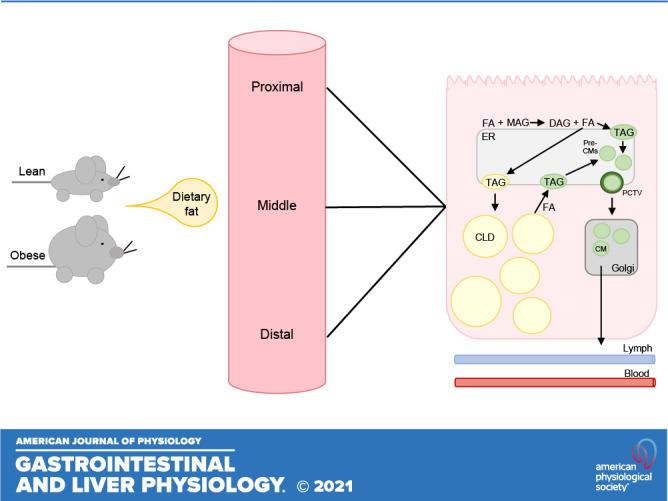
The absorptive cells of the small intestine, namely, enterocytes, contribute to postprandial blood lipid levels by secreting dietary triacylglycerol in chylomicrons. The rate and amount of dietary triacylglycerol absorbed vary along the length of the small intestine. Excess dietary triacylglycerol not immediately secreted in chylomicrons can be temporarily stored in cytoplasmic lipid droplets (CLDs) and repackaged in chylomicrons at later times. The characteristics of CLDs, including their size, number per cell, and associated proteins, may influence CLD metabolism and reflect differences in lipid processing or storage in each intestinal region. However, it is unknown whether the characteristics or proteomes of CLDs differ in enterocytes of each intestine region in response to dietary fat. Furthermore, it is unclear if obesity influences the characteristics or proteomes of CLDs in each intestine region. To address this, we used transmission electron microscopy and shotgun liquid chromatography tandem mass spectrometry (LC-MS/MS) analysis to assess the characteristics and proteome of CLDs in the proximal, middle, and distal regions of the small intestine of lean and diet-induced obese (DIO) mice 2 h after an oil gavage. We identified differences in lipid storage along the length of the small intestine and between lean and DIO mice, as well as distinct CLD proteomes reflecting potentially unique roles of CLDs in each region. This study reveals differences in lipid processing along the length of the small intestine in response to dietary fat in lean and DIO mice and reflects distinct features of the proximal, middle, distal region of the small intestine. This study reflects the dynamics of fat absorption along the length of the small intestine in lean and obese mice in the physiological response to dietary fat. We identified unique features of cytoplasmic lipid droplets (CLDs) in the proximal, middle, and distal regions of the small intestine of lean and obese mice that may contribute to regional differences in dietary fat processing, absorption, or CLD metabolism.
小肠的吸收细胞,即肠细胞,通过分泌乳糜微粒中的膳食三酰甘油来影响餐后血脂水平。膳食三酰甘油的吸收速率和量沿小肠的长度而变化。未立即在乳糜微粒中分泌的多余膳食三酰甘油可以暂时储存在细胞质脂滴 (CLD) 中,并在以后的时间重新包装在乳糜微粒中。CLD 的特征,包括其大小、每个细胞中的数量和相关蛋白,可能会影响 CLD 的代谢,并反映每个肠段中脂质处理或储存的差异。然而,尚不清楚膳食脂肪是否会影响每个肠段的肠细胞中 CLD 的特征或蛋白质组。此外,尚不清楚肥胖是否会影响每个肠段中 CLD 的特征或蛋白质组。为了解决这个问题,我们使用透射电子显微镜和 shotgun 液相色谱串联质谱 (LC-MS/MS) 分析来评估瘦鼠和饮食诱导肥胖 (DIO) 小鼠在油灌胃后 2 小时小肠近端、中部和远端区域 CLD 的特征和蛋白质组。我们发现了沿小肠长度和瘦鼠与 DIO 小鼠之间的脂质储存差异,以及反映每个区域中 CLD 潜在独特作用的不同 CLD 蛋白质组。这项研究揭示了在瘦鼠和 DIO 小鼠中,膳食脂肪沿小肠长度的脂质处理差异,并反映了近端、中部和远端小肠区域的独特特征。这项研究反映了在生理应对膳食脂肪的过程中,脂肪在吸收过程中沿小肠长度的动态变化。我们在瘦鼠和肥胖鼠的小肠近端、中部和远端区域中鉴定到了细胞质脂滴 (CLD) 的独特特征,这些特征可能有助于解释膳食脂肪处理、吸收或 CLD 代谢方面的区域差异。
 Zotero 插件