
AIM2 在自身免疫性疾病和癌症中的复杂作用。
The complex role of AIM2 in autoimmune diseases and cancers.
机构信息
Department of Dermatology, Hunan Key Laboratory of Medical Epigenomics, The Second Xiangya Hospital of Central South University, Changsha, China.
Division of Rheumatology, Allergy and Clinical Immunology, University of California at Davis School of Medicine, Davis, California, USA.
出版信息
Immun Inflamm Dis. 2021 Sep;9(3):649-665. doi: 10.1002/iid3.443. Epub 2021 May 20.
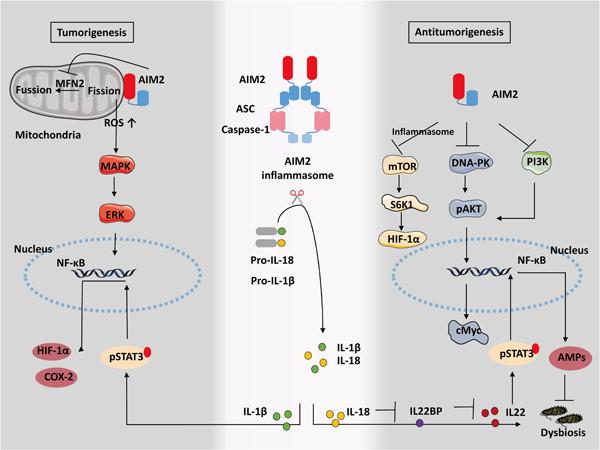
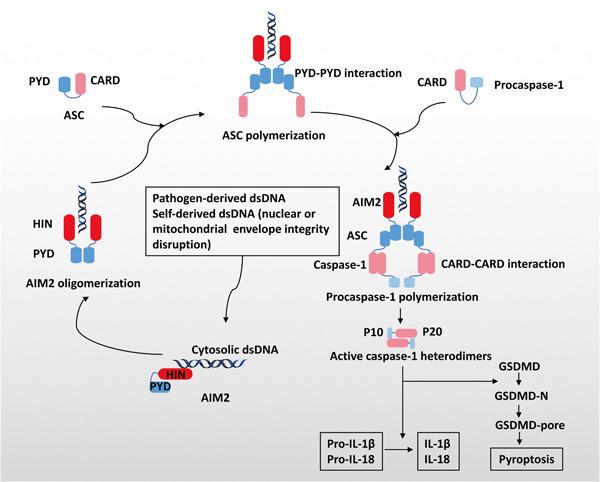
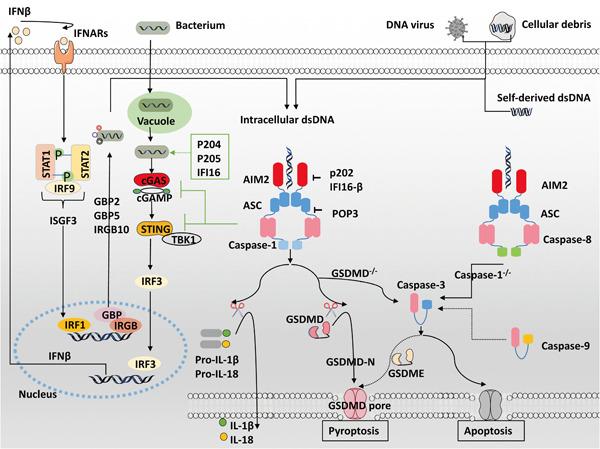
Absent in melanoma 2 (AIM2) is a novel member of interferon (IFN)-inducible PYHIN proteins. In innate immune cells, AIM2 servers as a cytoplasmic double-stranded DNA sensor, playing a crucial role in the initiation of the innate immune response as a component of the inflammasome. AIM2 expression is increased in patients with systemic lupus erythematosus (SLE), psoriasis, and primary Sjogren's syndrome, indicating that AIM2 might be involved in the pathogenesis of autoimmune diseases. Meanwhile, AIM2 also plays an antitumorigenesis role in an inflammasome independent-manner. In melanoma, AIM2 is initially identified as a tumor suppressor factor. However, AIM2 is also found to contribute to lung tumorigenesis via the inflammasome-dependent release of interleukin 1β and regulation of mitochondrial dynamics. Additionally, AIM2 reciprocally dampening the cGAS-STING pathway causes immunosuppression of macrophages and evasion of antitumor immunity during antibody treatment. To summarize the complicated effect and role of AIM2 in autoimmune diseases and cancers, herein, we provide an overview of the emerging research progress on the function and regulatory pathway of AIM2 in innate and adaptive immune cells, as well as tumor cells, and discuss its pathogenic role in autoimmune diseases, such as SLE, psoriasis, primary Sjogren's syndrome, and cancers, such as melanomas, non-small-cell lung cancer, colon cancer, hepatocellular carcinoma, renal carcinoma, and so on, hopefully providing potential therapeutic and diagnostic strategies for clinical use.
缺失在黑色素瘤 2 中(AIM2)是干扰素(IFN)诱导的 PYHIN 蛋白家族的新成员。在先天免疫细胞中,AIM2 作为细胞质双链 DNA 传感器,作为炎症小体的一部分,在先天免疫反应的启动中发挥着至关重要的作用。系统性红斑狼疮(SLE)、银屑病和原发性干燥综合征患者的 AIM2 表达增加,表明 AIM2 可能参与自身免疫性疾病的发病机制。同时,AIM2 也以炎症小体非依赖的方式发挥抗肿瘤作用。在黑色素瘤中,AIM2 最初被鉴定为肿瘤抑制因子。然而,AIM2 也被发现通过炎症小体依赖性释放白细胞介素 1β和调节线粒体动力学来促进肺癌的发生。此外,AIM2 通过反向抑制 cGAS-STING 通路导致巨噬细胞的免疫抑制和抗体治疗期间抗肿瘤免疫的逃逸。为了总结 AIM2 在自身免疫性疾病和癌症中的复杂作用和作用,本文综述了 AIM2 在先天和适应性免疫细胞以及肿瘤细胞中的功能和调控途径的新研究进展,并讨论了其在自身免疫性疾病(如 SLE、银屑病、原发性干燥综合征)中的致病作用,以及癌症(如黑色素瘤、非小细胞肺癌、结肠癌、肝细胞癌、肾癌等),希望为临床应用提供潜在的治疗和诊断策略。
 Zotero 插件