
基于脑 MRI 的脑胶质瘤分割的机器学习算法性能:系统文献回顾和荟萃分析。
Performance of machine learning algorithms for glioma segmentation of brain MRI: a systematic literature review and meta-analysis.
机构信息
Department of Medical Imaging, Radboud University Medical Center, Geert Grooteplein Zuid 10, 6525 EZ, Nijmegen, The Netherlands.
Clinic of Radiology, University Hospital Münster, Münster, Germany.
出版信息
Eur Radiol. 2021 Dec;31(12):9638-9653. doi: 10.1007/s00330-021-08035-0. Epub 2021 May 21.
OBJECTIVES
Different machine learning algorithms (MLAs) for automated segmentation of gliomas have been reported in the literature. Automated segmentation of different tumor characteristics can be of added value for the diagnostic work-up and treatment planning. The purpose of this study was to provide an overview and meta-analysis of different MLA methods.
METHODS
A systematic literature review and meta-analysis was performed on the eligible studies describing the segmentation of gliomas. Meta-analysis of the performance was conducted on the reported dice similarity coefficient (DSC) score of both the aggregated results as two subgroups (i.e., high-grade and low-grade gliomas). This study was registered in PROSPERO prior to initiation (CRD42020191033).
RESULTS
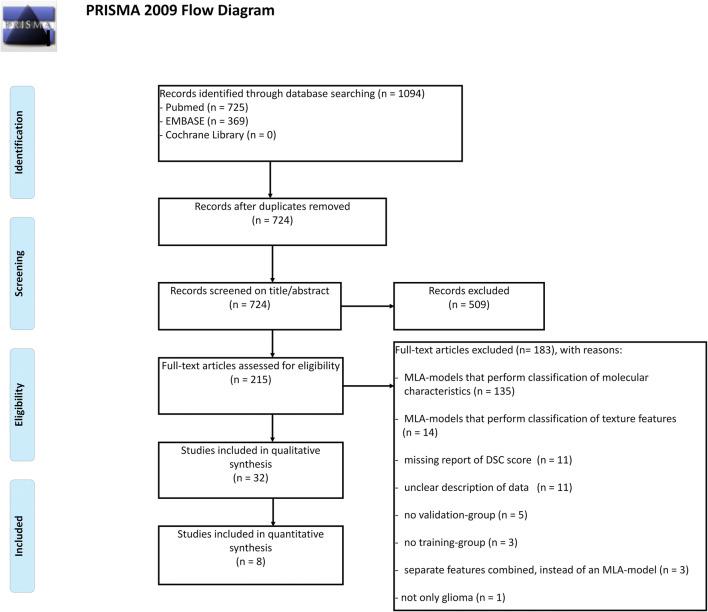
After the literature search (n = 734), 42 studies were included in the systematic literature review. Ten studies were eligible for inclusion in the meta-analysis. Overall, the MLAs from the included studies showed an overall DSC score of 0.84 (95% CI: 0.82-0.86). In addition, a DSC score of 0.83 (95% CI: 0.80-0.87) and 0.82 (95% CI: 0.78-0.87) was observed for the automated glioma segmentation of the high-grade and low-grade gliomas, respectively. However, heterogeneity was considerably high between included studies, and publication bias was observed.
CONCLUSION
MLAs facilitating automated segmentation of gliomas show good accuracy, which is promising for future implementation in neuroradiology. However, before actual implementation, a few hurdles are yet to be overcome. It is crucial that quality guidelines are followed when reporting on MLAs, which includes validation on an external test set.
KEY POINTS
• MLAs from the included studies showed an overall DSC score of 0.84 (95% CI: 0.82-0.86), indicating a good performance. • MLA performance was comparable when comparing the segmentation results of the high-grade gliomas and the low-grade gliomas. • For future studies using MLAs, it is crucial that quality guidelines are followed when reporting on MLAs, which includes validation on an external test set.
目的
不同的机器学习算法(MLAs)已被用于胶质瘤的自动分割,这在文献中已有报道。对不同肿瘤特征的自动分割可能对诊断和治疗计划有额外的价值。本研究旨在对不同的 MLA 方法进行综述和荟萃分析。
方法
对描述胶质瘤分割的合格研究进行了系统的文献检索和荟萃分析。对报告的骰子相似系数(DSC)得分进行了荟萃分析,结果分为两个亚组(即高级别和低级别胶质瘤)。本研究在启动前(CRD42020191033)在 PROSPERO 中进行了注册。
结果
文献检索后(n = 734),有 42 项研究被纳入系统综述。有 10 项研究符合纳入荟萃分析的标准。总体而言,纳入研究的 MLAs 的总体 DSC 评分为 0.84(95%置信区间:0.82-0.86)。此外,高级别和低级别胶质瘤的自动分割的 DSC 评分分别为 0.83(95%置信区间:0.80-0.87)和 0.82(95%置信区间:0.78-0.87)。然而,纳入研究之间存在很大的异质性,并且存在发表偏倚。
结论
有助于胶质瘤自动分割的 MLAs 具有良好的准确性,这对神经放射学的未来应用很有前景。然而,在实际应用之前,还有一些障碍需要克服。在报告 MLAs 时,遵循质量指南至关重要,其中包括在外部测试集上进行验证。
关键点
纳入研究的 MLAs 总体 DSC 评分为 0.84(95%置信区间:0.82-0.86),表明性能良好。
比较高级别和低级别胶质瘤的分割结果时,MLA 性能相当。
对于未来使用 MLAs 的研究,在报告 MLAs 时遵循质量指南至关重要,其中包括在外部测试集上进行验证。



 Zotero 插件