
TERT 变体在骨髓增生异常综合征中的临床和功能影响。
The clinical and functional effects of TERT variants in myelodysplastic syndrome.
机构信息
Division of Hematological Malignancies, Department of Medical Oncology, and.
Department of Data Sciences, Dana Farber Cancer Institute, Boston MA.
出版信息
Blood. 2021 Sep 9;138(10):898-911. doi: 10.1182/blood.2021011075.
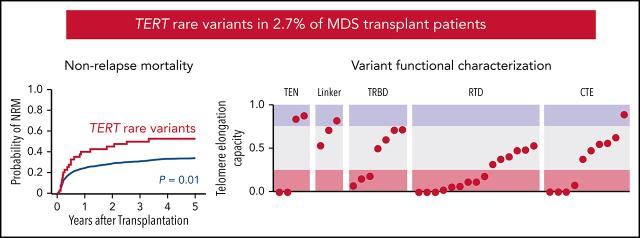
Germline pathogenic TERT variants are associated with short telomeres and an increased risk of developing myelodysplastic syndrome (MDS) among patients with a telomere biology disorder. We identified TERT rare variants in 41 of 1514 MDS patients (2.7%) without a clinical diagnosis of a telomere biology disorder who underwent allogeneic transplantation. Patients with a TERT rare variant had shorter telomere length (P < .001) and younger age at MDS diagnosis (52 vs 59 years, P = .03) than patients without a TERT rare variant. In multivariable models, TERT rare variants were associated with inferior overall survival (P = .034) driven by an increased incidence of nonrelapse mortality (NRM; P = .015). Death from a noninfectious pulmonary cause was more frequent among patients with a TERT rare variant. Most variants were missense substitutions and classified as variants of unknown significance. Therefore, we cloned all rare missense variants and quantified their impact on telomere elongation in a cell-based assay. We found that 90% of TERT rare variants had severe or intermediate impairment in their capacity to elongate telomeres. Using a homology model of human TERT bound to the shelterin protein TPP1, we inferred that TERT rare variants disrupt domain-specific functions, including catalysis, protein-RNA interactions, and recruitment to telomeres. Our results indicate that the contribution of TERT rare variants to MDS pathogenesis and NRM risk is underrecognized. Routine screening for TERT rare variants in MDS patients regardless of age or clinical suspicion may identify clinically inapparent telomere biology disorders and improve transplant outcomes through risk-adapted approaches.
胚系致病性 TERT 变体与端粒较短以及端粒生物学紊乱患者发生骨髓增生异常综合征 (MDS) 的风险增加相关。我们在接受异基因移植的 1514 名 MDS 患者中(2.7%),鉴定出 41 名无端粒生物学紊乱临床诊断的患者存在 TERT 罕见变异。携带 TERT 罕见变异的患者端粒长度较短(P <.001),MDS 诊断时年龄较轻(52 岁 vs 59 岁,P =.03),而无 TERT 罕见变异的患者端粒长度较长,MDS 诊断时年龄较大。在多变量模型中,TERT 罕见变异与总生存较差相关(P =.034),这主要归因于非复发死亡率(NRM;P =.015)增加。携带 TERT 罕见变异的患者因非感染性肺部原因导致的死亡率更高。大多数变异是错义替换,被归类为意义不明的变异。因此,我们克隆了所有罕见的错义变异,并在细胞基础测定中量化了它们对端粒延伸的影响。我们发现,90%的 TERT 罕见变异在延长端粒的能力上存在严重或中度损害。使用与端粒保护蛋白 TPP1 结合的人 TERT 的同源模型,我们推断 TERT 罕见变异会破坏特定结构域的功能,包括催化、蛋白-RNA 相互作用以及向端粒的募集。我们的结果表明,TERT 罕见变异对 MDS 发病机制和 NRM 风险的贡献尚未得到充分认识。无论年龄或临床怀疑如何,在 MDS 患者中常规筛查 TERT 罕见变异可能会识别出临床上无明显的端粒生物学紊乱,并通过风险适应方法改善移植结果。
 Zotero 插件