
丹麦在新冠大流行期间非新冠疾病的住院和死亡率:全国基于人群的队列研究。
Hospital admission and mortality rates for non-covid diseases in Denmark during covid-19 pandemic: nationwide population based cohort study.
机构信息
Department of Infectious Diseases, Aalborg University Hospital, Aalborg, Denmark
Aalborg Thrombosis Research Unit, Aalborg University, Aalborg, Denmark.
出版信息
BMJ. 2021 May 24;373:n1135. doi: 10.1136/bmj.n1135.
OBJECTIVE
To determine the incidence of hospital admissions and associated mortality rates for non-covid medical conditions during the covid-19 pandemic.
DESIGN
Nationwide, population based cohort study.
SETTING
Denmark from 13 March 2019 to 27 January 2021.
PARTICIPANTS
All Danish residents >1 year of age.
MAIN OUTCOMES MEASURES
Population based healthcare registries that encompass the entire Danish population were used to compare hospital admission and mortality rates during the covid-19 pandemic (from 11 March 2020 to 27 January 2021) with the prepandemic baseline data (from 13 March 2019 to 10 March 2020). Hospital admissions were categorised as covid-19 when patients were assigned a diagnosis code for covid-19 within five days of admission. All patients were followed until migration, death, or end of follow-up, whichever came first. Rate ratios for hospital admissions were computed using Poisson regression and were directly standardised using the Danish population on 1 January 2019 as reference. 30 day mortality rate ratios were examined by Cox regression, adjusted for age and sex, and covid-19 diagnosis was used as a competing risk.
RESULTS
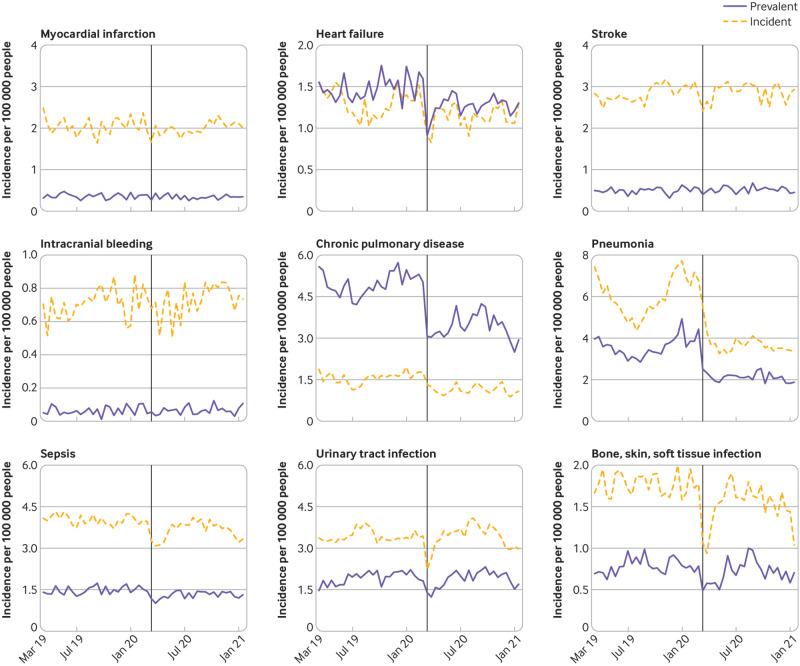
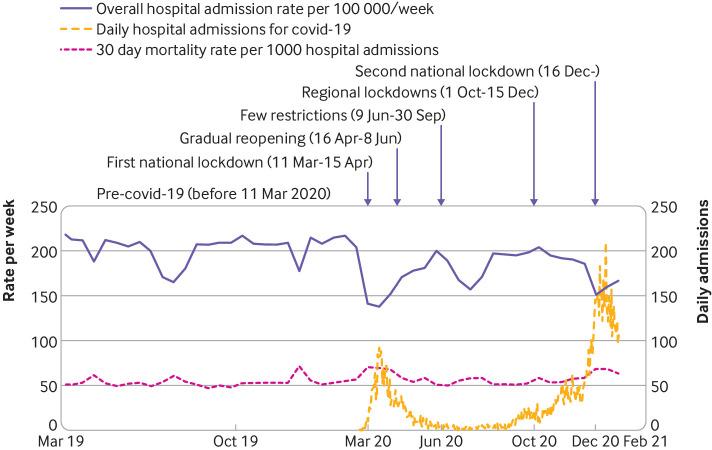
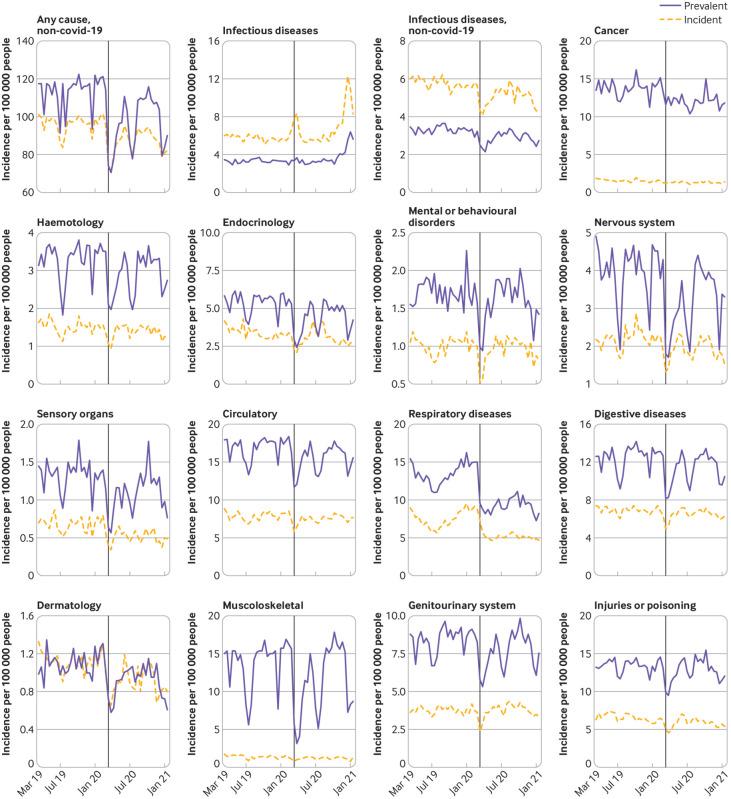
5 753 179 residents were identified during 567.8 million person weeks of observation, with 1 113 705 hospital admissions among 675 447 people. Compared with the prepandemic baseline period (mean hospital admission rate 204.1 per 100 000/week), the overall hospital admission rate for non-covid-19 conditions decreased to 142.8 per 100 000/week (rate ratio 0.70, 95% confidence interval 0.66 to 0.74) after the first national lockdown, followed by a gradual return to baseline levels until the second national lockdown when it decreased to 158.3 per 100 000/week (0.78, 0.73 to 0.82). This pattern was mirrored for most major diagnosis groups except for non-covid-19 respiratory diseases, nervous system diseases, cancer, heart failure, sepsis, and non-covid-19 respiratory infections, which remained lower throughout the study period. Overall 30 day mortality rates were higher during the first national lockdown (mortality rate ratio 1.28, 95% confidence interval 1.23 to 1.32) and the second national lockdown (1.20, 1.16 to 1.24), and these results were similar across most major diagnosis groups. For non-covid-19 respiratory diseases, cancer, pneumonia, and sepsis, the 30 day mortality rate ratios were also higher between lockdown periods.
CONCLUSIONS
Hospital admissions for all major non-covid-19 disease groups decreased during national lockdowns compared with the prepandemic baseline period. Additionally, mortality rates were higher overall and for patients admitted to hospital with conditions such as respiratory diseases, cancer, pneumonia, and sepsis. Increased attention towards management of serious non-covid-19 medical conditions is warranted.
目的
确定在 COVID-19 大流行期间非 COVID 医疗状况的住院率和相关死亡率。
设计
全国范围内的基于人群的队列研究。
地点
丹麦,2019 年 3 月 13 日至 2021 年 1 月 27 日。
参与者
所有年龄大于 1 岁的丹麦居民。
主要结局测量
使用涵盖整个丹麦人口的基于人群的医疗保健登记处,将 COVID-19 大流行期间(2020 年 3 月 11 日至 2021 年 1 月 27 日)与大流行前基线数据(2019 年 3 月 13 日至 2020 年 3 月 10 日)进行比较。患者在入院后 5 天内被分配 COVID-19 诊断代码时,将其归类为 COVID-19。所有患者均随访至移民、死亡或随访结束,以先发生者为准。使用泊松回归计算住院率的比率,并直接使用 2019 年 1 月 1 日的丹麦人口作为参考进行标准化。通过 Cox 回归检查 30 天死亡率比率,并根据年龄和性别进行调整,COVID-19 诊断被用作竞争风险。
结果
在 567.8 亿人周的观察期间,共确定了 575.3179 名居民,其中有 675447 人中有 1113705 人住院。与大流行前基线期(非 COVID-19 疾病每 10 万人/周 204.1 例住院率)相比,全国首次封锁后,非 COVID-19 疾病的整体住院率下降至每 10 万人/周 142.8 例(率比 0.70,95%置信区间 0.66 至 0.74),随后逐渐恢复到基线水平,直到第二次全国封锁时降至每 10 万人/周 158.3 例(0.78,0.73 至 0.82)。除非 COVID-19 呼吸道疾病、神经系统疾病、癌症、心力衰竭、败血症和非 COVID-19 呼吸道感染外,大多数主要诊断组均出现这种模式,这些疾病在整个研究期间的水平均较低。首次全国封锁期间(死亡率比 1.28,95%置信区间 1.23 至 1.32)和第二次全国封锁期间(1.20,1.16 至 1.24),30 天死亡率总体较高,这些结果在大多数主要诊断组中相似。对于非 COVID-19 呼吸道疾病、癌症、肺炎和败血症,封锁期间的 30 天死亡率比也较高。
结论
与大流行前基线期相比,全国封锁期间,所有主要非 COVID-19 疾病组的住院率均有所下降。此外,总体死亡率以及因呼吸疾病、癌症、肺炎和败血症等疾病住院的患者死亡率均较高。需要更加关注严重非 COVID-19 医疗状况的管理。
 Zotero 插件